
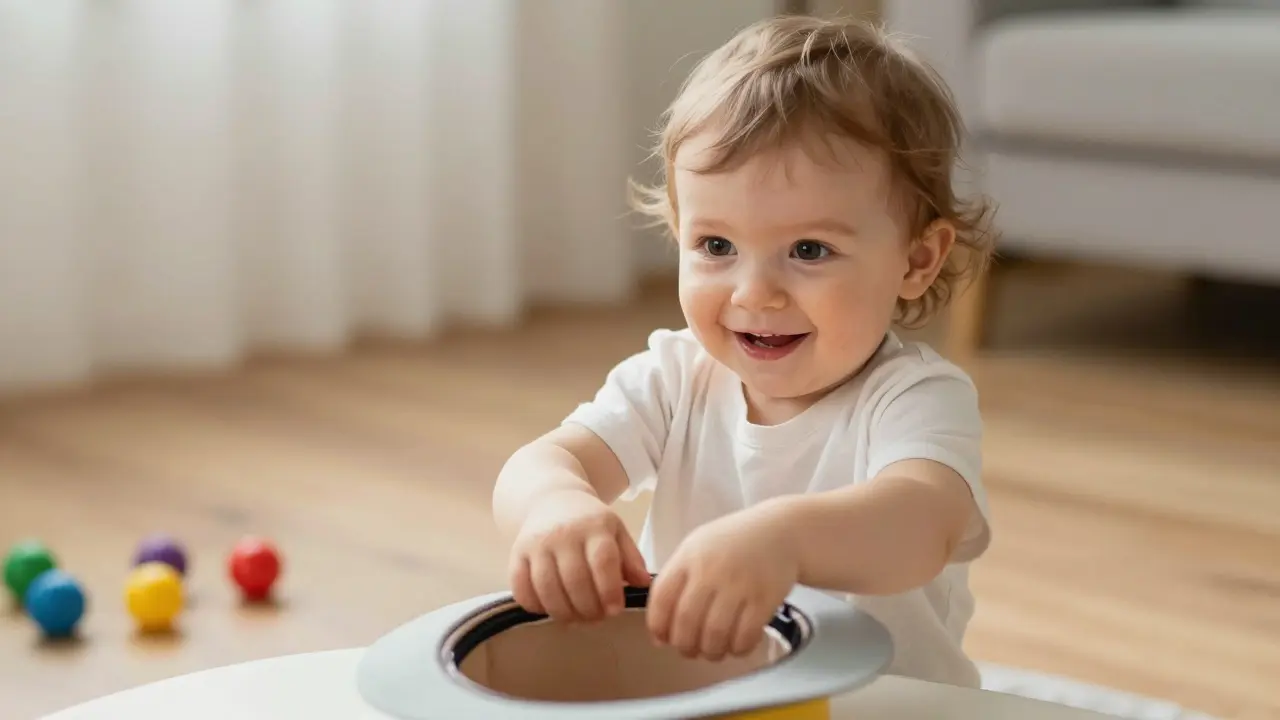
Ever watched a kid’s face light up after a coin vanishes into thin air? That moment isn’t just wonder-it’s a window into how their brain is changing. Magic doesn’t just entertain children; it reveals how their understanding of reality is built, broken, and rebuilt over time.
Before Age 3: Magic Is Just Reality
Kids under three don’t separate magic from real life. If you pull a toy out of an empty hat, they don’t think it’s a trick-they think the hat had the toy inside all along. Their brains haven’t developed the concept of object permanence fully yet, and even when they do, they don’t yet grasp cause and effect the way adults do. A card trick? To them, it’s just something that happened. No surprise, no mystery. Just a thing that occurred.Studies from the University of British Columbia show that toddlers will reach into a box even after watching an adult remove everything from it. They expect something to still be there. Magic doesn’t confuse them-it’s normal.
Ages 3 to 5: The Magic Belief Zone
This is when magic starts to feel… magical. Between three and five, kids begin to understand that things don’t just appear out of nowhere in the real world. But they still believe that some people-like parents, superheroes, or magicians-can bend the rules. This isn’t ignorance. It’s imagination in full swing.Ask a four-year-old how a magician made a rabbit disappear, and they’ll likely say, “He has magic powers.” Not because they’re dumb, but because their brains are wired to fill gaps with agency. They don’t need to know the method. They just need to believe someone can do the impossible.
That’s why simple tricks-like making a coin vanish or pulling a scarf from a sleeve-still blow them away. Their cognitive tools aren’t sharp enough to spot misdirection. They’re not looking for sleight of hand. They’re looking for wonder.
Ages 6 to 8: The Doubt Begins
Around six, kids start asking questions. “How did you do that?” becomes more common than “Wow!” They begin to notice patterns. If you do the same trick twice, they’ll watch your hands. They’ll test it. They’ll try to catch you.By seven, many kids start to suspect magic isn’t real magic. They think it’s a secret. A trick. A hidden move. This shift comes from developing theory of mind-the ability to understand that other people have thoughts and intentions they can’t see. They realize: if the magician did it this way before, maybe he’s hiding something.
A 2018 study from the University of Hertfordshire found that 65% of children aged six to eight believed magic tricks were “tricks,” not real magic. But here’s the twist: even though they knew it was a trick, most still said they liked it more than non-magical games. They weren’t fooled-they were fascinated.

Ages 9 to 12: The Skeptical Enthusiast
By nine or ten, most kids have figured out that magic tricks rely on skill, not supernatural power. They might even try to learn the trick themselves. You’ll see them practicing with cards, hiding objects in their sleeves, or watching YouTube tutorials to reverse-engineer what they saw.This is the age when magic shifts from pure wonder to problem-solving. They’re not just enjoying the show-they’re trying to crack the code. A good magician at this stage doesn’t just perform. They engage. They let the kid guess. They tease. They say, “See if you can figure it out.” That’s when the real magic happens: curiosity becomes active learning.
At this point, kids start to appreciate the art behind the trick. They notice timing, misdirection, and audience control. They might not understand the physics of a levitation illusion, but they get that it’s about distraction. They’re starting to think like detectives.
Teenagers and Beyond: Magic as a Skill
By thirteen, most teens see magic for what it is: performance art disguised as mystery. They know the tricks. They’ve seen behind-the-scenes videos. They’ve tried and failed to replicate them. But here’s the surprising part: many of them still love it.Why? Because now they understand the effort. They see the hours of practice, the psychology of attention, the precision of movement. Magic becomes a language-not of the supernatural, but of human cleverness. A teenager who learns a card trick isn’t trying to fool their friends. They’re trying to impress them with control, confidence, and creativity.
Some even start performing. Not because they believe in magic-but because they believe in the power of surprise.

What Parents and Teachers Should Know
If you’re showing magic to a child, match the trick to their stage. Don’t use complex illusions on a three-year-old-they won’t care. Don’t use a basic coin vanish on a ten-year-old-they’ll spot the move. Tailor the experience.Use magic to teach critical thinking. After a trick, ask: “How do you think it worked?” Don’t give the answer right away. Let them guess. Let them argue. Let them test ideas. That’s how science starts.
And don’t rush to explain. If a five-year-old thinks you have magic powers, let them believe it. That belief is a sign of healthy imagination. You’re not lying-you’re giving them space to wonder.
Why Magic Matters More Than You Think
Magic isn’t just entertainment. It’s a mirror for cognitive development. The way kids respond to magic tells us how their brains are growing. When they stop believing in magic, they’re not losing something-they’re gaining something bigger: logic, reasoning, and the ability to question what they see.That’s why the best magic shows for kids aren’t the ones with the most glitter or the loudest music. They’re the ones that leave room for questions. The ones that make a child lean forward, squint, and whisper, “How…?”
That whisper? That’s the sound of a mind waking up.
Do kids think magicians have real powers?
Young children, especially between ages three and five, often believe magicians have special abilities because their brains haven’t fully developed an understanding of physical laws. They see the result and assume the cause is supernatural, not mechanical. This isn’t a lack of intelligence-it’s normal developmental thinking. By age six or seven, most kids start to suspect it’s a trick, even if they can’t figure out how.
At what age do kids stop believing in magic?
Most children stop believing magic is real by age seven or eight. That’s when they start recognizing patterns, noticing misdirection, and understanding that things don’t just appear out of nowhere. But they don’t stop enjoying magic-they just shift from believing in it to appreciating it as a skill. Many kids this age become obsessed with learning how tricks work.
Can magic help kids learn?
Yes. Magic encourages observation, hypothesis testing, and critical thinking. When kids try to figure out how a trick works, they’re doing science. They notice details, make predictions, test ideas, and revise their thinking. Teachers who use magic in classrooms report improved focus and engagement. Magic turns abstract thinking into something tangible and fun.
Should I explain how a magic trick works?
It depends on the child’s age and reaction. With younger kids (under six), it’s better to let them wonder-explaining too soon can kill the magic. With older kids (seven and up), asking them to guess first is more valuable than giving the answer. If they’re curious and ask directly, explain it. The goal isn’t to hide the secret-it’s to keep them thinking.
Why do kids enjoy magic even after they know it’s a trick?
Because magic isn’t just about deception-it’s about skill, timing, and emotion. Kids (and adults) love the feeling of being surprised, even when they know it’s coming. It’s like watching a great athlete make a perfect play. You know it’s possible, but seeing it done well still feels amazing. Magic triggers joy, not just confusion.
Christina Morgan
January 9, 2026 AT 15:50My niece is five and still thinks my card tricks are real magic. She calls me ‘The Wizard Auntie’ and won’t let me explain anything. Honestly? I’m not gonna ruin it. That look on her face when the queen jumps out of the deck? Priceless.
Let them wonder. The world’s gonna take that away soon enough.
Kathy Yip
January 11, 2026 AT 14:37i always thought it was kinda beautiful how kids just accept magic as part of the world before they learn about physics and probability. like, they’re not dumb for believing-they’re just operating on a different kind of logic. one that’s full of wonder instead of skepticism. maybe we should all try to hold onto that a little longer.
also, typo: ‘seperate’ should be ‘separate’ in the first section. just sayin’.
Bridget Kutsche
January 13, 2026 AT 04:43As a preschool teacher, I use magic tricks every Friday to spark curiosity. The way kids lean in, whisper to each other, try to predict what happens next-it’s pure cognitive gold.
One kid last month spent a week trying to replicate a ‘vanishing coin’ with tape and a napkin. He didn’t get it right, but he learned about hidden objects, attention, and persistence. Magic isn’t just fun-it’s early STEM in disguise.
Teachers, please use this. Kids remember the wonder. They forget the worksheets.
Jack Gifford
January 14, 2026 AT 12:54My 8-year-old cousin watched a magician pull a dove out of a hat last month. He didn’t say ‘wow.’ He said, ‘Did he hide it in his sleeve?’ Then he watched the whole show twice, staring at the guy’s hands. By the end, he was asking for a magic kit.
That’s the sweet spot-when they know it’s a trick but still want to be part of it. That’s when learning clicks.
Sarah Meadows
January 15, 2026 AT 16:20Look, if your kid still believes in magic after age 6, you’re not raising a genius-you’re raising a gullible sucker. Real Americans don’t fall for illusions. We solve problems. We build things. We don’t sit around waiting for rabbits to appear from hats.
Teach them engineering. Teach them coding. Not fairy tales wrapped in card tricks.
Nathan Pena
January 15, 2026 AT 22:38It’s fascinating how the article romanticizes cognitive development as if it’s some poetic transition from innocence to reason. The truth? Children don’t ‘grow out of’ magic-they grow out of gullibility. The moment they realize the magician is manipulating perception, they’re not ‘fascinated’-they’re just disappointed the illusion wasn’t better executed.
Also, the Hertfordshire study’s sample size was under 100. That’s not statistically significant. Please stop pretending this is science.
Mike Marciniak
January 16, 2026 AT 08:16They say kids stop believing in magic at seven. But what if they’re being programmed to stop believing? What if the government, the media, the schools-they all want kids to stop seeing the impossible? Magic is the last thing that reminds us reality isn’t fixed. They don’t want us to question. They want us to accept. That’s why they push ‘explanations’ so hard.
Don’t tell your kid how it’s done. Let them keep seeing the cracks in the matrix.
VIRENDER KAUL
January 17, 2026 AT 03:10It is a well-known fact in developmental psychology that the human mind in early childhood operates under a principle of animistic thinking wherein inanimate objects and phenomena are attributed with consciousness and agency. The phenomenon described herein is not unique to Western societies but is a universal cognitive stage observed across cultures with varying degrees of expression.
However, in India we have a long tradition of conjuring known as ‘jadoo’ which is deeply embedded in folk narratives and is not merely entertainment but a cultural artifact of epistemological transition.
One must be cautious not to over-romanticize this phase as ‘wonder’ when it is merely a cognitive deficit.
Mbuyiselwa Cindi
January 19, 2026 AT 01:30I used to do magic shows for kids in rural South Africa-no fancy props, just coins and scarves. The joy on their faces? Pure. One boy told me, ‘I’m gonna be a wizard when I grow up.’ He’s 14 now, studying engineering. Still does tricks for his little cousins.
Don’t rush the magic. Let it live a little longer. It doesn’t disappear-it just changes shape.
Krzysztof Lasocki
January 20, 2026 AT 14:24So let me get this straight-we’re celebrating the moment kids stop believing in magic like it’s a graduation ceremony? Congrats, you’ve now learned the world is boring and adults are liars. Great job, humanity.
Meanwhile, I’m over here trying to convince my 6-year-old that the tooth fairy isn’t just my wife with glitter and a fake British accent. At least magic is honest-it doesn’t pretend to be real. The tooth fairy? That’s a scam.
Henry Kelley
January 20, 2026 AT 22:54my 7yo asked me how the card trick worked yesterday. i said ‘i dunno, how do u think?’ he spent 20 mins watching my hands, then whispered ‘you switched it when you coughed.’ i was impressed.
he still thinks i’m kinda magic tho. and honestly? i’m not gonna tell him otherwise. the world can wait.
Victoria Kingsbury
January 21, 2026 AT 08:42As a cognitive scientist with a focus on perceptual development, I can confirm that the transition from magical thinking to mechanistic reasoning aligns with Piaget’s concrete operational stage, though recent neuroimaging studies suggest the shift is more gradient than stage-based.
Moreover, the dopamine response to misdirection in children mirrors that of adults experiencing surprise-indicating that the emotional reward of magic persists regardless of belief. The ‘wonder’ isn’t in the illusion-it’s in the predictive error correction. This is why even skeptics love it.
Also, the UBC study used eye-tracking, not just reach behavior. Important distinction.
Tonya Trottman
January 21, 2026 AT 17:40Let’s be real-this whole article is just a warm, fuzzy blanket for parents who don’t want to admit their kid’s brain is still glitchy at age four. ‘Oh look, he believes in magic! Isn’t that cute?’ No. He’s not ‘imaginative.’ He’s cognitively underdeveloped. And no, ‘letting him believe’ isn’t nurturing-it’s delaying reality.
Also, ‘theory of mind’ isn’t some mystical awakening-it’s a measurable neurological milestone. Stop anthropomorphizing developmental psychology. And for god’s sake, ‘orthography’ is spelled with an ‘o,’ not an ‘a.’