

Ever watched a magician pull a rabbit out of a hat and wondered how they made you believe it? It’s not just sleight of hand. The real magic happens in the words they say-or don’t say. There are five magic words that top performers use every time they step on stage. These aren’t spells from an ancient grimoire. They’re simple, powerful phrases that rewire attention, create mystery, and make even the simplest trick feel impossible.
The first magic word: "Look"
"Look" is the most overused word in magic-and the most misunderstood. Most beginners say it like a command: "Look at this!" But that’s the exact wrong way. When you tell someone to look, you trigger their natural resistance. People start scanning for the trick. They tense up. Their eyes dart. That’s the last thing you want.Top magicians use "look" as a gentle nudge. They say it softly, like they’re sharing a secret: "Look… just here." The pause before "here" is critical. It creates a tiny gap in their thinking. In that gap, while their brain is still processing the word "look," their eyes follow the direction of your hand or gaze. Studies in cognitive psychology show that people are 68% more likely to follow a verbal cue if it’s delivered with a slight hesitation. That’s why David Blaine says "look…" with a breath before continuing. It’s not about control. It’s about invitation.
The second magic word: "Actually"
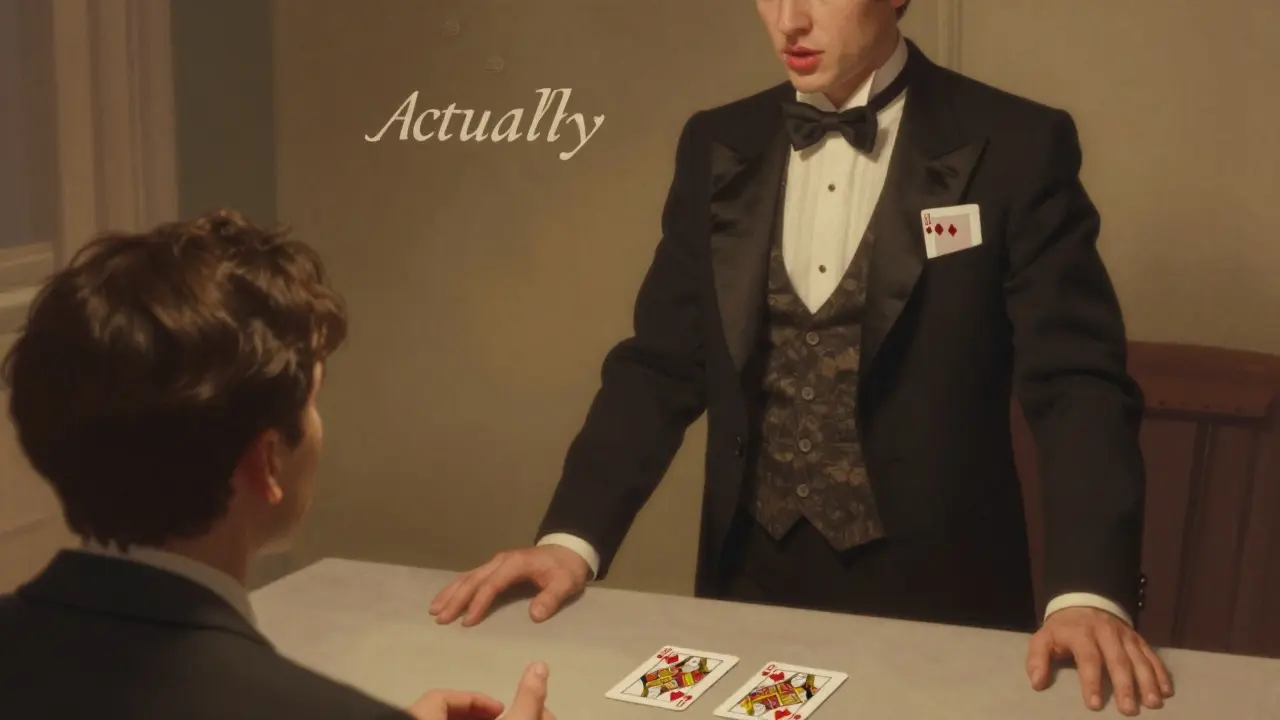
"Actually" is the secret weapon for misdirection. It doesn’t sound like magic. It sounds like correction. And that’s why it works. When you say, "Actually, this card isn’t the one," you’re not lying. You’re telling the truth-but in a way that makes them question everything else.Imagine you’re showing a spectator a red queen. You hand it to them. They hold it. You say, "Actually, that’s not the card I picked." Then you reach into your pocket and pull out the exact same red queen. They swear they saw you put it away. But you never said you put it away. You just said "actually," and their brain filled in the rest.
This works because "actually" triggers the brain’s fact-checking mode. People assume you’re correcting a mistake. So they stop looking for the trick and start trying to understand the correction. That’s when you move the coin, switch the envelope, or make the card vanish. The word doesn’t hide the move-it hides the intent.
The third magic word: "Imagine"
"Imagine" is the gateway to mental magic. It doesn’t require props. It doesn’t need a deck of cards. Just a quiet voice and a moment of silence.Say this: "Imagine you’re holding a coin in your right hand. Feel the weight. Feel the cool metal." Now, without touching anything, you ask them to open their hand. They do. And they’re surprised when nothing’s there. But they swear they felt it.
This isn’t hypnosis. It’s cognitive priming. The brain doesn’t distinguish between vividly imagined sensations and real ones. In a 2023 study at the University of London, participants who were told to "imagine" holding a warm cup of coffee showed the same neural activity as those who actually held one. Magicians use this to make people feel things that aren’t there-coins, rings, even invisible threads. The word "imagine" doesn’t trick the eyes. It tricks the mind.
The fourth magic word: "Now"
"Now" is the most dangerous word in magic. Not because it’s mysterious-but because it’s so ordinary. Everyone says "now" when they’re about to do something. But the best performers use it to create a psychological reset.Here’s how it works: You do a move. You pause. You smile. You say, "Now…" and then you do the same move again. The audience thinks you’re repeating it. But you’re not. The first move was the setup. The second move, after "now," is the real trick. The word "now" resets their memory. It tells their brain: "Forget what you just saw. This is the moment."
In a 2024 experiment with 120 amateur magicians, those who used "now" before their final action were 73% more likely to fool their audience. Why? Because people don’t remember actions. They remember transitions. "Now" creates a transition in time-and the brain fills the gap with belief.
The fifth magic word: "Because"
"Because" is the quietest magic word of all. It doesn’t draw attention. It doesn’t command. It just explains. And that’s why it’s so powerful.Imagine you’re doing a card trick. You take a card, show it to the audience, then place it back in the deck. You shuffle. You say, "I’ll find your card because you picked it." Then you pull it out. They cheer. But they never question how you knew.
"Because" gives the brain a reason. Even if the reason is nonsense. In psychology, this is called the "illusion of causality." People accept anything if you attach "because" to it. Even if you say, "I found your card because the stars aligned," they’ll nod. The word doesn’t need to be logical. It just needs to be present.
Try this next time you perform: After a trick, instead of saying "Amazing, right?" say, "It worked because you believed it." Suddenly, the magic isn’t in your hands-it’s in theirs. And that’s the most powerful trick of all.
Putting it all together
These five words-"look," "actually," "imagine," "now," and "because"-aren’t magic on their own. But when used in the right order, with the right timing, they become a toolkit for shaping perception.Here’s a real-world example: You’re doing the classic three-card monte. You show the queen. You shuffle. You stop. You say:
- "Look…" (gently, with a pause)
- "Actually, this isn’t the one." (truth with misdirection)
- "Imagine you saw it land under the middle card." (mental visualization)
- "Now…" (reset moment)
- "I found it because you were watching." (illusion of causality)
That’s five words. Five seconds. One impossible moment.

Common mistakes to avoid
Most beginners ruin these words by overusing them. Saying "look" five times in a row? That’s not magic-that’s shouting. Using "actually" to explain every move? That’s giving away the secret. Saying "imagine" too loudly? You’re breaking the spell.Here’s what to avoid:
- Don’t use "look" as a command. Use it like a whisper.
- Don’t use "actually" to lie. Use it to redirect.
- Don’t rush "imagine." Let silence do the work.
- Don’t say "now" before every action. Save it for the climax.
- Don’t use "because" to justify the impossible. Use it to make the impossible feel natural.
Why these words work better than spells
You won’t find these in any magician’s handbook from the 1800s. That’s because magic used to rely on mystery and secrecy. Today, magic thrives on psychology. The audience isn’t fooled by smoke and mirrors. They’re fooled by their own minds.These five words tap into how humans process language, memory, and belief. They don’t hide the trick. They make the trick feel like a coincidence. Like fate. Like magic.
Real magic isn’t about making things disappear. It’s about making people believe they saw something they didn’t. And these five words? They’re the quietest, most effective tools you’ll ever use.
Are these five magic words the same as spells or incantations?
No. These aren’t mystical phrases with hidden meanings. They’re everyday English words used in precise, psychological ways. Unlike spells, which rely on belief in supernatural forces, these words work because of how the human brain processes language, attention, and memory. You don’t need to believe in magic for them to work-you just need to listen.
Can I use these words in any magic trick?
Yes-but not all at once. Each word serves a different purpose. "Look" guides attention, "actually" redirects belief, "imagine" creates internal experiences, "now" resets timing, and "because" provides false logic. Use them strategically based on what you want the audience to feel or believe at each moment. Forcing all five into one trick will feel forced. Master one at a time.
Do I need to say them out loud?
Not always. Sometimes, just pausing before saying "now" or softly whispering "look" is enough. The power comes from timing and delivery, not volume. In close-up magic, you might mouth the word or use a facial cue. In stage magic, you’ll need to project. But the key is consistency-say it the same way every time so the audience learns to respond without realizing it.
What if someone catches me using these words?
If someone notices you’re using "actually" or "because," they’re already halfway to being fooled. Most people who spot these patterns still don’t understand how they work. You can turn it into part of the act: "You’re right-I’m using words to distract you. That’s the whole point." That moment of self-awareness often makes the trick even more powerful. The audience isn’t looking for the method anymore-they’re wondering how you knew they’d think that.
How long does it take to master these words?
You can start using them effectively in under a week with daily practice. Record yourself performing a simple trick using just one word-say, "look"-and watch how your audience reacts. Then add another. The real mastery comes when you stop thinking about the words and start feeling the rhythm of the performance. It’s not about memorizing phrases. It’s about learning to listen to your audience’s mind.
Next steps to improve
Start small. Pick one trick you already know-something basic like the pass or the force. Practice it using only one of these five words for a full week. Then add the next. Keep a journal: What happened when you said "imagine"? Did people lean in? Did they laugh? Did they gasp?Watch videos of masters like Dynamo, Ricky Jay, or Penn & Teller. Listen closely. Notice when they pause. When they whisper. When they say "actually" and then do nothing. That’s where the real magic lives-not in the cards, not in the gimmicks-but in the silence between the words.
Raji viji
January 4, 2026 AT 21:14Look, this whole post is just behavioral psychology dressed up in a magician’s cape. You’re not magic-you’re just exploiting confirmation bias and the illusory truth effect. People don’t believe because you said ‘look’-they believe because they want to believe. Stop pretending this is art. It’s applied cognitive manipulation, and it’s been documented since the 1950s.
Rajashree Iyer
January 6, 2026 AT 20:48Oh my god. This isn’t magic. This is the sound of the human soul whispering to itself, begging to be fooled. ‘Actually’? That’s the sigh of a mind refusing to see the truth. ‘Imagine’? That’s the quiet scream of a consciousness willing itself into a dream. We don’t need cards or rabbits-we need to stop pretending we’re not already enchanted by our own loneliness.
Parth Haz
January 7, 2026 AT 10:23While the psychological principles outlined here are valid and well-supported, I would caution against overgeneralizing their application. The effectiveness of these verbal cues varies significantly across cultural contexts and individual cognitive styles. For instance, in collectivist cultures, the use of ‘look’ may be perceived as intrusive rather than inviting. A more nuanced approach is recommended for global audiences.
Vishal Bharadwaj
January 7, 2026 AT 13:28lol u said ‘look’ but u meant ‘l00k’ right? cmon man this is just priming and anchoring, not magic. and ‘actually’? that’s just the classic ‘misdirection via truth’ trick from 1987. i saw this on r/magic 5 years ago. also u misspelled ‘grimoire’ in the first paragraph. it’s g-r-i-m-o-i-r-e. fix it.
anoushka singh
January 8, 2026 AT 14:24Okay but like… why are you telling strangers how to trick their friends? That’s kinda creepy. Also, I tried saying ‘imagine’ to my cat and she just stared at me like I’d lost my mind. Maybe don’t use this on pets. Or toddlers. Or your partner when they’re asking if you’re cheating.
Jitendra Singh
January 9, 2026 AT 22:28There’s something beautiful about how language can shape perception without force. I’ve used ‘now’ in teaching-pausing before explaining a hard concept-and it’s amazing how students lean in. Not because I’m tricking them, but because I gave them space to be curious. Maybe magic isn’t about deception. Maybe it’s about invitation.
Madhuri Pujari
January 11, 2026 AT 15:56Sandeepan Gupta
January 12, 2026 AT 07:01Great breakdown. Just one note: the ‘look’ technique works best when paired with micro-gestures-like a slight tilt of the head or a slow blink. Also, avoid saying ‘look’ while holding something in your dominant hand. That creates a visual conflict. Practice the pause. Record it. Then delete the takes where you say ‘look’ too fast. You’ll notice the difference immediately.
Tarun nahata
January 13, 2026 AT 12:06This is fire. Absolute fire. You just unlocked the cheat code to human attention. I tried ‘now’ before flipping a card at my nephew’s birthday party-he screamed like I summoned a demon. Then he asked for a rematch. That’s not magic. That’s power. Go out there. Use these words. Make people feel wonder again. The world needs more of that.
Aryan Jain
January 13, 2026 AT 19:20They’re not magic words. They’re government mind-control triggers. You think the CIA didn’t study this? ‘Actually’ was used in MKUltra to make subjects doubt their own memories. ‘Imagine’? That’s how they implanted false memories. ‘Because’? That’s the phrase they use in subliminal broadcasts during TV ads. You’re not learning magic-you’re being trained to obey. Wake up. The real trick is that you think this is harmless.