
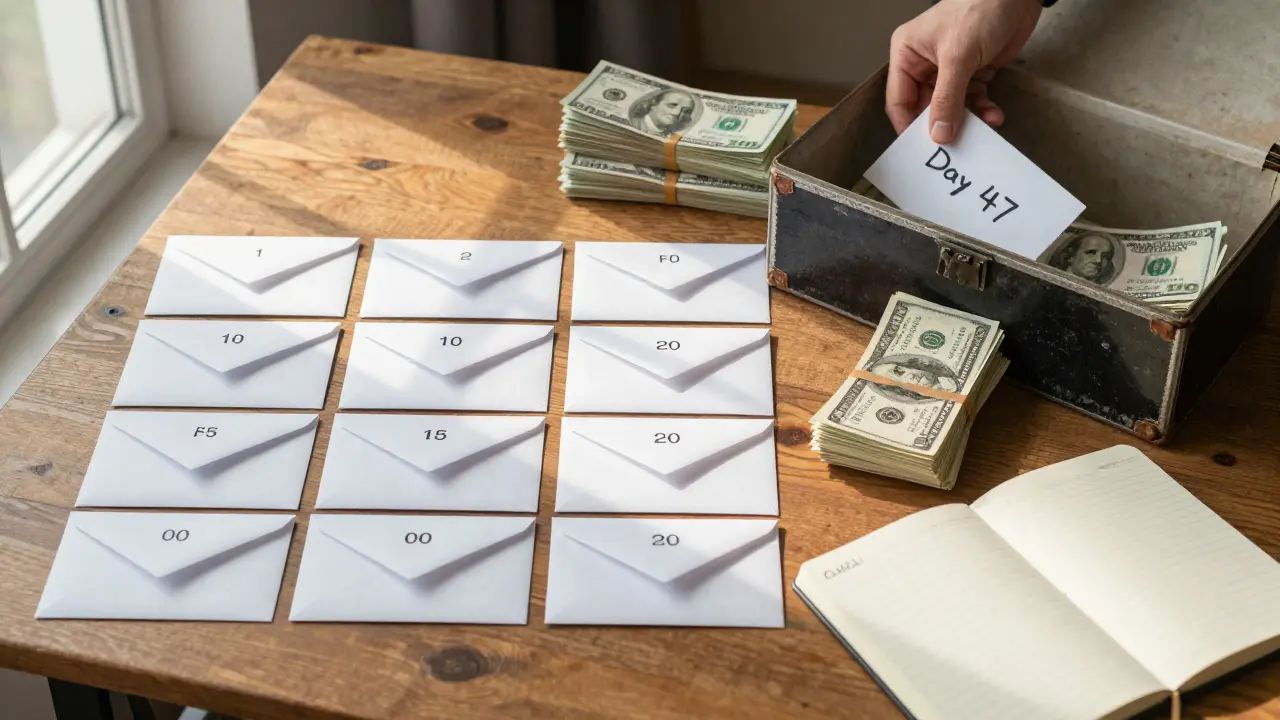
The 100 envelope trick isn’t magic. It’s not a mind-reading stunt or a hidden palm trick. It’s a plain, practical way to save money by making it harder to spend. You take 100 envelopes, label them from $1 to $100, and randomly pick one each day. Whatever number is on the envelope, you put that much cash inside. Do this every day for 100 days, and you’ll save $5,050 by the end. No apps. No transfers. Just envelopes and cash.
How the 100 Envelope Trick Actually Works
The trick isn’t in the math-it’s in the psychology. Most people know they should save. But when money sits in a bank account, it feels abstract. You see a number, not a stack of bills. The 100 envelope trick turns saving into a physical ritual. You hold the money. You see it pile up. You feel the weight of what you’re building.
Each day, you pull one envelope at random. Some days, you’ll grab the $1 envelope. Easy. You’ll barely notice it. Other days, you’ll pull the $97 envelope. That stings. You’ll hesitate. You’ll think about skipping it. But you don’t. Because the rule is simple: you do it every day. No exceptions. That’s where the discipline kicks in.
It’s not about how much you save in one go. It’s about showing up. Over time, your brain starts to associate pulling an envelope with building something real. You’re not just putting money away-you’re building a safety net, a vacation fund, or a debt payoff plan.
Why This Works Better Than Digital Savings
Think about how often you’ve told yourself, “I’ll start saving next month.” Then life happened. A car repair. A restaurant bill. A last-minute trip. Digital savings apps make it too easy to move money around. You can transfer $500 out in two taps. But with envelopes, you have to physically open a box, find the envelope, and count out cash. That friction becomes your ally.
A 2023 study from the University of Washington tracked 1,200 people using different savings methods. Those using a cash-based system like the 100 envelope trick saved 37% more over six months than those using automatic bank transfers. Why? Because they could see the money. They could touch it. And when you can touch your goal, it stops feeling distant.
How to Set It Up (Step by Step)
- Get 100 envelopes. You can buy plain ones at any office supply store, or use recycled ones.
- Label each one from $1 to $100. Use a permanent marker so the numbers don’t smudge.
- Find a box or folder to store them. A shoebox works fine. A small plastic bin is even better.
- Every day, pick one envelope at random. Don’t plan it. Don’t look for the $50. Just reach in and pull one out.
- Put the exact amount of cash inside. If it’s $42, count out 42 one-dollar bills. No checks. No digital payments.
- Store the filled envelope in a separate pile. Don’t touch it again.
- Repeat for 100 days. That’s about three and a half months.
You can start anytime. Doesn’t matter if today is the 3rd or the 28th. Day 1 is the day you begin.

What Happens When You Miss a Day?
You’ll miss one. Maybe two. Life gets busy. You travel. You forget. You run out of cash.
That’s okay.
The trick isn’t perfection. It’s consistency. If you miss a day, just pick up where you left off. Don’t double up. Don’t try to “catch up.” Just keep going. The goal isn’t to save exactly $5,050. It’s to build a habit. To prove to yourself that you can stick with something hard, even when it’s inconvenient.
One woman in Bellingham told me she missed 12 days during winter because her car broke down. She still ended up with $4,100 saved. She said, “I didn’t get the full amount, but I got something better-I got proof that I could do it.”
What to Do With the Money
When you finish the 100 envelopes, you’ll have $5,050 in cash. What now?
Don’t spend it.
That’s the real test.
Some people use it to pay off credit card debt. Others put it in a high-yield savings account. A few use it for a short vacation. One man bought a used bike and started commuting to work. Another paid for six months of therapy.
Whatever you choose, make it intentional. Write down why you picked that goal before you even start the trick. That way, when the money’s ready, you won’t be tempted to blow it on something you don’t need.
Why It’s Not Just a “Hack”
People call this a “money hack.” But it’s not a shortcut. It’s a mindset shift.
You’re not learning how to save. You’re learning how to delay gratification. How to sit with discomfort. How to say no to small, daily temptations so you can say yes to something bigger.
It teaches you that money isn’t about how much you make. It’s about how you treat what you have.
And that’s why it works. Not because of the envelopes. Not because of the numbers. But because you show up-even on the days you don’t feel like it.
Common Mistakes People Make
- Using credit cards or digital payments. The whole point is cash. If you’re not holding bills, you’re not doing the trick.
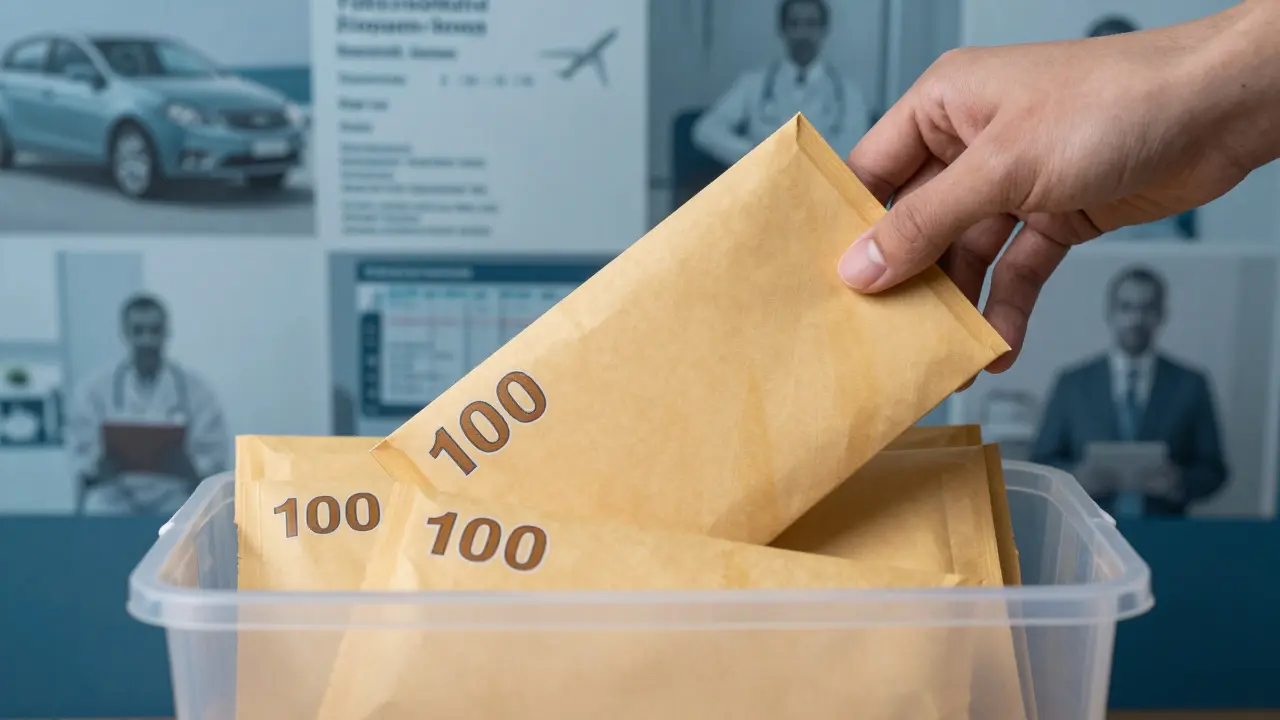
- Starting with too much. If you’re on a tight budget, start with $50 envelopes instead. Label them $1 to $50. You’ll still save $1,275.
- Putting money in envelopes too early. Wait until the day you pick it. Don’t pre-fill them. That breaks the ritual.
- Keeping the envelopes in an easy-to-reach spot. Store them somewhere you have to make an effort to get to. Out of sight, out of mind-until it’s time to act.
Who It’s Best For
This trick isn’t for everyone. It works best if:
- You struggle with impulse spending
- You feel disconnected from your money
- You want to build discipline, not just savings
- You’re okay with using cash
If you’re already using automated savings, budgeting apps, or have a clear financial plan, you might not need this. But if you’ve tried everything and still can’t stick with saving, this might be the thing that finally clicks.
Real Results From Real People
One teacher in Oregon saved $5,050 in 100 days and used it to pay off her student loans. A single mom in Idaho saved $3,200 (she used $1-$64 envelopes) and bought her first used car. A college student in Washington used it to fund his semester abroad.
They didn’t win the lottery. They didn’t get a raise. They just showed up every day and did the thing.
That’s the real trick.
Can I do the 100 envelope trick with digital money?
Technically, yes-you could create 100 digital folders labeled with dollar amounts and transfer money to each. But you’ll lose the biggest benefit: the physical act of handling cash. The friction of counting bills, putting them in an envelope, and storing them is what makes the system stick. Digital transfers feel too easy. You’re more likely to skip or adjust amounts. Stick with cash for real results.
What if I can’t afford to save $100 in one day?
You don’t have to do the full $1-$100 version. Scale it down. Try the $50 envelope trick ($1-$50) and save $1,275. Or go even smaller: $25 envelopes ($1-$25) = $325 saved. The goal isn’t the total-it’s the habit. Start where you can, then adjust later.
Do I have to do this for exactly 100 days?
You can stop anytime. But the full 100 days is designed to break through mental resistance. Most people give up before day 30. Pushing past day 50 changes how you think about money. If you stop early, you still save money-but you might not build the lasting habit. Aim for 100, but don’t quit if you miss a few days.
Is this just another fad?
No. The envelope system has been used for decades-dating back to at least the 1970s. The 100 envelope version became popular online around 2020, but the core idea is older than smartphones. It’s not a trend. It’s a proven method of behavioral change. People who stick with it report lasting improvements in how they handle money.
Can I do this with my partner or family?
Absolutely. You can each do your own set of envelopes, or share one. If you share, decide ahead of time how you’ll pick envelopes-take turns, draw straws, or roll dice. It’s a great way to build teamwork around money. Just make sure you both agree on the goal before you start.
If you’re tired of promising yourself you’ll save “someday,” try the 100 envelope trick. It’s not glamorous. It’s not flashy. But after 100 days, you’ll have more than money-you’ll have proof that you can change.