
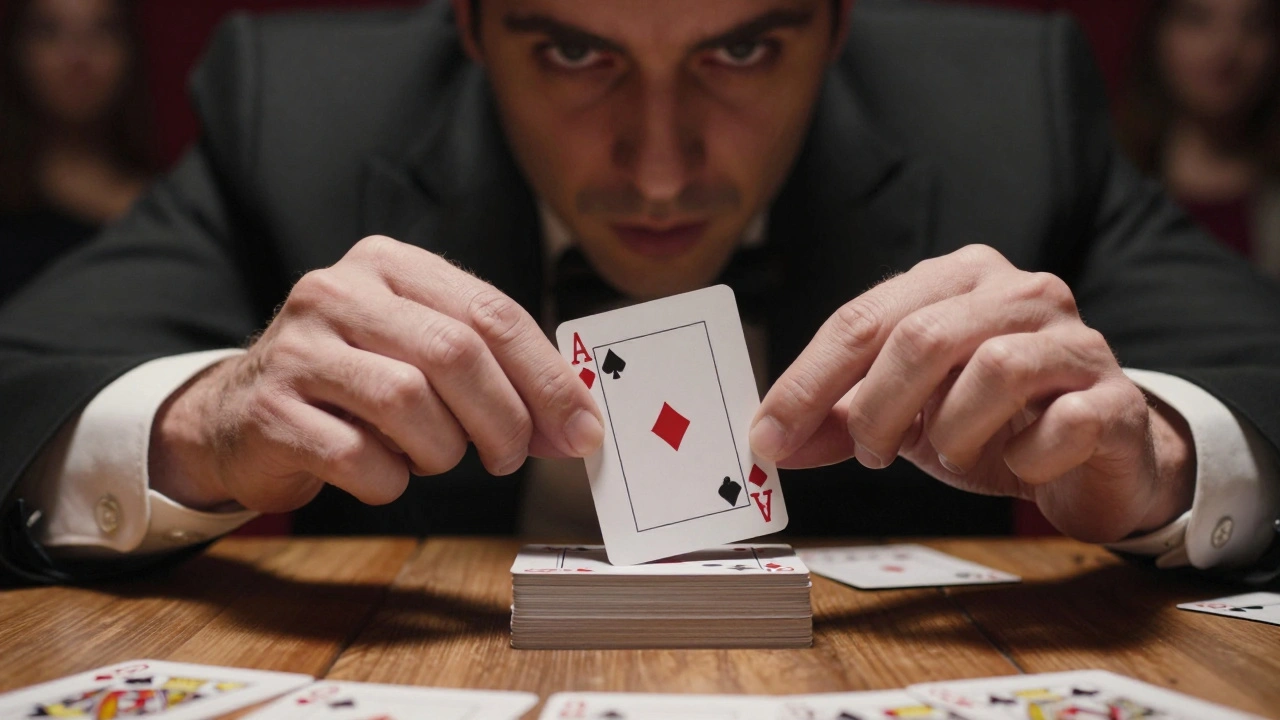
Ever watched a magician pull a rabbit out of a hat or make a card vanish right in front of your eyes and wondered, what’s that trick even called? You’re not alone. Magic isn’t just about sleight of hand-it’s a language of named illusions, each with its own history, method, and flair. Whether you’re a beginner with a magic kit or just curious after a street performance, knowing the real names of these tricks helps you understand how they work-and maybe even learn to do them yourself.
Classic Card Tricks Everyone Knows
Card tricks are the backbone of most magic shows. They’re portable, easy to practice, and look impossible even when you know the secret. Here are the big ones you’ve probably seen:- The Ambitious Card - A selected card keeps rising to the top of the deck no matter how many times it’s buried. It’s a staple in close-up magic and relies on controlled cuts and false shuffles.
- The Ten Card Trick - Ten cards are spread face down. A spectator picks one, remembers it, and puts it back. The magician then reveals it by counting through the pile in a specific pattern. The secret? The card is placed in the 10th position, and the count is designed to land on it every time.
- The Force - Not a trick by itself, but a technique used in dozens of others. It’s how magicians make you think you freely chose a card, when they actually controlled your choice. The classic version is the Hamman Force, where the card is subtly pushed into your hand while you think you’re grabbing it.
- The Pass - A secret move where the magician switches the top card of the deck with a card deeper in the pack. Used to set up other tricks like The Card to Pocket or The Rising Cards.
These tricks are often included in beginner magic kits because they teach fundamental skills: misdirection, timing, and handling. You don’t need expensive gear-just a standard deck and patience.
Coin and Small Object Manipulation
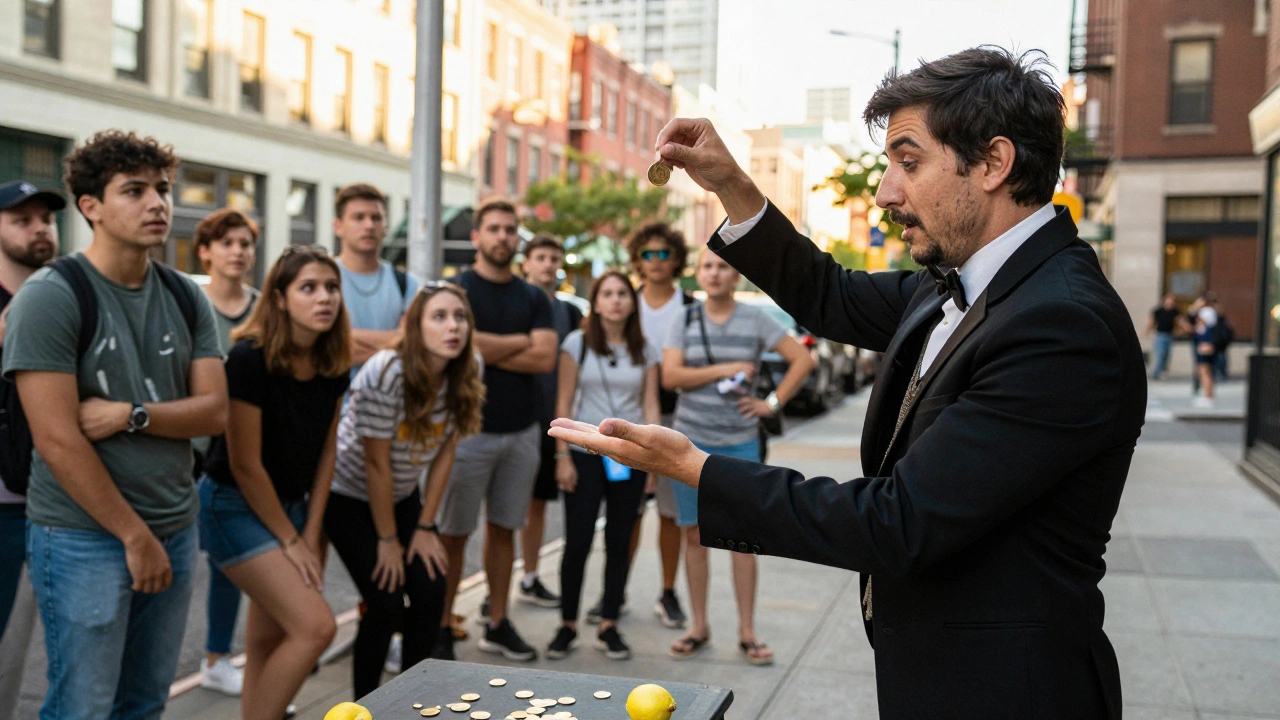
Coin tricks are some of the oldest forms of magic. They’re perfect for street performances because they require no props beyond what’s in your pocket. The most famous ones include:- The French Drop - A classic palm and vanish. You hold a coin between thumb and fingers, then pretend to transfer it to your other hand while secretly keeping it hidden. It’s the foundation of most coin vanish routines.
- The Multiplying Coins - One coin becomes two, then four, then six. The secret lies in hidden duplicates and clever palming. The classic version uses three coins: two real, one fake. The fake is palmed and revealed later as a "new" coin.
- The Chinese Coin Trick - A coin appears to pass through a table or a solid surface. Modern versions use a magnet or a gimmicked table, but the original relied on a hidden compartment and timing.
- The Vanishing Coin in Lemon - A coin is placed under a lemon, then disappears. The lemon is cut open to reveal nothing inside. The secret? The coin is palmed before the lemon is placed, and a fake coin is left under it.
These tricks are great for beginners because they’re visual and don’t require a stage. Most magic trick kits include a set of gimmicked coins or a practice lemon. You’ll find that mastering the French Drop alone opens the door to dozens of routines.
Large-Scale Illusions and Stage Tricks
When magic moves from the palm of your hand to a full stage, the tricks get bigger-and more complex. These aren’t usually found in retail magic kits, but they’re the ones that leave audiences speechless:- The Sawing a Woman in Half - First performed by P.T. Selbit in 1921, this illusion uses a specially designed box with hidden compartments. The assistant isn’t actually cut in half-her body is positioned to create the illusion using angled panels and false limbs.
- The Levitation - There are many versions, but the most famous is the Balducci Levitation, where the magician stands at an angle and appears to float a few inches off the ground. It’s a simple trick based on foot positioning and audience perspective.
- The Zig Zag Girl - A woman is placed in a box that’s then divided into three sections. The middle section is pulled apart, and she appears to be split into thirds. The secret? The box is wider than it looks, and the assistant bends her body to fit into the spaces.
- The Cups and Balls - One of the oldest known magic tricks, dating back to ancient Egypt. Three cups and several balls are used to make balls appear, disappear, and move between cups. Modern versions use gimmicked balls or false bottoms. It’s a test of dexterity and misdirection.
These illusions rely on mechanics, mirrors, and misdirection more than hand skills. They’re not something you’ll learn from a $20 kit-but understanding how they work helps you appreciate the craft behind them.
Psychological and Mentalism Tricks
Not all magic is about sleight of hand. Some tricks play directly with your mind. These are called mentalism tricks, and they’re some of the most powerful because they feel real:- The Book Test - A spectator opens a book to a random page, picks a word, and the magician somehow names it. The secret? The magician controls the book’s selection using a force technique, or the book has a hidden code (like every page’s top word is the same).
- The Mind Reading Prediction - The magician writes a prediction before the show. Later, a spectator does something random-like picking a number or drawing a symbol-and it matches the prediction exactly. The trick relies on forcing a choice or using a dual-purpose prediction (e.g., writing "the number 7" when the spectator is likely to pick 7).
- The Three Card Monte - Often used by street hustlers, this trick uses three cards and misdirection to make you think you can track the winning card. The dealer moves the cards fast, but the winning card is never where you think. It’s a psychological trap.
Mentalism tricks are popular in modern magic because they feel personal. You don’t need fancy props-just confidence and an understanding of human behavior. Many magic kits now include "mentalism modules" with gimmicked envelopes, prediction pads, and force decks.
What’s in a Typical Magic Trick Kit?
If you’ve ever bought a magic kit from a store, you’ve probably seen one with 20-50 tricks inside. Most beginner kits include:- A deck of playing cards (often marked or gimmicked)
- Three or four gimmicked coins
- A rubber band trick
- A sponge ball set
- A pencil that appears to pass through a table
- A prediction envelope
- A small mirror or optical illusion device
These kits teach the most common named tricks: the French Drop, the Ambitious Card, the Vanishing Coin, and the Rubber Band Through Finger. They’re designed to give you quick wins-tricks you can do in under a minute that impress friends.
But here’s the catch: most kits don’t teach you the why behind the tricks. They show you how to do the move, but not how to make it look real. That’s where practice comes in. A trick only works if the audience believes you’re not cheating. That takes timing, eye contact, and a little showmanship.

Why Knowing the Names Matters
Calling a trick by its real name isn’t just for show-it’s how you learn. If you Google "how to do the card trick where the card jumps," you’ll get a dozen confusing videos. But if you search for "how to do the Ambitious Card," you’ll find tutorials from professional magicians who’ve spent years perfecting it.Knowing the names also helps you talk to other magicians. Magic is a community. At conventions, you’ll hear people say, "I used the Hindu Shuffle in my Ten Card Trick," or "I added a pass to the classic French Drop." Without the names, you’re stuck describing everything with hand motions.
And if you’re serious about learning magic, you’ll eventually want to move beyond kits. Books like The Royal Road to Card Magic or Mark Wilson’s Complete Course in Magic use the real names. They assume you already know what a "force" or a "pass" is. If you don’t, you’ll hit a wall.
Final Thought: Magic Is About the Experience, Not Just the Trick
The name of the trick is just the label. What makes magic unforgettable is how you deliver it. A poorly performed "Ambitious Card" will fall flat. A well-timed one, with a story and a pause, can make someone believe in magic.So don’t just learn the names. Learn the rhythm. Learn the pause. Learn how to make someone lean in. The trick is the vehicle. The wonder? That’s all you.
What are the most common magic tricks for beginners?
The most common beginner magic tricks include the Ambitious Card, the French Drop, the Ten Card Trick, the Vanishing Coin, and the Rubber Band Through Finger. These are all included in standard magic trick kits and teach foundational skills like misdirection, palming, and controlled shuffles.
Do magic trick kits teach you how the tricks actually work?
Most kits show you how to perform the moves but rarely explain the psychology or mechanics behind them. For example, a kit might teach you how to do the "Force," but not why it works on people’s decision-making. To truly understand, you need to study books or videos from professional magicians who break down the principles, not just the steps.
Are all magic tricks based on sleight of hand?
No. While many tricks rely on hand skills like palming or false shuffles, others use psychology (mentalism), optics (mirrors and angles), or mechanics (gimmicked props). The Sawing a Woman in Half illusion, for example, uses hidden compartments and stage design-not dexterity.
What’s the difference between a card trick and a mentalism trick?
Card tricks rely on physical manipulation of cards-shuffling, cutting, forcing. Mentalism tricks manipulate the mind-using suggestion, prediction, or forced choices to make people think you’re reading their thoughts. A card trick makes you wonder how the card got there. A mentalism trick makes you wonder how the magician knew what you were thinking.
Can you learn real magic from a store-bought kit?
Yes, but only the basics. Kits are great for learning moves and building confidence. To become a skilled magician, you need to go beyond the kit-study performances, learn the names of tricks, practice delivery, and understand why audiences believe what they see. The kit is the starter tool, not the finish line.
Want to go deeper? Start by learning one trick-really learn it. Do it in front of a mirror. Then do it for a friend. Then do it while telling a story. That’s where magic becomes real.
kelvin kind
December 4, 2025 AT 13:16Been doing magic for years, and the Ambitious Card still blows my mind every time.
Fred Edwords
December 5, 2025 AT 01:54I appreciate how thoroughly you broke down each trick-especially the distinction between the Force and the Pass. So many people conflate them, but they’re fundamentally different techniques. The Hamman Force is pure psychology; the Pass is pure mechanics. Both require years to master, but one fools the mind, the other fools the eyes. And yes, the Ten Card Trick? Classic. I still use it in my street sets. It’s deceptive because it looks random-but it’s mathematically rigid. Perfect for beginners who think magic is about flashy moves. It’s not. It’s about control.
Sarah McWhirter
December 5, 2025 AT 19:13Okay, but what if the ‘gimmicked coins’ are actually microchips? I’ve seen videos where the coin ‘responds’ to the magician’s thoughts-like, literally vibrates. I’m not saying the government’s behind it… but why do all magic kits come with the same exact three coins? Coincidence? Or is this part of a larger mind-control experiment? Also, have you ever noticed that every magician wears a watch? Hmm. 🤔
Ananya Sharma
December 6, 2025 AT 09:41You call these ‘beginner tricks’? That’s laughable. The French Drop? It’s not a trick-it’s a betrayal of physics. The entire premise of magic relies on the audience’s willingness to ignore sensory reality. And you’re telling me this is harmless entertainment? You’re normalizing cognitive dissonance as a social activity. People spend hours learning how to trick their friends into believing lies. That’s not art-that’s a cult. And don’t even get me started on the ‘Book Test.’ You’re training people to accept that someone else can control their choices. This isn’t magic. This is behavioral conditioning wrapped in sequins. And yet, no one questions it. Why? Because it’s fun. And fun is the opiate of the masses.
Ian Cassidy
December 6, 2025 AT 14:35Force + Pass + Palm = the holy trinity of card magic. Master those three, and the rest is just dressing. The rest of the tricks? Just variations on a theme. You don’t need 50 tricks-you need 3 that you can do perfectly. That’s what separates the amateurs from the pros.
Zach Beggs
December 7, 2025 AT 12:02Agreed with Kelvin. The real magic is in the delivery, not the move. I’ve seen someone do a terrible Ambitious Card with zero flair-and it still got applause because they told a story about their grandpa teaching them. That’s the secret sauce.
Kenny Stockman
December 8, 2025 AT 08:00Love this breakdown. Seriously. If you’re just starting out, don’t try to learn all the tricks at once. Pick one-like the French Drop-and do it 100 times in front of a mirror. Then do it while watching TV. Then do it while talking to someone. The second you stop thinking about the move and start thinking about the person watching? That’s when it becomes magic. You got this.
Antonio Hunter
December 8, 2025 AT 11:37There’s a quiet beauty in how magic preserves tradition. The Cups and Balls? Ancient. The Ambitious Card? Over a century old. And yet, modern magicians still perform them-because the mechanics haven’t changed, but the context has. We’re no longer in Victorian parlors; we’re in TikTok feeds and Zoom calls. But the core remains: human curiosity, the suspension of disbelief, the shared moment of wonder. That’s why I teach magic to kids in after-school programs. It’s not about deception-it’s about teaching them to pay attention. To notice the small things. To be present. And honestly? That’s the most powerful illusion of all.
Paritosh Bhagat
December 10, 2025 AT 07:29Wait, so you’re telling me that people actually believe this stuff? Like, really? You’re telling me someone doesn’t realize the coin is palmed? That’s not magic-that’s gullibility. And you call this a ‘community’? I’ve seen magicians in India charge families hundreds of rupees for ‘miracle’ tricks that are literally just the French Drop with a napkin. It’s exploitation dressed up as entertainment. And you’re glorifying it? The fact that you think ‘practice’ is enough? No. It’s not. You’re teaching people to be fooled. And that’s dangerous. 🙄
Ben De Keersmaecker
December 10, 2025 AT 10:21Interesting how the terminology varies across cultures. In Japan, they call the Ambitious Card ‘Kōkai no Kādo’-‘the card that returns.’ The French Drop? ‘Kami no Te’-‘the hand of the gods.’ Language shapes perception. In the West, we frame magic as deception. In some Eastern traditions, it’s seen as a form of spiritual skill, a way to reveal hidden order. The trick doesn’t change-but the meaning does. That’s worth reflecting on.
Aaron Elliott
December 12, 2025 AT 07:11While your exposition is structurally coherent and semantically lucid, it remains fundamentally flawed in its epistemological underpinnings. Magic, as a performative art, presupposes the deliberate suspension of empirical verification-a practice antithetical to rational inquiry. To catalog these illusions as ‘tricks’ is to reify their legitimacy. One does not ‘learn’ how to deceive; one merely refines the technique of misdirection. And yet, you treat this as pedagogical. This is not education. It is the institutionalization of cognitive dissonance.
Chris Heffron
December 13, 2025 AT 02:05Love the breakdown! 😊 The Ten Card Trick is my go-to for parties. People always freak out. Also, just learned the Hindu Shuffle last week-so satisfying when it works. 🤫
Adrienne Temple
December 14, 2025 AT 23:42Y’all are overthinking it. 😊 Just pick one trick. Do it until it feels natural. Then do it for someone you love. Watch their face light up. That’s it. That’s the whole point. No need for philosophy, no need for conspiracy theories. Just magic. ❤️
Sandy Dog
December 16, 2025 AT 15:44Okay but what if the rabbit in the hat is actually ALIVE and the magician is a wizard? Like, what if this whole time we’ve been underestimating magic? What if the cards are cursed? What if the lemon trick? The lemon was NEVER a lemon? 😱 I’ve been having nightmares since I read this. I think I saw a coin blink at me last night. I’m not okay. Someone call a priest. Or a magician. I don’t know anymore. 🤯
Nick Rios
December 17, 2025 AT 18:14Thanks for writing this. I’ve been trying to learn magic since I was 12, and I always felt like I was missing something. You didn’t just list tricks-you explained why they matter. That’s rare. I’ll start with the French Drop tomorrow. No pressure. Just practice.