
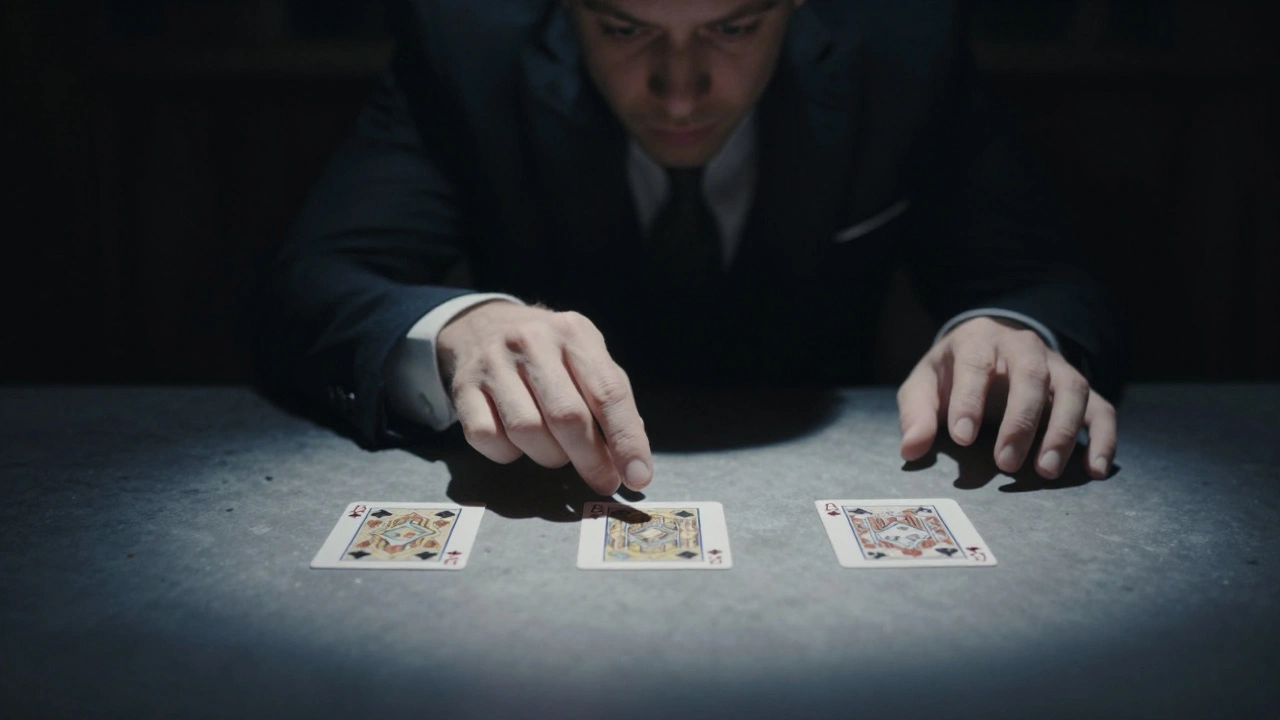
Three peeking isn’t a spell, a code, or a secret handshake. It’s a simple card trick that fools even sharp-eyed observers-and it works because your brain does most of the work for the performer. If you’ve ever watched a mentalist pick a card you thought was hidden, only to realize later you never actually saw the card being chosen, you’ve seen three peeking in action.
How Three Peeking Actually Works
Three peeking is a method used in card magic and mentalism where a spectator is led to believe they’ve freely selected one of three cards, but the performer already knows which one they’ll pick. The trick relies on subtle psychological pressure, misdirection, and the way humans process choices under uncertainty.
Here’s the basic setup: the performer lays out three face-down cards in a row. They ask the spectator to point to one. Before the finger lands, the performer says something like, "I can feel you’re drawn to the middle one," or "You’re not going to pick the one on the left-too obvious." Then, as the spectator hesitates, the performer subtly shifts their gaze or leans slightly toward the card they want chosen. The spectator, sensing that the performer expects a certain choice, unconsciously picks it.
It’s not hypnosis. It’s not magic. It’s behavioral psychology.
Why People Fall for It
Humans hate ambiguity. When faced with multiple options and no clear reason to choose, we look for cues-any cue-to make a decision. That’s called the authority bias. We assume someone who looks confident knows something we don’t.
Studies in social psychology, like those from the University of California, show that when people are unsure, they’re 68% more likely to follow a nonverbal signal from someone they perceive as an expert. In three peeking, the performer doesn’t force the choice-they create the illusion of freedom while guiding the outcome.
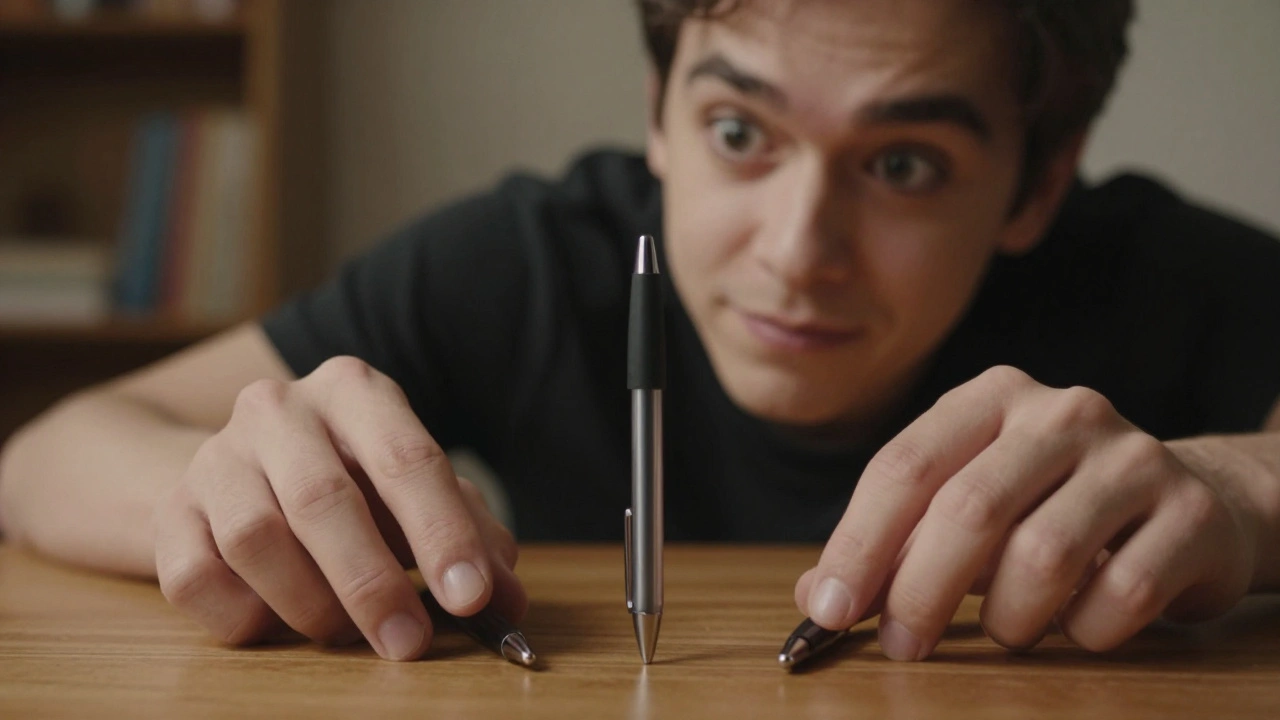
Try this yourself: hold up three pens and ask a friend to pick one. Don’t say anything. Watch what happens. Most people will stare at the pens, shift their weight, look at you for a hint. Now, next time, glance slightly at the one you want them to pick. You’ll be shocked how often they choose it-even if you didn’t say a word.
The Role of Misdirection
Three peeking doesn’t rely on sleight of hand. That’s what makes it so powerful. You don’t need to palm a card or switch decks. You just need to control attention.
Most performers use verbal misdirection: "You’re thinking of the red one, aren’t you?" or "I saw you hesitate on the second card-that’s the one." The spectator, believing they’re being read, starts to rationalize their choice. They convince themselves they picked it because it felt right, not because they were nudged.
Some advanced versions use physical misdirection. A performer might brush their sleeve against the table, tap their foot, or adjust their glasses-all while their eyes lock onto the target card. These tiny movements go unnoticed because the spectator is focused on the cards, not the performer’s body language.
Real-World Examples
Three peeking shows up everywhere-not just on stage. Magicians like Derren Brown use it in TV specials to make people believe they’ve chosen a random number, only to reveal it was predicted hours earlier. Street performers use it to get people to pick a specific bill from a handful. Even salespeople use the same principle: "Most customers go for the middle option," they say, knowing that’s the one they want to sell.
In one famous experiment, researchers gave participants three identical-looking coffee mugs and asked them to pick their favorite. Before they chose, the experimenter said, "I’ve noticed most people pick the one on the right." 83% of participants picked the right mug-even though all three were identical. The only difference? The suggestion.
How to Spot Three Peeking
If you want to avoid being fooled, watch for these signs:
- The performer makes a confident statement about your choice before you make it.
- You feel pressured to pick quickly, or they seem disappointed if you don’t pick the "expected" one.
- They look at the card they want you to pick, then quickly look away.
- You notice your own hesitation-and then you pick the card they seemed to expect.
Once you start noticing these patterns, you’ll see three peeking everywhere. It’s not just a trick-it’s a window into how easily our decisions can be shaped.

Why It’s Still Powerful Today
In an age of AI, deepfakes, and data tracking, you might think people are more skeptical. But the opposite is true. With so many choices and so much noise, we’re more dependent than ever on mental shortcuts. Three peeking thrives because it taps into a basic human need: to feel understood.
When a mentalist says, "I know what you’re thinking," it feels personal. It feels like magic. But it’s not magic-it’s a mirror. The trick works because you’re the one giving it meaning.
Can You Use Three Peeking Ethically?
Yes-but only if you’re honest about it. In performance, it’s entertainment. In sales or persuasion, it becomes manipulation.
There’s a line between guiding someone to a better choice and tricking them into one. If you’re using three peeking to help someone pick a product they’ll love, that’s influence. If you’re using it to make them buy something they don’t need, that’s exploitation.
The best mentalists don’t just control choices-they reveal how choices are made. And that’s the real magic.
Is three peeking the same as cold reading?
No. Cold reading uses vague statements and feedback to make someone believe you know personal details about them. Three peeking is about guiding a specific, immediate choice-like picking a card-using subtle cues. Cold reading is about storytelling; three peeking is about decision manipulation.
Do you need special cards or tools for three peeking?
No. Three peeking works with any three identical cards, coins, or objects. The trick isn’t in the props-it’s in the timing, tone, and body language. That’s why it’s so hard to detect.
Can you learn three peeking as a beginner?
Absolutely. You don’t need years of practice. Start by practicing with friends: lay out three pens, say something like, "I think you’ll pick the blue one," then watch what happens. The key is confidence, not technique. Most people will pick the one you hinted at-even if you didn’t touch it.
Why does three peeking work better with strangers than friends?
Because with strangers, you’re seen as an authority figure. With friends, they know your habits, your quirks, and they’re less likely to fall for your cues. The trick works best when the person doesn’t know you well enough to second-guess your behavior.
Is three peeking used in real-life situations outside of magic shows?
Yes. Advertisers use it to steer you toward a product. Retailers place the most profitable item in the middle. Politicians imply what voters "should" support. Even dating apps use it-by showing you profiles that match what you’ve clicked before, they make you feel like you chose freely, when you’re being guided.
Teja kumar Baliga
December 3, 2025 AT 04:04This is wild-I tried it with my cousins using three pens last weekend. They all picked the one I glanced at. No words, no pressure, just a tiny eye shift. It’s like my brain was broadcasting a signal they couldn’t ignore.
Tiffany Ho
December 3, 2025 AT 11:59i tried this with my roommate and she picked the exact pen i wanted without me saying anything. i felt so guilty but also so amazed. like wow our brains are so easy to trick
Nicholas Zeitler
December 3, 2025 AT 17:35Okay, but let’s be real-this isn’t just about card tricks. It’s about how every single decision we make in modern life is being subtly engineered. From grocery store layouts to dating apps to political polling. You think you’re choosing? Nah. You’re responding to cues you didn’t even notice. And the worst part? You’ll never admit you were guided. You’ll say, ‘I just liked it.’
It’s not magic. It’s marketing. It’s psychology. It’s capitalism with a smile.
I’ve started catching it everywhere. The middle shelf. The ‘most popular’ button. The way a salesperson pauses right before the expensive option. It’s all three peeking. And we’re all the spectators.
And yet-we keep falling for it. Because being told what to want feels safer than choosing for ourselves.
So what’s the solution? Awareness? Maybe. But awareness doesn’t stop the machine. It just makes you feel weird about it.
I’m not saying don’t enjoy the trick. I’m saying don’t pretend you’re not part of it.
And if you’re a performer? Please don’t use this to sell people things they don’t need. That’s not magic. That’s manipulation.
But if you’re using it to help someone see their own potential? That’s the real magic.
k arnold
December 5, 2025 AT 12:03Wow. A whole post about how to point at a card. Groundbreaking. Next up: ‘How to breathe in a way that makes people think you’re deep.’
lucia burton
December 6, 2025 AT 01:31This is a textbook example of cognitive heuristics in action-specifically, the anchoring effect combined with nonverbal priming and the authority bias. The performer isn’t manipulating the choice-they’re activating the spectator’s innate decision-making architecture, which evolved for social cohesion, not for resisting subtle environmental nudges. In evolutionary terms, following the gaze of a perceived authority figure was literally a survival mechanism. So what we’re seeing here isn’t a trick-it’s a neurocognitive reflex that’s been weaponized for entertainment. And frankly? It’s terrifying how efficiently it works.
And yes, this is why UX designers and behavioral economists are obsessed with it. It’s not about persuasion-it’s about architecture. You don’t convince people. You design the environment so their brains do the convincing for you.
It’s not magic. It’s behavioral engineering.
And if you’re not using this in your A/B testing? You’re leaving conversion rates on the table.
Denise Young
December 7, 2025 AT 19:56Oh please. You call this ‘three peeking’? I’ve seen this exact technique used in retail for decades. The middle product is always the most expensive one. The ‘premium’ option. The one they want you to buy. They don’t even need to look at it-just put it in the center and wait. People are dumb. And it works. Every. Single. Time.
And now you’re making it sound like some deep psychological revelation? Honey, I’ve watched my grandma pick the middle coffee mug at a yard sale because ‘it looked right.’
It’s not magic. It’s just capitalism with a thesaurus.
Sam Rittenhouse
December 9, 2025 AT 12:00I used to think magic was about sleight of hand. Then I learned about cold reading. Then I learned about three peeking. And now I realize-the real magic is how willing we are to believe we’re free when we’re not. We crave the illusion of choice because the truth-that we’re guided, shaped, nudged-is too heavy to carry. So we smile, pick the card, and say ‘I knew it was that one.’
It’s beautiful. And heartbreaking.
Thank you for this. I’ll never look at a pen the same way again.
Peter Reynolds
December 9, 2025 AT 13:58Interesting. I tried it with my sister. She picked the left one. I was looking at the right. She said she just liked the color. I didn’t push. She didn’t feel pressured. Maybe it doesn’t work on everyone?
michael Melanson
December 11, 2025 AT 05:48My dad used to do this with dice at family dinners. He’d say ‘you’re gonna pick the six’ and somehow everyone did. I thought he was cheating. Turns out he was just good at reading people. I still don’t know if he’s a genius or a creep.