
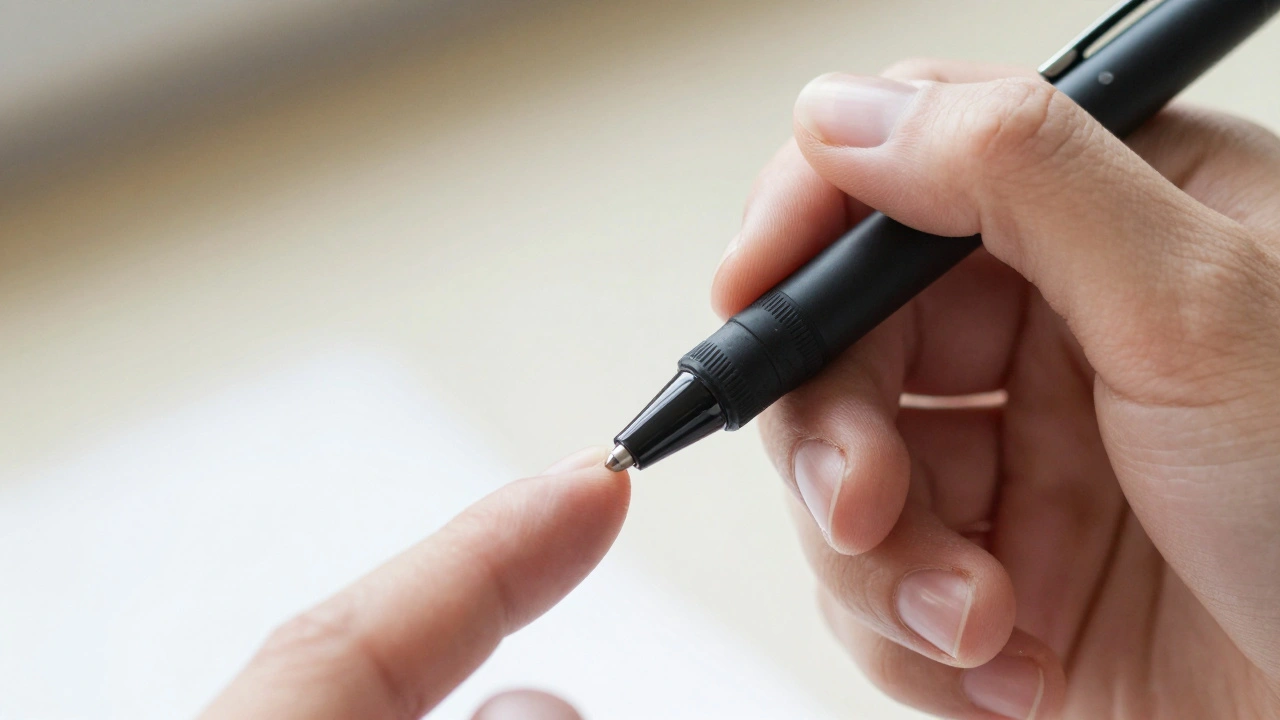
Pen spinning isn’t magic, but it looks like it. One moment you’re just holding a pen, the next it’s spinning around your fingers like it’s alive. People stare. Friends ask how you do it. And the best part? You don’t need special gear-just a pen and a few minutes a day.
What Exactly Is Pen Spinning?
Pen spinning is the art of manipulating a pen using your fingers, wrists, and hands to create smooth, controlled movements. It’s not about juggling or tossing-it’s about precision. Think of it like finger drumming, but with a writing tool. The goal isn’t to impress with speed, but with control and flow.
It started in Japanese schools in the 1980s as a way for students to pass time during lectures. Now, it’s a global community with online forums, competitions, and even YouTube channels with millions of views. People spin pens to relax, to focus, or just because it feels satisfying.
There are no official rules. No magic wand. No secret hand signals. Just physics, repetition, and patience.
Why Start With the Basics?
Most beginners jump straight to YouTube videos of people doing complex combos-spins, flips, and transitions that look like they’re from a sci-fi movie. Then they get frustrated when their pen flies across the room.
Here’s the truth: every pro started with one move. The thumb spin. That’s it. Master that, and everything else follows.
Think of pen spinning like learning to ride a bike. You don’t start with a downhill race. You start by balancing, then pedaling, then turning. Same here.
Step 1: The Thumb Spin (The Foundation)
This is the first move you need to learn. It’s simple, but if you get it wrong, everything else will feel awkward.
- Hold the pen between your thumb and index finger, like you’re about to write. Let the tip of the pen rest on the base of your middle finger.
- Use your thumb to push the pen upward, rolling it forward over your index finger.
- As the pen rotates, catch it between your index and middle finger. Don’t grab it-let it settle naturally.
- Repeat. Don’t worry about speed. Focus on smoothness.
It’ll feel clunky at first. The pen might slip. It might roll too far. That’s normal. Most people need 10-20 tries just to get the motion right. Do this for 5 minutes a day for a week. You’ll notice a difference.
Pro tip: Use a pen with a rubber grip. It gives you more friction. Avoid cheap, smooth pens-they’re too slippery.
Step 2: The Finger Pass (The Next Step)
Once the thumb spin feels natural, move to the finger pass. This is where you transfer the pen from one finger to another without dropping it.
- Start with the pen held between your thumb and index finger.
- Use your middle finger to push the pen toward your ring finger.
- Let the pen roll over your ring finger and catch it between your ring finger and pinky.
- Now reverse it: push it back from your pinky to your ring finger, then to your middle, and so on.
This move looks simple, but timing matters. If you push too hard, the pen flies. Too soft, and it stops. The sweet spot is a gentle nudge with your fingertip-not your whole hand.
Practice this slowly. Do 10 passes in each direction. Do it while watching TV. Do it while waiting for your coffee. Muscle memory builds in small moments.
Step 3: The Charge (The First Real Trick)
The charge is where pen spinning starts to look cool. It’s a smooth rotation that goes from your index finger, over your thumb, and back.
- Hold the pen vertically between your thumb and index finger.
- Let the pen rest on the side of your index finger, near the knuckle.
- Use your thumb to push the pen forward and down, letting it roll over your thumb and into the space between your thumb and middle finger.
- As it comes around, catch it with your middle finger.
This move is the gateway to combos. Once you can do it cleanly, you can link it to the thumb spin. That’s your first combo: thumb spin → charge → thumb spin.
Many people quit here because the charge feels unnatural. It’s not. It’s just different. Your hand hasn’t learned the motion yet. Keep going. Two weeks of daily practice, and it’ll feel automatic.
Common Mistakes and How to Fix Them
You’re not alone if your pen keeps flying off. Here are the three most common mistakes-and how to fix them:
- Mistake: Using too much force. Fix: Use your fingertips, not your wrist. Think of it as guiding, not throwing.
- Mistake: Looking at your hand the whole time. Fix: Once you’ve got the motion, close your eyes for a few seconds. You’ll feel the pen’s rhythm. That’s when you know you’ve got it.
- Mistake: Trying to learn 5 moves at once. Fix: Stick to one move until you can do it 10 times in a row without dropping. Then move on.
Also, don’t spin near glass, electronics, or expensive stuff. I learned that the hard way. A pen shattered a coffee mug once. It wasn’t pretty.
What Pen Should You Use?
You don’t need a special pen. But not all pens are created equal.
Look for:
- Weight: Around 10-15 grams. Too light? It flies. Too heavy? It’s tiring.
- Length: Standard ballpoint length-about 14 cm.
- Grip: Rubber or textured. Avoid glossy plastic.
- Balance: The center of gravity should be near the middle.
Popular choices among spinners: Uni-ball Jetstream, Pilot G-2, or even a standard Bic Cristal. Test a few. The right pen feels like an extension of your fingers.

How Long Until You Look Good?
It depends on how much you practice.
- After 1 week: You can do a clean thumb spin.
- After 2 weeks: You’ve got the finger pass and charge down.
- After 1 month: You can link them into a simple combo. People notice.
- After 3 months: You’re doing tricks others ask you to teach.
There’s no rush. Pen spinning isn’t a race. It’s a habit. The reward isn’t applause-it’s the quiet satisfaction of control.
Where to Go From Here
Once you’ve mastered the basics, you can start exploring:
- Shadow: A spin that rotates around the back of your fingers.
- Teleport: A quick transfer between fingers without visible motion.
- Infinity: A continuous loop that looks like the pen is moving in a figure-eight.
Watch videos from PenSpinning on YouTube. Don’t copy-observe. Notice how they pause, how they breathe, how they let the pen settle. That’s the real skill.
Join r/pen_spinning on Reddit. Share your progress. Ask questions. The community is small but supportive.
Final Thought: It’s Not About the Pen
Pen spinning isn’t about showing off. It’s about presence. When you’re spinning, you’re not thinking about your to-do list. You’re not checking your phone. You’re just there-focused, calm, in control.
That’s the real magic.
Can you do pen spinning with any pen?
You can try with any pen, but not all pens work well. Cheap, smooth pens slide too easily and are hard to control. Look for pens with a rubber grip, medium weight (10-15 grams), and balanced design. The Uni-ball Jetstream, Pilot G-2, and Bic Cristal are popular choices among beginners and pros alike.
How long does it take to learn pen spinning?
You can learn the basic thumb spin in a day with 10 minutes of practice. Getting consistent takes about a week. Most people see noticeable improvement after two weeks of daily practice. To do clean combos and tricks, expect to spend 1-3 months. The key isn’t talent-it’s consistency.
Is pen spinning useful or just a party trick?
It’s both-and more. While it looks like a party trick, many people use pen spinning to reduce stress, improve focus, or even as a form of mindfulness. It trains fine motor skills and hand-eye coordination. Some students spin during lectures to stay alert. It’s not just about looks-it’s about mental rhythm.
Why does my pen keep falling?
Most often, it’s because you’re using too much force or not catching the pen at the right point. Pen spinning relies on gentle momentum, not strength. Practice slowly. Focus on letting the pen roll naturally over your fingers instead of pushing it. Also, make sure your pen has enough grip-smooth pens are the usual culprit.
Can kids learn pen spinning?
Absolutely. Pen spinning is safe and great for kids. It helps develop fine motor skills and patience. Start with a larger, heavier pen-like a thick marker-so it’s easier to control. Many children pick it up faster than adults because they’re less worried about looking silly.