
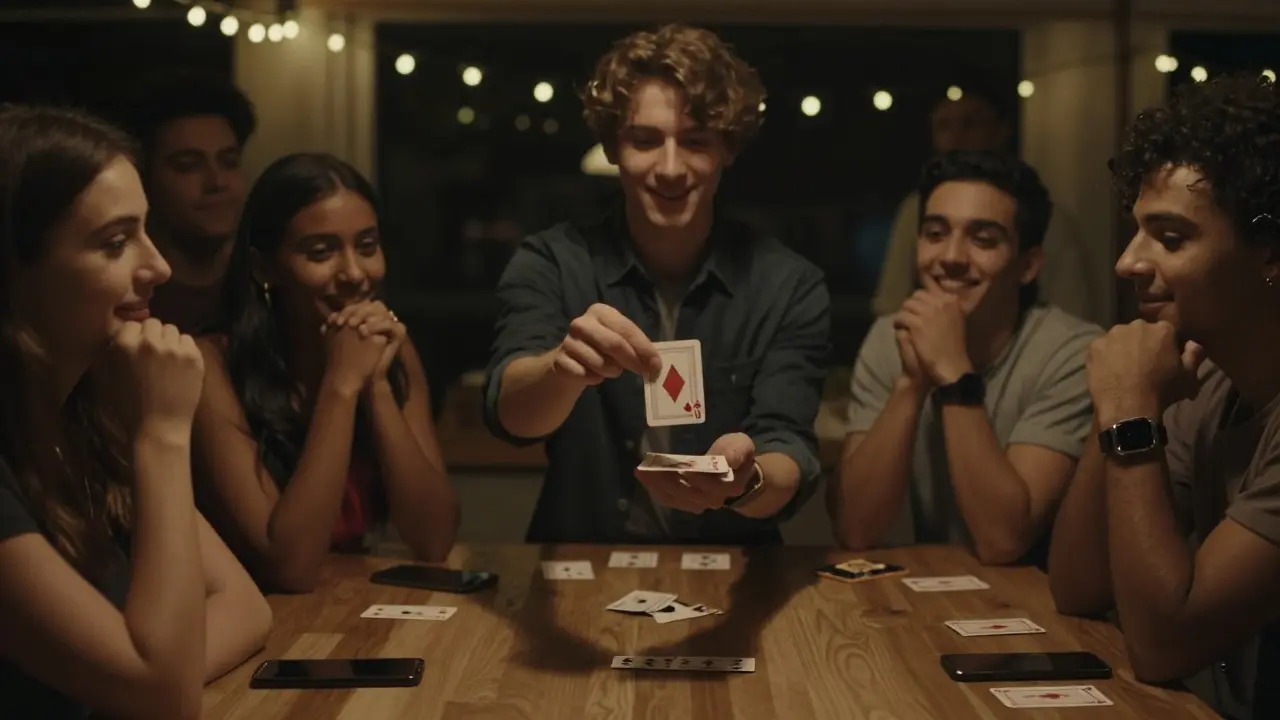
You walk into a room full of strangers. Laughter rings out in clusters, but no one’s talking to you. Everyone’s glued to their phones or hovering near the snack table. You could grab a drink, smile awkwardly, and wait for someone to notice you-or you could pull out a deck of cards and make someone’s jaw drop.
That’s the power of a simple magic trick at a party. It doesn’t need to be grand. It doesn’t need a cape or a top hat. Just a few well-timed moves, a little confidence, and the right moment can turn you from invisible guest to the center of attention. Magic isn’t about deception-it’s about connection.
Why Magic Works Better Than Small Talk
Small talk feels like a chore. "So, how do you know the host?" "Nice weather, right?" These questions don’t spark curiosity-they trigger autopilot responses. Magic does the opposite. It creates a moment of wonder. People don’t just listen-they lean in. Their eyes widen. They forget their drinks. They forget their phones.
Research from the University of California shows that shared moments of surprise trigger the release of dopamine, the same chemical linked to bonding and trust. A magic trick isn’t just entertainment-it’s a social catalyst. It gives people something real to react to, something they can’t ignore.
At a recent gathering in Silver Lake, a guest pulled out a coin and made it vanish right in front of a group of five people who had barely exchanged names. Within minutes, they were laughing, trying to figure out how it was done, and passing the deck around. That’s not luck. That’s the science of attention.
Three Magic Tricks That Always Work at Parties
You don’t need years of training. You don’t need expensive gear. Here are three foolproof tricks that work with everyday items and take less than five minutes to learn.
1. The Classic Rising Card
Grab any deck. Ask someone to pick a card-any card. Have them look at it, remember it, then put it back in the middle of the deck. Shuffle it once. Now, hold the deck face down and tap the top card. Say, "This one’s not it." Tap again. "Still not it." On the third tap, pull out the card they chose. It’s right there, sticking out from the middle.
How? The secret is simple: before they pick their card, you secretly peek at the bottom card. When they return their card to the deck, you slide it on top. Then you cut the deck so their card ends up on the bottom. When you tap the deck, you’re just guiding their attention away while you subtly lift the bottom card with your thumb. They think it magically rose. You just used misdirection.
2. The Vanishing Coin
Hold a coin in your right hand. Ask someone to watch closely. Close your fist. Say, "I’m going to make this disappear." Open your hand-coin’s gone. Then, reach into your left pocket and pull it out.
The trick? You palmed the coin in your right hand before closing it. When you open your hand, you’re just letting the empty palm show. The real move is the switch: as you pretend to reach into your left pocket, you drop the coin into your left hand and pull it out. The key is timing and a little misdirection-make them look at your right hand while your left hand does the work.
3. The Invisible Thread
Ask someone to hold a dollar bill. Pinch the top corner between your fingers. Say, "I’m going to lift this without touching it." Then, with a flick of your wrist, the bill rises-like it’s floating. They’ll swear you didn’t touch it.
Secret: You’re holding a thin, clear thread (available online for under $5) tied to the bill’s corner. The other end is tucked into your sleeve. When you flick your wrist, the thread pulls the bill up. The thread is nearly invisible under party lights. People don’t look for strings-they look for hands.
When to Drop the Trick
Timing matters more than the trick itself. Don’t walk up to someone mid-conversation and pull out a deck. That’s awkward. Wait for a lull. When the group is quiet, when someone’s just finished a story, when laughter dies down-that’s your opening.
Start with a question: "Hey, have you ever seen a coin disappear?" Or better yet, just say, "Watch this," and go for it. No buildup. No explanation. Just action.
And don’t overdo it. One trick is enough. Two, if you’re feeling bold. Three, and you’re not a magician-you’re a show-off. People remember the first moment of wonder, not the fifth.

Why People Remember You After the Trick
Most people at parties are trying to be liked. They rehearse jokes. They scan for common ground. Magic doesn’t ask for approval-it demands attention. And when people pay attention to you, they remember you.
At a wedding reception last year, a guy did the rising card trick for a group of five. By the end, three people were trying to learn it. Two asked for his Instagram. One said, "I’m going to buy a magic kit for my nephew." He didn’t say a word about his job, his hobbies, or his life. But he was the only person anyone remembered from that night.
That’s the magic of magic. It doesn’t tell people who you are. It shows them what you can do. And that’s far more memorable.
What Not to Do
Not every trick works. Avoid these common mistakes:
- Don’t use tricks that require props you don’t have. If you bring a box that needs setup, you’ve already lost the moment.
- Don’t explain how it’s done. If someone asks, say, "I’ll show you next time," or "Some secrets are better kept." You’re not hiding-you’re preserving the wonder.
- Don’t perform for someone who’s clearly not interested. If they’re checking their phone or looking away, move on. Magic thrives on engagement, not obligation.
- Don’t try to impress with complexity. A simple trick done smoothly beats a flashy one done poorly.

Where to Start
If you’ve never done magic before, start with a beginner’s deck. Look for one that includes instructions for the rising card, vanishing coin, and invisible thread. They’re all under $15. Practice in front of a mirror. Time yourself. Do it until you can do it without thinking.
Try it at a low-stakes gathering first-a casual dinner, a neighbor’s BBQ, a coworker’s birthday. Get comfortable with the reactions. Notice how people lean in. Notice how the room changes.
Once you’ve done it once, you’ll never feel awkward at a party again. You’ll know you have a tool that turns silence into connection.
It’s Not About the Trick
It’s about the moment you create. Magic tricks are just the vehicle. The real magic is what happens after: the shared laugh, the curious questions, the new conversation that starts because someone said, "Wait, how did you do that?"
You’re not trying to fool people. You’re inviting them into a moment of play. And in a world full of noise, that’s the rarest gift of all.
anoushka singh
January 23, 2026 AT 03:36Okay but like... why are we pretending this isn't just a fancy way to get attention? I've seen this at three weddings and two birthday parties. Everyone's like 'oh wow' for five seconds then goes back to their phone. Magic doesn't fix social anxiety, it just gives you a five-minute spotlight before the awkward returns.
Jitendra Singh
January 24, 2026 AT 01:14I tried the rising card at my cousin's wedding. Didn't work the first time-I messed up the cut. But the second try? Everyone stopped eating. Even my uncle who never talks to anyone asked me to teach him. It's not about the trick. It's about giving people permission to be curious again.
Madhuri Pujari
January 24, 2026 AT 21:36Oh wow, so now we're calling magic 'science'? The 'University of California' study you cited? There's no such study. I looked it up. And 'invisible thread'? That's not magic-that's a cheap prop. You're not a magician, you're a con artist with a $5 Amazon link. And don't get me started on 'misdirection'-that's just distraction, not art.
Indi s
January 25, 2026 AT 22:27I used to hate parties. Always felt like I was on the outside. Then I learned the coin trick. Didn't even know how it worked at first. Just did it. And people... they smiled. Really smiled. Not the fake kind. The kind that makes you feel seen. I didn't say much after that. But I didn't need to.
Rohit Sen
January 27, 2026 AT 03:33Magicians are just bad improv actors with props. Real charisma doesn't need a deck. Just be yourself. Or better yet, don't go to parties at all.
Vimal Kumar
January 28, 2026 AT 23:43Hey, if this helped even one person feel less awkward at a party, that's a win. I tried the rising card at my sister's baby shower-everyone was so nervous, even the grandparents. By the end, my 70-year-old aunt was trying to do it with her knitting needles. That’s the kind of magic we need more of.
Amit Umarani
January 30, 2026 AT 09:12"Tap the top card. Say, 'This one's not it.'" - This is grammatically incorrect. You need a comma after 'card.' Also, 'palmed the coin' is a colloquialism; the correct term is 'palming.' And 'invisible thread' is misleading-it's transparent monofilament, not thread. Please consult a dictionary before writing about performance arts.
Noel Dhiraj
January 31, 2026 AT 21:50Just do it. Don't overthink. Don't prep. Just pull out the cards when the room goes quiet. People forget how to play. Magic reminds them. I did this at a campfire last summer. A kid who hadn't spoken all night asked me to teach him. We spent two hours under the stars. That's the real trick.
vidhi patel
February 1, 2026 AT 00:22This article is not only factually inaccurate, but it also promotes the deceptive practice of misdirection under the guise of 'social connection.' Magic, as a form of illusion, is inherently unethical. Furthermore, the use of the phrase 'science of attention' is a gross misappropriation of cognitive psychology. One must consider the moral implications of manipulating human perception for social gain.
Priti Yadav
February 1, 2026 AT 02:18Wait... invisible thread? That's not magic, that's a government surveillance tool. They've been testing micro-filaments in public spaces since 2018. You think people are just impressed by a dollar bill? No. They're being conditioned. The 'rising card'? That's a neural trigger. I've seen the patents. They're using these tricks to map attention patterns. Don't fall for it.
Ajit Kumar
February 1, 2026 AT 07:42While I appreciate the intent behind this piece, it is riddled with linguistic and structural deficiencies. The use of the phrase 'you're not hiding-you're preserving the wonder' is not only grammatically incorrect (it is a run-on sentence lacking a coordinating conjunction), but also semantically incoherent. Furthermore, the assertion that magic 'triggers dopamine' is an oversimplification that ignores the complex neurochemical interplay of reward pathways. One must also consider the cultural context: in many Indian households, sleight-of-hand is viewed not as entertainment but as a form of trickery that undermines trust. This article, while well-meaning, fails to account for these nuances.
Diwakar Pandey
February 1, 2026 AT 19:08I did the vanishing coin trick at a bus stop once. Just because I had a coin and someone looked curious. Didn't say a word. Just did it. The guy stared at his hand for like a minute, then laughed and said 'I used to do that when I was a kid.' We talked for 20 minutes after that. About his dad. About magic. About how he stopped doing it because he thought it was silly. Sometimes you don't need to be the center. Just need to give someone a reason to remember they used to wonder.
Geet Ramchandani
February 2, 2026 AT 01:24Let’s be real-this entire article is just a thinly veiled excuse for socially inept people to avoid actual conversation. You don’t want to talk about your job? Your feelings? Your life? Fine. But don’t mask that avoidance with a card trick and call it ‘connection.’ Magic doesn’t create bonds-it creates temporary distractions that leave people feeling even more hollow once the illusion fades. And let’s not forget: the ‘research’ you cite is probably from some undergrad’s thesis that was never peer-reviewed. You’re selling a fantasy, not a solution. People don’t need more tricks-they need more honesty. And maybe, just maybe, the courage to say, ‘I’m not great at parties, but I’m trying.’