

Have you ever watched a magician pull a card out of thin air, guess your secret number, or make a coin vanish-and wondered how they did it? Most people assume it’s all sleight of hand, misdirection, or secret assistants. But here’s the truth: behind nearly every classic magic trick is a solid, repeatable mathematical rule. Not magic. Not mystery. Math.
Why Math Works Better Than Hocus-Pocus
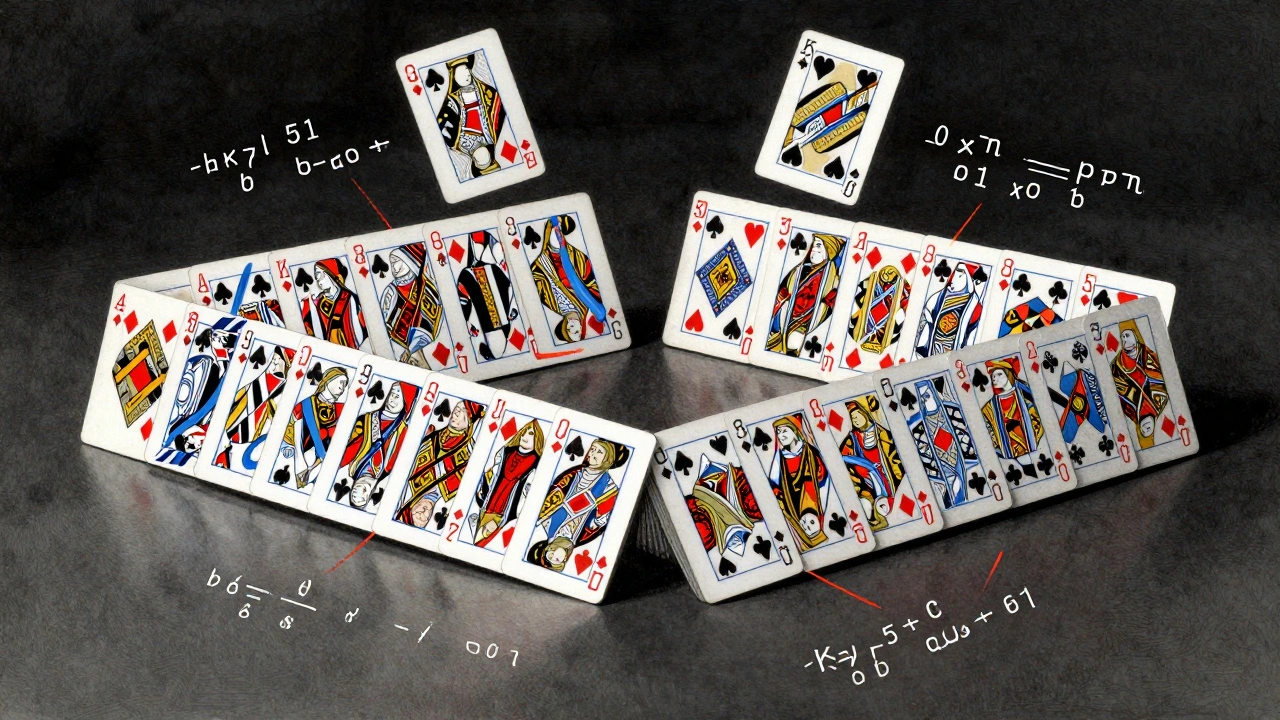
Magicians don’t need supernatural powers. They need patterns. And math is the ultimate pattern-finder. A deck of 52 cards? That’s 52! possible arrangements-over 8 followed by 67 zeros. But magicians don’t shuffle randomly. They use controlled sequences. They rely on fixed rules that always produce the same result, no matter how many times you try.
Take the classic "21-card trick." You pick a card. The magician deals the cards into three piles, asks which pile your card is in, gathers them in a specific order, and repeats this three times. Then-poof-your card is the 11th card in the deck. It’s not luck. It’s base-3 arithmetic. Each time the pile is reassembled, the position of your card gets narrowed down by a factor of three. After three rounds, it lands exactly in the middle. No guessing. No trickery. Just numbers.
Card Tricks That Run on Modular Arithmetic
Modular arithmetic-clock math-is the secret sauce behind dozens of card tricks. Think of a clock: after 12, you go back to 1. That’s modulo 12. In card tricks, it’s often modulo 13 (for ranks) or modulo 4 (for suits).
The "Out-Faro Shuffle" is a perfect example. If you split a deck exactly in half and interlace the cards perfectly-top card from the right half, then left, then right, and so on-after eight perfect shuffles, the deck returns to its original order. That’s not coincidence. It’s math. The position of each card follows a formula: new position = (2 × old position) mod 51. Do it eight times? You’re back to start.
Magicians like Dai Vernon and Alex Elmsley used this to make cards appear where they shouldn’t. They didn’t memorize positions. They calculated them. And they taught students to do the same.
Probability and the Illusion of Choice
Ever been asked to "pick a card, any card"-and then the magician somehow knew which one you’d pick? That’s not mind reading. It’s probability engineering.
Some tricks use what’s called the "force." It’s not about forcing you to pick a card-it’s about making you think you chose freely, while the outcome was predetermined. One common method? The "Hamman Force." The magician holds the deck face down and asks you to say "stop" when you feel like it. They stop dealing at the 15th card-because 15 is the number they want you to pick. Why 15? Because studies show most people stop between 10 and 20. It’s not random. It’s statistically reliable.
Another trick: "Think of a number between 1 and 10." The magician then reveals you picked 7. Why? Because 7 is the most commonly chosen number in psychological studies. In a 2011 survey of over 3,000 people, 7 was selected 30% of the time. The next most common? 3 and 5. But 7? It’s the default. Magicians don’t guess. They use data.
Number Tricks That Feel Like Mind Reading
One of the most popular tricks goes like this:
- Think of any number.
- Multiply it by 2.
- Add 10.
- Divide by 2.
- Subtract your original number.
- The answer is 5.
No matter what number you start with, you always get 5. Here’s why:
Let’s say your number is x.
- 2x
- 2x + 10
- (2x + 10) / 2 = x + 5
- x + 5 - x = 5
It’s algebra. Clean. Predictable. And it works every time. Magicians use variations of this trick with different numbers-12, 18, 20-but the structure stays the same. The trick isn’t in the performance. It’s in the equation.
Geometry and the Vanishing Act
Ever seen a magician make a person disappear? Or a coin slip through a table? That’s not magic. That’s geometry.
The "Disappearing Coin" trick uses angles and hidden space. The coin is placed on a surface, then covered with a cloth. The magician moves their hand in a way that blocks your view-but the coin never leaves the table. It just slides into a hidden groove or folds under a flap. The trick relies on your brain assuming the space under the cloth is flat and solid. It’s not. It’s designed to exploit optical blind spots.
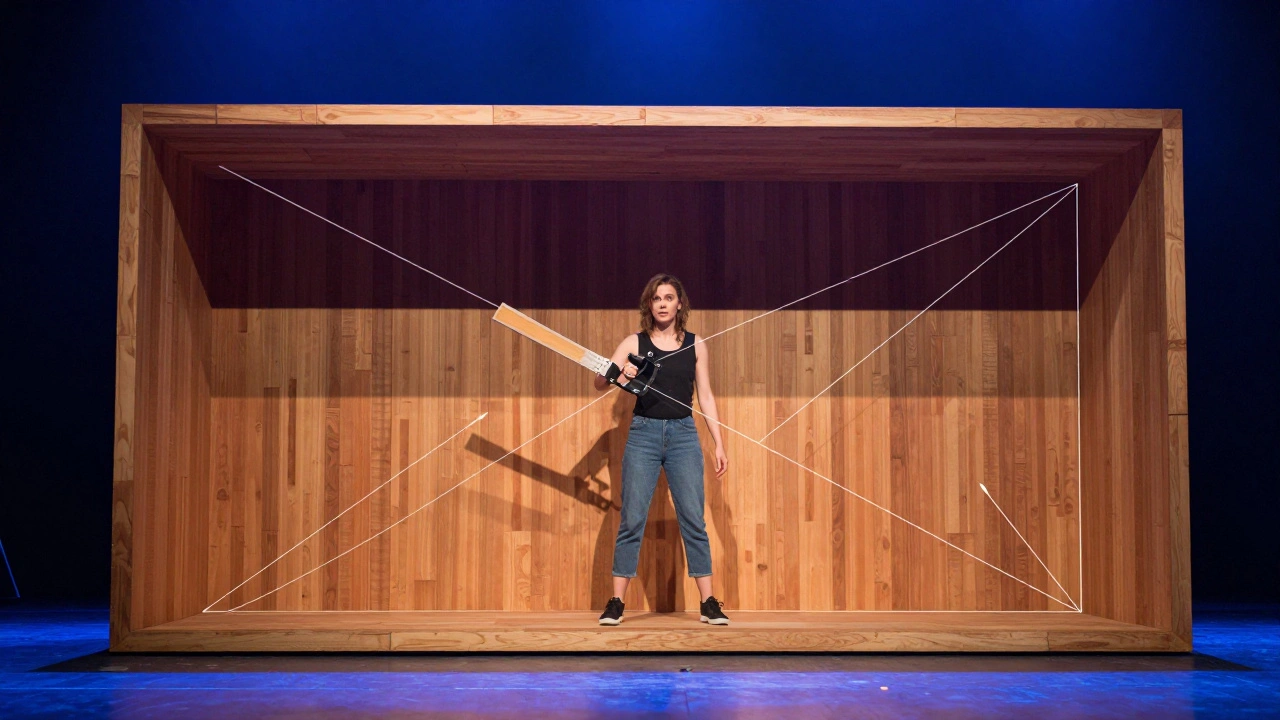
The "Sawing a Woman in Half" illusion? It’s not a saw. It’s a box with two compartments. The assistant’s body is bent and positioned so that when the box is split, the top half appears to be one person and the bottom half another. The math? It’s all about proportions, angles, and perspective. The box is longer than it looks. The assistant’s legs are tucked at an angle that matches the illusion. The audience sees what the geometry tells them to see.
Why This Matters Beyond the Stage
These tricks aren’t just for entertainment. They’re teaching tools. Math teachers use them to show students that algebra isn’t abstract-it’s practical. Computer scientists study card shuffling algorithms to improve random number generation. Psychologists use forced choices to understand decision-making biases.
Even in everyday life, understanding how math creates illusions helps you spot manipulation. Ads that say "9 out of 10 people prefer this"? That’s a force. Surveys that only ask leading questions? That’s probability engineering. Magic tricks are just the most visible version of how numbers shape perception.
How to Try It Yourself
You don’t need a fancy deck or a top hat. Start simple:
- Grab a deck of cards. Count to 21 and lay them out in three rows of seven.
- Ask someone to pick a card and tell you which row it’s in.
- Gather the rows, putting the chosen row in the middle.
- Repeat twice more.
- Their card will be the 11th card.
Practice it. Do it in front of a mirror. Time how long it takes. You’ll notice that the more consistent your handling, the more convincing it becomes. That’s the real secret: precision beats flair.
Final Thought: Magic Is Just Math You Don’t Understand
There’s no magic in magic. There’s only math that’s been hidden in plain sight. The best magicians aren’t mystics. They’re mathematicians who know how to make you forget you’re doing math at all.
Next time you see a trick, don’t ask "How did they do that?" Ask "What rule are they following?" You’ll start seeing patterns everywhere. And once you do, you’ll never look at a deck of cards the same way again.
Can you really use math to predict any card trick?
Yes, if the trick is designed using mathematical principles-which most classic tricks are. Tricks like the 21-card trick, Faro shuffles, and number-force routines rely on fixed algorithms. They’re predictable by design. But tricks that rely purely on sleight of hand or audience participation (like picking a card at random) can’t be predicted mathematically unless the magician controls the variables.
Do professional magicians study math?
Many do. Some, like Persi Diaconis (a former magician turned Stanford statistician), have PhDs in math. Others learn the math behind tricks through books like "Magic for Mathematicians" or "The Mathematics of Magic Tricks and Card Games." You don’t need a degree, but knowing how modular arithmetic or probability works makes you a better performer and a sharper observer.
Is there a trick that uses calculus?
Not in traditional stage magic. Calculus deals with change and motion-too complex for quick performances. But in advanced mechanical illusions or robotic magic systems (like those used in labs or tech demos), calculus helps calculate trajectories, timing, and motion paths. For live shows, though, algebra and probability are the real tools.
Why do magicians always use 52-card decks?
Because 52 is divisible into clean groups (4 suits, 13 ranks), and its size makes shuffling and dealing practical. More importantly, 52 is a number that allows for well-studied mathematical patterns-like the 8-perfect-Faro-shuffle cycle. Smaller or larger decks break these patterns. So it’s not tradition. It’s optimization.
Can I learn these tricks without knowing advanced math?
Absolutely. You don’t need to solve equations to perform them. You just need to follow the steps exactly. The math is built into the procedure. Learn the sequence, practice the handling, and the math will work for you-even if you don’t fully understand it. That’s the beauty of it.
Janiss McCamish
December 4, 2025 AT 14:45That 21-card trick always blew my mind. I tried it on my little cousin last weekend and she screamed when the card appeared in the middle. No magic, just math. I love when things make sense.
Richard H
December 5, 2025 AT 19:17Math? Seriously? I thought magic was about skill and showmanship. Now you’re telling me it’s just algebra with a hat? That’s boring. Real magic should feel like a miracle, not a homework problem.
Kendall Storey
December 5, 2025 AT 21:19Bro, the Faro shuffle is pure algorithmic poetry. Every card’s position is a function of modular arithmetic-2x mod 51, eight times, back to start. It’s not just a trick, it’s a deterministic system. Magicians like Elmsley didn’t just perform-they engineered entropy. That’s next-level stuff. 🤯
Ashton Strong
December 7, 2025 AT 14:26Thank you for this beautifully articulated exploration of the mathematical foundations of magic. It is truly inspiring to witness how abstract principles can be transformed into moments of wonder. This is the kind of intellectual artistry that bridges disciplines and enriches our collective understanding.
Steven Hanton
December 8, 2025 AT 18:29I’ve always been fascinated by how tricks rely on predictable patterns rather than randomness. The idea that a deck can return to its original order after eight perfect shuffles is mind-blowing. It reminds me of how algorithms in computer science use similar cyclic logic. Maybe we should teach this in high school math classes.
Robert Byrne
December 10, 2025 AT 06:55you spelled ‘algebra’ wrong in the third paragraph. it’s ‘algebra’ not ‘algebra’? wait no you got it right. but your commas are all over the place. fix your punctuation. this is supposed to be educational.
Tia Muzdalifah
December 11, 2025 AT 12:48omg i just tried the 1-10 number trick on my roommate and she picked 7 😭 i swear i didnt tell her anything. i think magic is just math that’s really good at hiding. also i spelled ‘math’ as ‘m ath’ by accident. oops.
Zoe Hill
December 11, 2025 AT 23:10That algebra trick with the 5? I did it with my niece and she thought I was a wizard. I didn’t even know why it worked until I read this. I love how something so simple can feel like magic. Thanks for breaking it down 🥹
Albert Navat
December 12, 2025 AT 04:11Modular arithmetic? Faro shuffles? You’re speaking like a crypto dev who just discovered card counting. This is all just entropy manipulation wrapped in a tuxedo. The real magic is how people still fall for it. We’re all just pattern-seeking apes with bad attention spans.
King Medoo
December 13, 2025 AT 16:45Math? Pfft. I know the truth. The government uses these tricks to condition us to accept predictable outcomes. The 21-card trick? It’s not math-it’s a mind-control protocol disguised as entertainment. They want you to believe everything has a formula. 🤖💣 But the real magic? The one they don’t teach you? It’s in the silence between the cards. 🕳️👁️
Rae Blackburn
December 15, 2025 AT 15:48They’re lying about the 52-card deck. It’s not about optimization. It’s because the Illuminati chose 52 to match the number of weeks in a year. The suits? Seasons. The jokers? The hidden agents. You think this is about math? It’s about control. And they’re watching you right now as you read this.
LeVar Trotter
December 16, 2025 AT 09:11For anyone thinking this is too technical-don’t overthink it. The beauty is in the repetition. You don’t need to know modular arithmetic to make the 21-card trick work. Just practice the stack, keep your hands steady, and the math does the heavy lifting. It’s like riding a bike-you learn by doing, not by memorizing equations.
Tyler Durden
December 18, 2025 AT 01:28Okay so I just spent 45 minutes trying to replicate the Faro shuffle and my deck is now bent like a pretzel. I think I broke it. But I also think I understand why it works. The math is beautiful. The failure? Also beautiful. This is why I love learning. Even when I mess up. I’m gonna try again tomorrow. Maybe I’ll get it right. Or maybe I’ll just make a new trick out of the mess. Either way-math wins.