
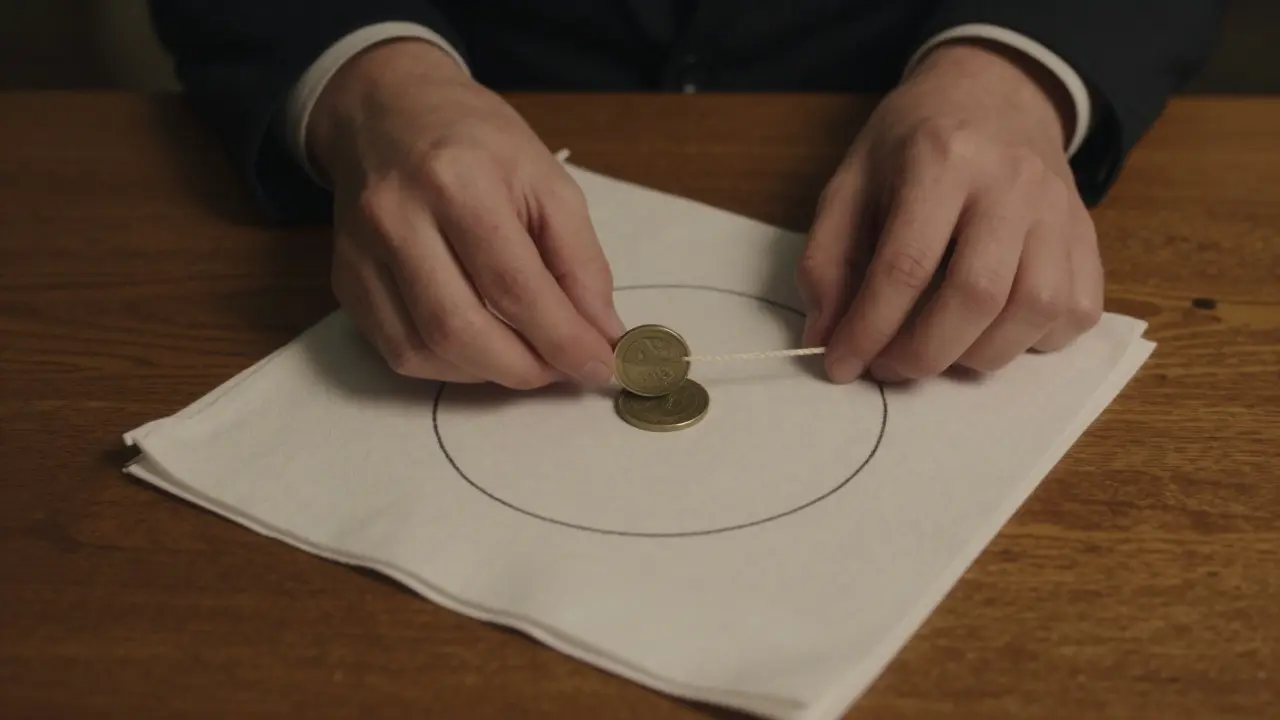
Want to make a magic circle but feel like it’s too complicated? You’re not alone. Most beginners think magic circles need fancy tools, secret hand motions, or years of practice. The truth? You can make a working magic circle with just a piece of string, a marker, and five minutes. No candles. No chants. No robes.
What Exactly Is a Magic Circle?
A magic circle isn’t a spell. It’s a visual trick that tricks the eye into seeing something impossible. In magic, a circle drawn on paper or floor becomes a boundary that objects seem to defy - coins vanish inside it, cards float above it, or your hand disappears when you reach through it. The power isn’t in the circle itself, but in how you use it to control attention.
The classic version uses a loop of rope or string laid flat on a table. When you place an object inside and cover it with a cloth, people swear they saw it vanish - even though it’s still there. That’s the magic. It’s not about supernatural forces. It’s about misdirection, timing, and simple physics.
What You Need (No Fancy Gear)
You don’t need a magic kit to start. Here’s everything you need:
- A 3-foot length of thin, flexible string (yarn, embroidery thread, or even a shoelace works)
- A small, flat object like a coin, a playing card, or a bottle cap
- A marker or chalk (to draw a circle on a table or floor)
- A small cloth napkin or handkerchief (no bigger than 6x6 inches)
That’s it. No wands. No assistants. No expensive props. If you’ve got these five things, you’re ready.
Step 1: Draw the Circle
Grab your marker or chalk and draw a circle about 6 inches wide on a flat surface. It doesn’t have to be perfect. A slightly wobbly circle actually looks more natural - people notice clean lines, and that distracts them. The circle should be big enough to fit your palm inside, but not so big that you lose control.
Pro tip: Use a coin as a stencil. Place it on the surface, trace around it, then lift it. Instant circle.
Step 2: Make the String Loop
Take your string and tie the ends together to make a loop. Don’t make it too tight - you need a little slack. The loop should be just big enough to fit over the coin or card you’ll use. Test it: place the object inside the loop and pull gently. It should snug around the edges without crushing it.
If you’re using a coin, the loop should sit just above the rim. If you’re using a card, it should rest flat inside the loop, not sticking out.

Step 3: Set the Trap
Place the loop of string on top of the drawn circle. Center it. Now, lay your coin or card inside the loop. Make sure it’s flat and not tilted. This is where most beginners mess up - they let the object stick out or wobble. A clean, centered setup is invisible to the audience, but critical to the trick.
Step 4: The Cover-Up
Take your cloth and drape it loosely over the coin and loop. Don’t press it down. Just let it rest. The cloth hides everything - the string, the coin, the circle. This is your moment of misdirection.
Now, say something like: “Watch closely - this coin is about to disappear.” Then, lift the cloth slightly on one side - just enough to show the coin is still there. Pause. Let them look. Then, slowly pull the cloth straight up and away. As you lift, use your other hand to tug the string loop off the coin - but do it under the cloth. The coin stays on the table. The loop? Gone.
The audience sees the cloth come up. They don’t see the string slide off. To them, the coin vanished. It didn’t. It was never in the loop to begin with. The loop was just a distraction.
Step 5: The Reveal
After you lift the cloth, point to the coin. Say: “It’s still here.” Then, reach into the air where the loop was and pull out the string - like you’re pulling a ribbon from a hat. The audience will gasp. They swear they saw the coin disappear. But you never moved it. You just moved their focus.
Why This Works (And Why Most Beginners Fail)
The biggest mistake beginners make? They think the circle has power. It doesn’t. The circle is just a visual anchor. The real magic is in your hands.
If you move too fast, people catch the string. If you speak too much, they focus on your mouth instead of your hands. If you don’t center the coin, the loop looks awkward. The trick fails because of small errors - not because it’s hard.
Practice this 10 times in front of a mirror. Watch your hands. Watch your eyes. Watch how your body shifts when you pull the string. You’ll notice things you didn’t before - like how you lean forward when you’re nervous. That’s your tell. Fix it.

How to Make It Look More Magical
Once you’ve got the basics down, here’s how to turn it from a simple trick into something unforgettable:
- Use a colored string that matches the table - it blends in.
- Draw the circle with a white chalk on a dark table. It pops without looking staged.
- Speak slowly. Pause after you say “disappear.” Let the silence build tension.
- Do it in low light. A dim lamp or candle (real or fake) adds mystery.
- After the trick, hand the coin to someone. Let them check it. They’ll be convinced it never left.
One performer I saw in LA did this with a dollar bill and a loop of dental floss. No one believed it. He made it look like the bill was swallowed by the air. That’s the goal.
Common Mistakes to Avoid
- Using thick rope - it won’t slide cleanly.
- Drawing the circle too big - it looks like a game, not magic.
- Letting the cloth touch the coin - it gives away the secret.
- Trying to do it with two hands at once - stick to one hand for the pull.
- Over-explaining - don’t say “watch my hand.” Let them watch.
Practice Routine
Do this every day for a week:
- Day 1: Just lay the loop and coin. Practice centering.
- Day 2: Add the cloth. Practice lifting it without moving the coin.
- Day 3: Practice pulling the loop off under the cloth - no coin movement.
- Day 4: Do it in front of a mirror. Record yourself.
- Day 5: Try it on someone who doesn’t know magic.
- Day 6: Change the object - use a card, a key, a button.
- Day 7: Do it without saying a word. Just the motion. Watch their reaction.
By day seven, you’ll be surprised at how natural it feels. And your friends? They’ll think you’ve been practicing for years.
Next Steps: What to Try After This
Once this trick clicks, you’ll start seeing magic everywhere. The next step? Try the magic circle with a ring. Use a thin metal ring instead of a coin. The same setup - loop, cloth, misdirection. But now, when you lift the cloth, the ring is gone. And when you pull the string… it’s still on the loop. But the ring? Vanished. It’s the same principle - just harder to figure out.
After that, learn how to make a coin appear inside a sealed envelope. The magic circle taught you how to control attention. Now you’ll learn how to control space.