
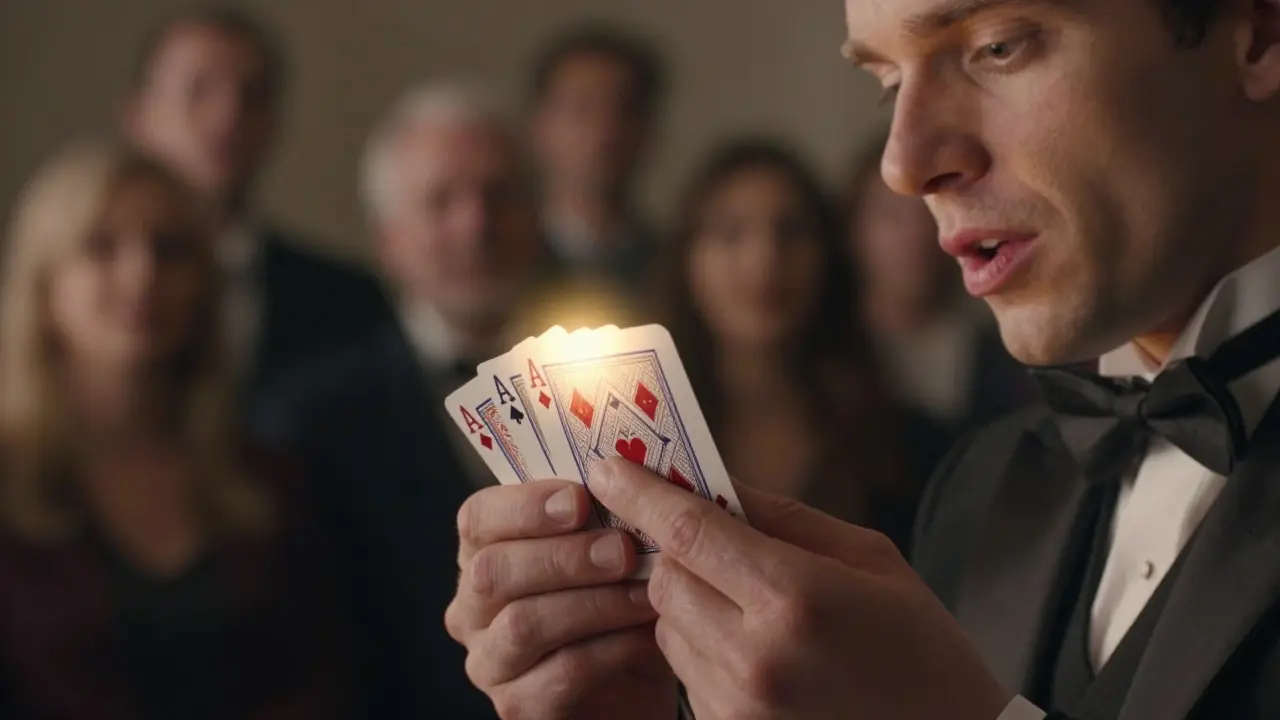
Ever watched a magician pull a rabbit out of a hat and wondered why you believed it? It’s not just the sleight of hand. It’s the words they say right before the trick begins. The right phrase doesn’t just distract-it shapes what your brain expects. And if you’re using a magic trick kit, getting those words right can mean the difference between a shrug and a gasp.
It’s Not About the Trick, It’s About the Setup
Most magic trick kits come with instructions that show you how to palm a card or misdirect with a gesture. But they rarely tell you what to say. That’s because the words are personal. They’re part of your performance, not the prop. The best magicians don’t just perform tricks-they build moments. And those moments start with a line that feels natural, not rehearsed.Think about it: if you say, "Watch closely," your audience tenses up. They’re staring at your hands, waiting for a slip. But if you say, "I’ve been practicing this for years," they relax. They assume you’ve got it figured out. That’s when the trick works.
Classic Lines That Actually Work
There are a few phrases that have stood the test of time-not because they’re magical, but because they’re psychologically smart.- "This is where it gets interesting." This phrase signals a shift. Your audience’s brain prepares for something unexpected. It’s not a command to look-it’s an invitation to wonder.
- "I don’t know how this works either." This one disarms skepticism. People trust someone who admits they don’t have all the answers. It makes the impossible feel more real.
- "Let’s see what happens." It turns your performance into an experiment. Your audience becomes a participant, not just a spectator.
- "You wouldn’t believe me if I told you." This creates curiosity. It doesn’t promise a trick-it promises a secret. That’s more powerful than any gimmick.
These aren’t magic spells. They’re conversation starters that lower mental resistance. The trick works better because your mind is already open.
Why the Wrong Words Kill the Effect
Say something like, "Here’s the secret," and you’ve already ruined it. Your audience’s brain locks onto the word "secret." They start looking for the hidden mechanism. You’ve turned magic into a puzzle.Or worse-"I’m going to make this coin disappear." Now they’re watching your hands for the drop. They’re not amazed. They’re analyzing. And if they catch even a hint of motion, the whole illusion collapses.
One performer I saw at a local fair used the phrase, "This coin has a mind of its own." The crowd laughed. Then he flipped it-and it landed on the table, face down. He didn’t touch it. No sleight. Just a coin that "chose" to flip. People clapped. Not because they saw how it was done, but because they believed the coin had agency. That’s the power of language.

Matching Your Words to Your Kit
Not all magic kits are the same. A card trick kit needs different energy than a coin vanish set or a levitation prop. Your words should match the vibe of the trick.If you’re using a classic card trick kit, lean into mystery. Try: "I picked this card because it felt right. Now I’m curious-did it pick you back?" It turns a simple force into a personal moment.
For a coin vanish, use simplicity. Say: "This coin was just sitting here. Now it’s not." Short. Clean. No fluff. The audience fills in the gap.
With a magic box or escape kit, build tension. "I’ve seen people get stuck in here for hours. I’m going to try to get out before the music stops." Now you’ve added stakes. Time becomes your accomplice.
Practice the Words Like You Practice the Move
You wouldn’t try a new palm without rehearsing it. So why treat your lines like an afterthought?Record yourself. Say your line, then watch the video. Do you sound natural? Or like you’re reading from a script? If your voice tightens, if you hesitate, if you smile too early-fix it.
Try saying your line while doing a simple task-washing dishes, walking the dog. If it feels comfortable in your mouth when you’re distracted, it’ll feel real when you’re performing.
One trick I use: say your line backward. It forces you to hear the rhythm. If it sounds clunky backward, it’ll sound clunky forward.
The Secret Ingredient: Silence
The best magic trick doesn’t always start with words. Sometimes it starts with silence.After you say your line, pause. Let it hang. Don’t rush into the move. Give your audience a second to absorb what you just said. That pause is where the illusion takes root.
Most beginners rush. They say their line, then immediately make the move. But magic lives in the gap between thought and action. That’s where belief grows.
Try this: say your line. Wait three seconds. Then do the trick. Notice how the audience leans in. That’s not your hand doing the work-that’s your silence.

What to Avoid
There are a few phrases that sound cool in movies but ruin real magic:- "Abracadabra" - It’s outdated. It makes you look like you’re pretending to be a cartoon wizard.
- "Ta-da!" - Too loud. Too obvious. It’s a cue that the trick is over, not a moment of wonder.
- "I’m going to make this disappear." - Too direct. You’re telling them what to look for.
- "This is impossible." - It invites doubt. People don’t believe you when you say something’s impossible. They wait for you to fail.
Replace these with phrases that invite curiosity, not confirmation.
Build Your Own Line
The most powerful magic words are the ones you make up. They should sound like something you’d actually say. Not a line from a book. Not a script from YouTube.Ask yourself:
- What would I say if I was genuinely surprised by this?
- What would I say to a friend who’s never seen magic before?
- What tone matches my personality-funny, serious, mysterious, calm?
Try this exercise: Take a trick from your kit. Do it once without saying anything. Then do it again, but say the first thing that comes to mind. Record it. Pick the version that feels most like you.
One performer I know says, "I think this pen’s got a crush on my ear." He does a pen vanish. The line is ridiculous. And that’s why it works. It’s unexpected. It’s him. And it makes people laugh before they even realize they’ve been fooled.
Final Thought: Magic Is a Conversation
A magic trick isn’t a solo act. It’s a dialogue between you and your audience. The words you say before the trick are the first sentence. The silence after is the second. The reaction is the reply.If you’re using a magic trick kit, you’ve got the tools. Now give them voice. Don’t just perform the move. Tell the story. Let your words do half the work. Because the real magic isn’t in the card or the coin-it’s in the moment you create before it even happens.
What’s the best phrase to say before a card trick?
The best phrase depends on your style, but a strong choice is: "I picked this card because it felt right. Now I’m curious-did it pick you back?" It turns a mechanical force into a personal moment, making the trick feel less like a trick and more like a coincidence.
Should I use "Abracadabra" in my magic routine?
Avoid it. "Abracadabra" sounds like a cartoon and pulls the audience out of the moment. Modern magic thrives on subtlety. Your words should feel real, not theatrical. A simple pause or a quiet, curious line works better than any ancient incantation.
How do I make my magic lines sound natural?
Say your line out loud while doing something else-walking, washing dishes, driving. If it feels awkward when you’re distracted, it’ll sound forced during a performance. Record yourself and listen. Pick the version that sounds like you, not a magician from a movie.
Do I need to memorize my lines exactly?
No. Memorizing word-for-word makes you sound robotic. Know the intent behind the line-whether it’s to create mystery, humor, or calm-and say it in your own words. Magic thrives on authenticity, not repetition.
Why does silence work better than talking?
Silence gives your audience space to wonder. Talking fills the gap with logic. When you say something, your brain tries to explain it. When you’re quiet, your brain fills the void with possibility. That’s where magic lives.
Jasmine Oey
January 12, 2026 AT 10:18Okay but like… have you ever actually seen someone use "I’ve been practicing this for years" and NOT sound like a middle schooler trying to impress their crush at a talent show? 😭 I mean, magic isn’t about pretending you’re a wizard-it’s about being so effortlessly cool that the audience forgets to breathe. And if you’re using a kit, you’re already halfway to cringe. Just say less. Always say less.
Marissa Martin
January 14, 2026 AT 03:25I just… I can’t believe people still think magic is about words. It’s about deception. It’s about control. And if you’re relying on a phrase to make someone believe… well, maybe you’re not ready for the stage. The real magic is in the silence between heartbeats. Not in some scripted line you found on Reddit.
James Winter
January 15, 2026 AT 09:03Canada does magic better. We don’t need fancy words. We just do it. Quiet. Smooth. No drama. You Americans overthink everything.
Aimee Quenneville
January 15, 2026 AT 21:43"This coin has a mind of its own." 😂 I love this. Also, I just said it out loud while brushing my teeth and my cat stared at me like I’d lost my soul. Which, honestly? Same energy as the trick. Magic isn’t about fooling people. It’s about making them question reality. And maybe their therapist.
Cynthia Lamont
January 16, 2026 AT 01:23First of all, you have a typo in "You wouldn’t believe me if I told you." - it’s missing a comma after "you." Second, "Abracadabra" isn’t outdated, it’s sacred. Third, you say "magic lives in the gap between thought and action" - but you wrote 2,000 words to explain it. So you’re clearly not practicing what you preach. And fourth - why is every example a card trick? What about sleight of hand with dice? Or levitation? You’re clearly just regurgitating YouTube scripts with a thesaurus.
Kirk Doherty
January 17, 2026 AT 11:43Yeah. Just say what feels right. No need to overthink it.
Dmitriy Fedoseff
January 17, 2026 AT 22:45There’s a deeper truth here - magic isn’t about illusion. It’s about shared vulnerability. When you say, "I don’t know how this works either," you’re not hiding the trick - you’re inviting the audience into your uncertainty. That’s not psychology. That’s communion. In many Indigenous traditions, the shaman doesn’t perform for the crowd - they perform with them. Your words are the bridge. The silence? That’s the sacred space. And if you treat magic like a product you’re selling… you’ve already lost.
Meghan O'Connor
January 18, 2026 AT 10:39"Let’s see what happens" - really? That’s the best you’ve got? Sounds like a child’s birthday party magician. And why are you so obsessed with "magic kits"? Real magicians don’t use kits. They train for years. This post reads like a blog written by someone who bought a trick set on Amazon last Tuesday.
Morgan ODonnell
January 19, 2026 AT 09:02I tried saying "I think this pen’s got a crush on my ear" to my little sister. She laughed so hard she spilled her juice. Then the pen disappeared. She didn’t even notice. That’s when I knew - magic doesn’t need to be serious. It just needs to be real.
Liam Hesmondhalgh
January 19, 2026 AT 21:34Who cares what you say? Just do the trick fast and walk away. No one wants to hear your life story before you make a coin vanish. Also Abracadabra is fine. Get over it.
Patrick Tiernan
January 20, 2026 AT 04:22So you spent 10 paragraphs telling people to say less… and then wrote a 2000 word essay. Classic. Also I just said "you wouldn’t believe me if I told you" while eating a burrito and my dog ran away. So… I guess it works