
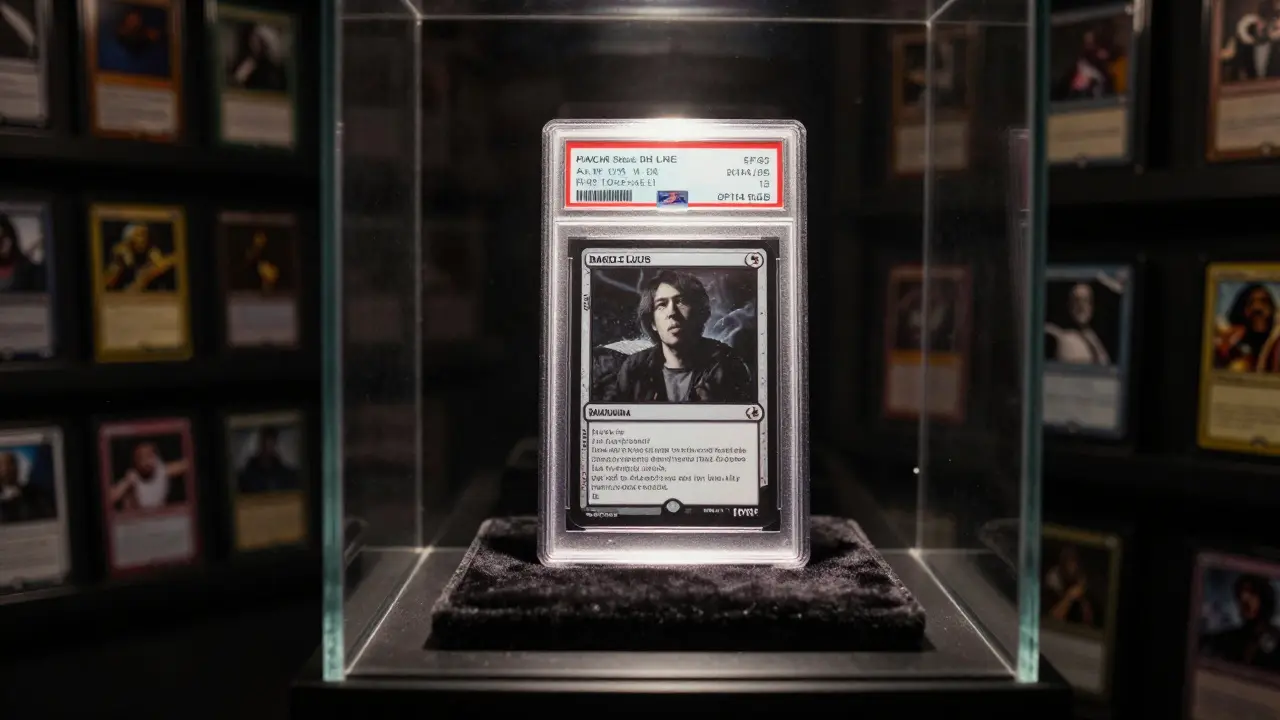
There’s a card in Magic: The Gathering that doesn’t just sit on a shelf-it sits in a vault. It’s not just rare. It’s the kind of rare that makes collectors drop everything and fly across the country just to see it in person. And if you ever see one for sale? You’re looking at a price tag that can hit $500,000. That’s not a typo. This card, the Black Lotus, is the rarest magic card ever printed.
Why the Black Lotus Is the Holy Grail
The Black Lotus was part of the very first set of Magic: The Gathering cards released in 1993, called Alpha. Only 1,100 were printed. That’s it. No reprints. No second chances. No digital versions. If you want one, you have to find one of those 1,100 cards-and most of them are in terrible shape.Why does it matter so much? Because it does something no other card can. For zero mana, you can tap it and add three mana of any color to your pool. That means you can cast a powerful spell on turn one, before your opponent even gets a chance to play a land. In competitive play, it’s like having a cheat code. That’s why it was banned in almost every tournament format back in the 90s. And that’s why it’s still the most wanted card in the game.
What Makes a Card Rare? It’s Not Just Quantity
You might think rarity just means fewer copies. But with Magic cards, it’s more complex. The Black Lotus isn’t just rare because it was printed in small numbers. It’s rare because it was printed at a time when no one knew Magic would become a global phenomenon. Back then, kids bought booster packs for $1 and tossed the cards into shoeboxes. Many Black Lotuses were lost, damaged, or thrown away. The ones that survived? They’re in perfect condition because their owners knew they had something special.There are other rare cards-like the Ancestral Recall or Mox Pearl-but none match the Black Lotus’s combination of power, history, and scarcity. Even the Timetwister, another Alpha card, doesn’t have the same impact. It’s powerful, sure. But it doesn’t let you cast a spell before your opponent even draws their first card.

The Condition That Makes It Worth a Fortune
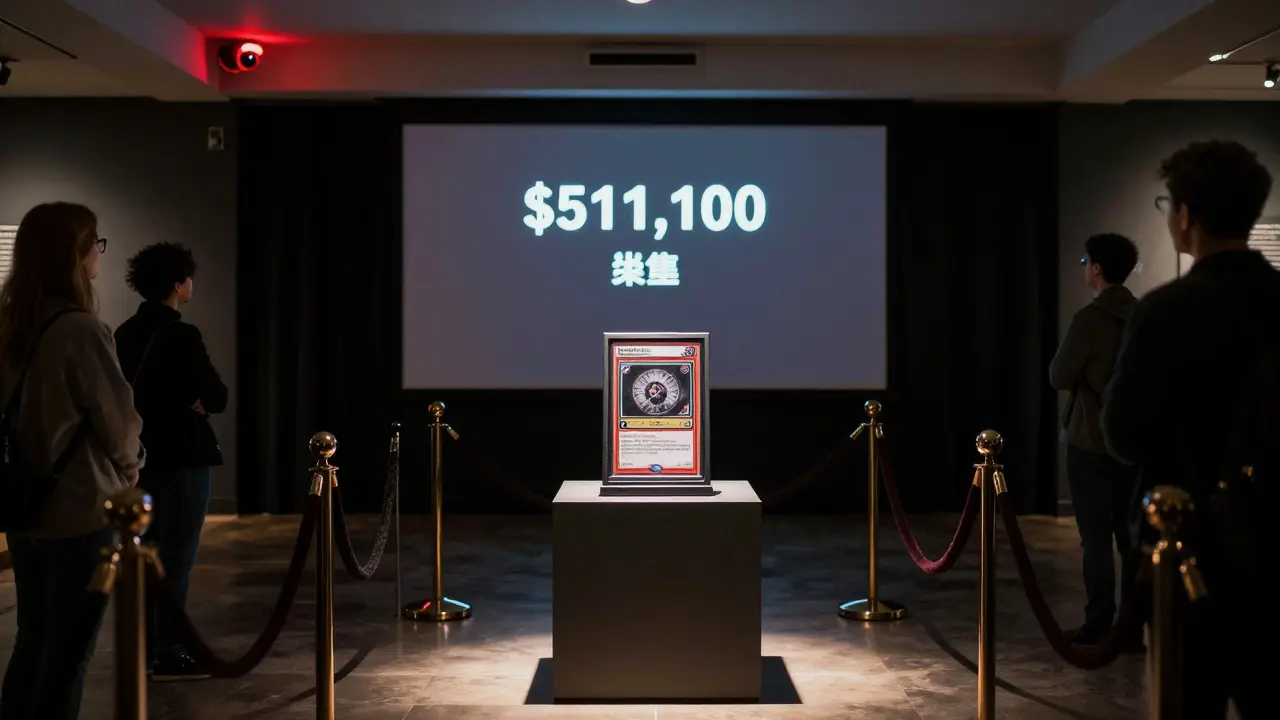
Not all Black Lotuses are equal. A card in poor condition might sell for $50,000. A card graded as Gem Mint (a 10 by Professional Sports Authenticator) can go for over $400,000. The highest price ever paid? $511,100 in 2021. That sale was documented, verified, and recorded. The card was in flawless condition, with perfect edges, no scratches, and vibrant color. It looked like it had just come out of the factory.That’s why collectors don’t just look at rarity-they look at preservation. A card that’s been handled too much, bent, or exposed to sunlight loses value fast. That’s why the best ones are sealed in hard plastic cases and stored in climate-controlled vaults. Some owners never even open the case. They treat it like a piece of fine art, not a game card.
How It Changed the Collecting World
Before the Black Lotus, trading cards were just toys. After it, they became investments. People started buying booster packs not to play, but to hunt. Dealers began grading cards with precision tools and microscopes. Auction houses like Heritage Auctions and Sotheby’s started hosting Magic card sales alongside fine art and vintage coins.It also sparked a wave of counterfeits. Fake Black Lotuses are everywhere. Some are so good they fool even experienced collectors. That’s why serious buyers only trust cards graded by PSA or Beckett. They check the hologram, the ink texture, the exact shade of black, even the microscopic wear on the corners. One tiny flaw can drop the value by 80%.
Is There Anything Close to It Today?
Wizards of the Coast, the company behind Magic: The Gathering, has printed many rare cards since 1993. The Emperor’s Crown from the 2016 Secret Lair set? Limited to 10 copies. The Power Nine cards? Only 1,100 of each. But none of them match the Black Lotus’s legacy. It’s not just a card-it’s a symbol. It’s the original. The first. The one that started it all.Even modern cards like the Time Vault or Winter Orb are powerful, but they don’t have the same mystique. The Black Lotus was printed before the internet, before online marketplaces, before anyone understood what collectibles could be worth. It was just a card in a box. And now, it’s worth more than most cars.
What You Can Do If You Can’t Afford One
If you’re dreaming of owning a Black Lotus, here’s the truth: you probably won’t. But you don’t need to. There are other ways to get involved. You can buy a reprint in the Modern Masters sets-they’re legal for casual play and cost under $50. Or you can buy a high-quality replica for display. Many collectors do. They frame them next to a photo of the original card they saw at a museum exhibit.You can also join the community. Attend local Magic tournaments. Talk to collectors. Visit card shops that have display cases with rare cards. Some even let you hold them under supervision. You don’t need to own it to appreciate it.
The Black Lotus isn’t about ownership. It’s about wonder. It’s the card that proved a little piece of paper, printed in a basement in 1993, could become more valuable than gold.
Is the Black Lotus still legal to play with in tournaments?
No. The Black Lotus has been banned in nearly all official tournament formats since the mid-1990s because it gives too big of an advantage. It’s only allowed in a few casual formats like Vintage, and even then, you’re limited to one copy per deck. Most players never see it in a real game-it’s too expensive and too powerful.
How many Black Lotus cards are left in existence?
Approximately 2,200 were printed across Alpha and Beta sets, but only about 700 to 800 are known to still exist today. Many were lost, damaged, or destroyed over the decades. Of those, only around 100 are in top condition (graded 9 or 10), making them the most valuable.
Can I buy a Black Lotus online?
Yes, but only through trusted auction houses or verified dealers. Sites like eBay or Etsy are full of fakes. Always check if the card is graded by PSA, Beckett, or CGC. Look for a certification number you can verify on the grading company’s website. If a seller won’t show you the certificate, walk away.
Why isn’t Wizards of the Coast printing more Black Lotuses?
Because they don’t need to. The Black Lotus is already legendary. Printing more would destroy its value and undermine the game’s history. Wizards has intentionally avoided reprinting any of the Power Nine cards, including Black Lotus, to preserve their status. Even special sets like Secret Lair or Modern Masters avoid them on purpose.
Are there any other cards that come close in value?
A few come close, but none surpass it. The Ancestral Recall and Mox Sapphire from the Alpha set can sell for $100,000 to $200,000 in top condition. The Time Vault and Timetwister also reach six figures. But none have the same combination of cultural impact, power level, and scarcity. The Black Lotus is the original, and it’s still the king.
Rakesh Kumar
January 6, 2026 AT 21:11This card is wild-I remember trading a whole box of boosters for a Black Lotus replica back in ‘99 and my dad thought I was insane. Turns out he was right, but also kinda wrong.
Ronnie Kaye
January 7, 2026 AT 18:38Let me get this straight-you’re telling me a piece of cardboard printed in 1993 is worth more than my entire car collection? And I thought my Xbox was a bad investment.
Michael Gradwell
January 8, 2026 AT 01:39People pay half a million for a card? I bet the guy who printed it didn’t even get a bonus. Classic capitalism. Also, if you’re rich enough to buy this, why are you still playing Magic?
Flannery Smail
January 9, 2026 AT 23:34Actually, the rarest card is the one that says ‘this card is banned’ in the rules text. Nobody ever finds that one.
Emmanuel Sadi
January 11, 2026 AT 18:23Of course it’s worth half a million-because you people are idiots. You’re paying for nostalgia, not value. If you had invested that money in Bitcoin in 2010, you’d own a small island by now. But no, you’d rather keep it in a plastic sleeve.
Ian Maggs
January 13, 2026 AT 11:01It’s fascinating, isn’t it?-how a piece of paper, imbued with cultural weight, symbolic power, and the ghost of a thousand childhoods spent shuffling decks in basements, becomes a relic of economic absurdity… and yet… still… beautiful.
Nicholas Carpenter
January 14, 2026 AT 18:28I’ve held a real Black Lotus once-at a convention, under glass, with a guard standing next to me. I didn’t touch it. I didn’t even breathe too hard. But for five seconds, I felt like I was holding history.
Tony Smith
January 16, 2026 AT 11:13While I appreciate the cultural significance of the Black Lotus, I must emphasize that its valuation is a product of market speculation, not intrinsic utility. The card’s design, though elegant, violates fundamental balance principles of collectible gaming-and its continued exclusion from competitive formats is not merely a rule, but a moral imperative for the integrity of the game.
Chuck Doland
January 17, 2026 AT 05:18It is worth noting that the Alpha printing of the Black Lotus was produced under conditions of extreme technical limitation, with inconsistent ink saturation and paper stock variation. The few surviving specimens exhibiting perfect color fidelity and edge integrity are, statistically speaking, anomalies of preservation-not design. Their value is therefore less a function of rarity, and more a testament to the extraordinary care taken by a vanishingly small subset of collectors who understood, decades before the market did, that material artifacts carry the weight of collective memory.
Bill Castanier
January 18, 2026 AT 12:20Wizards won’t reprint it because they know what happens when you turn magic into money. The game survives because it’s still a game.
Priyank Panchal
January 18, 2026 AT 22:51You people act like this card is sacred. It’s just a piece of plastic with ink. If you want to spend your life chasing ghosts, fine. But don’t pretend you’re preserving culture-you’re just hoarding.