
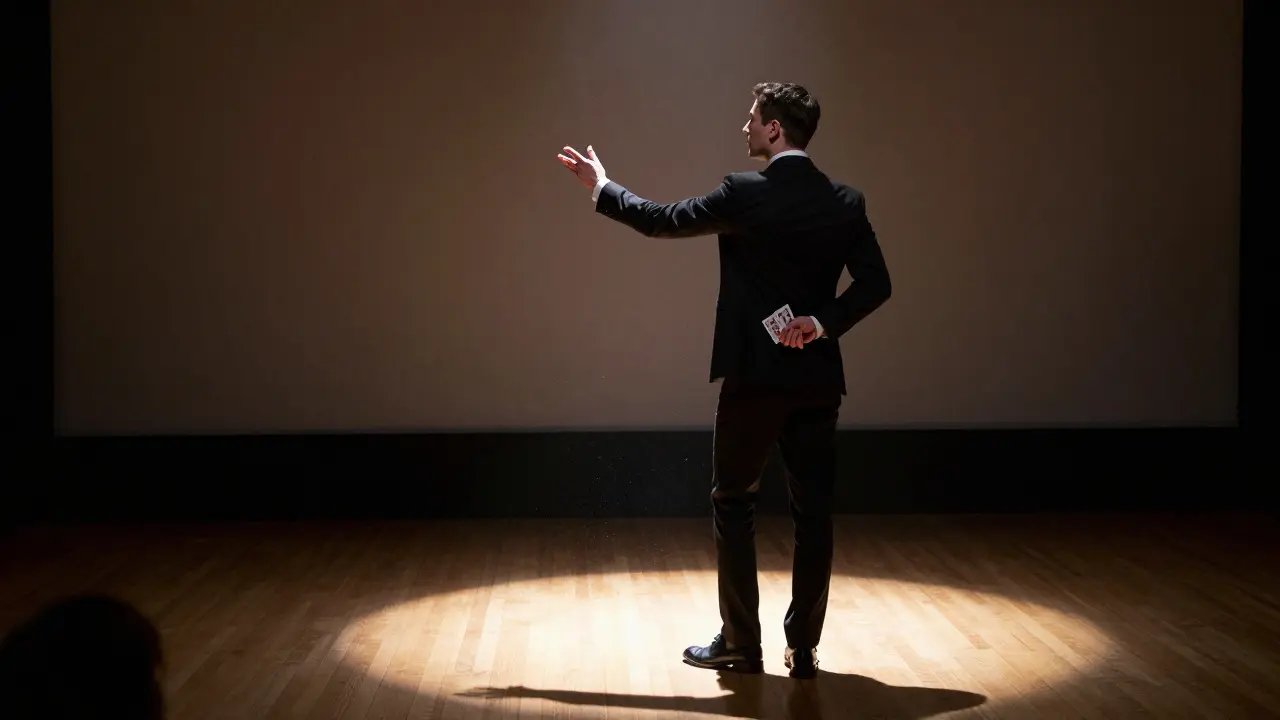
Have you ever watched a magician make a card vanish right in front of your eyes-and still couldn’t figure out how? It’s not because you weren’t looking hard enough. It’s because you were looking in the wrong place. That’s the secret behind every great magic trick: misdirection.
What Misdirection Really Is
Misdirection isn’t about hiding something behind your back. It’s about controlling where your audience’s mind goes. A magician doesn’t need to move fast or use complex gadgets. They just need to make you think about something else-anything else-while the real action happens. This isn’t magic. It’s psychology.Think about it: when someone says, "Look at my left hand," your eyes go there-even if nothing is happening. Your brain follows the cue. That’s misdirection in action. The magician isn’t fooling your eyes; they’re fooling your attention. And attention is the one thing you can’t control once it’s been guided.
Studies in cognitive psychology show that humans have limited attentional bandwidth. In one experiment at Harvard, researchers showed participants a video of people passing basketballs. Halfway through, a person in a gorilla suit walked through the scene. Surprisingly, nearly half the viewers didn’t see the gorilla because they were focused on counting passes. Magicians use this exact principle. They give you a task-watch the coin, follow the hand, count the cards-and while you’re busy doing that, the trick happens right under your nose.
How Magicians Train Their Misdirection
Good magicians don’t rely on luck. They practice misdirection like a musician practices scales. There are three core methods they use to redirect attention.- Physical Misdirection: A sudden movement, a gesture, or even a raised eyebrow. A magician might drop a coin on purpose-not to find it, but to make you look down while they palm another one.
- Verbal Misdirection: Words that seem casual but are carefully timed. "Do you see this?" or "This is where it gets interesting"-both phrases trigger a mental shift. Your brain tries to predict what comes next, and that’s the gap the trick fills.
- Temporal Misdirection: Timing matters more than motion. A magician might pause right before the move, making you expect something big. When nothing happens, your brain resets-and that’s when the real action occurs.
One of the most famous examples is the "French Drop," a classic coin vanish. The magician holds the coin between thumb and fingers, then makes a quick, exaggerated motion with the empty hand. Meanwhile, the coin stays hidden in the original hand, disguised by the natural curve of the palm. The audience doesn’t miss the coin-they never saw it leave because they were watching the other hand.
Why Misdirection Works on Everyone
It doesn’t matter if you’re a skeptic, a scientist, or a seasoned magician. Misdirection works on everyone. Why? Because our brains are wired to predict patterns. We assume cause and effect. We assume what we see is real. Magicians exploit those assumptions.When you watch a card trick, your brain says: "The card was here. Now it’s gone. It must have moved." But it never moved. It was never there to begin with. The magician created the illusion of presence, then removed the context that made you believe it was real. That’s not sleight of hand-it’s sleight of mind.
Even professional magicians who’ve seen a trick a hundred times still get fooled by a new one. Why? Because they’re still human. Their brains still follow the same rules. The only difference is they know to look for the pattern. But even then, if the pattern is well-designed, they’ll still miss it.

Real-World Examples of Misdirection
You don’t need a stage to see misdirection in action. It’s everywhere.- Con artists: A street hustler asks you to watch the three cups while he shuffles them. You focus on the cups. He’s actually slipping a wallet into your coat pocket.
- Advertising: A car commercial shows a sleek vehicle racing through mountains. The voiceover talks about "unmatched safety." You remember the mountains. You forget the safety stats.
- Politics: A politician answers a question about taxes by talking about national pride. You leave feeling good-about something that wasn’t even the topic.
These aren’t magic tricks, but they use the same tool: redirecting focus. The goal isn’t to deceive you into thinking something impossible happened. It’s to make you stop asking the right questions.
Learning Misdirection for Yourself
You don’t have to become a magician to use misdirection. You can use it to improve your communication, your presence, even your confidence.Try this exercise: Next time you’re talking to someone, say something important-like "I need to talk to you about something"-then immediately ask them a simple, unrelated question: "Did you see that bird outside?" Watch how their attention shifts. Now, say your real point. Most people won’t remember the setup. They’ll just respond to what you said last.
Or try this with a friend: Hold a pen in your hand. Say, "Watch my fingers." Then, slowly move your other hand across the table. When they’re focused on that, drop the pen into your lap. Most won’t notice. You didn’t hide it. You just made them stop looking.
These aren’t tricks to manipulate people. They’re lessons in awareness. Once you understand how attention works, you start seeing how often it’s manipulated-in ads, in conversations, in media. And that’s the real magic: seeing through the illusion.

The Ethics of Misdirection
Just because you can misdirect doesn’t mean you should. Magic is entertainment. It’s a shared game where the audience knows they’re being fooled-and they’re okay with it. They pay to be amazed.But outside the theater, misdirection becomes dangerous. When used to deceive, manipulate, or hide the truth, it’s not art. It’s exploitation. A magician’s job is to make you wonder. A con artist’s job is to make you lose.
The difference is intent. Magic invites you in. It says, "I’m going to trick you, and you’re going to love it." The rest? That’s just lying with style.
Why Misdirection Still Matters Today
In a world of endless notifications, scrolling feeds, and viral distractions, attention is the most valuable currency. Companies spend billions to capture it. Politicians spend years to control it. Social media algorithms are built on misdirection-showing you what you’re likely to react to, not what you need to see.Learning how misdirection works gives you power. Not the power to trick others-but the power to protect yourself. When you recognize when your attention is being pulled, you can choose where to focus. You can ask: "What am I not seeing?" That’s the real trick.
Next time you watch a magician, don’t try to figure out how they did it. Try to understand why you didn’t see it. That’s where the real lesson lies.
Is misdirection the same as sleight of hand?
No. Sleight of hand is about physical dexterity-moving objects quickly or secretly. Misdirection is about controlling attention. You can do a perfect sleight of hand and still fail if the audience is watching the right place. Conversely, you can do nothing with your hands and still make something disappear if you control where people look.
Can misdirection be used outside of magic?
Yes. It’s used in advertising, politics, sales, and even everyday conversations. A salesperson might emphasize a product’s color while downplaying its price. A politician might talk about patriotism to avoid answering a question about policy. Recognizing these patterns helps you see through the distraction.
Why do people enjoy being fooled by magic?
Because magic creates wonder without deception. The audience knows the magician isn’t claiming to have real powers. They’re participating in a shared experience of mystery. It’s not about believing the impossible-it’s about feeling the joy of not knowing. That’s why people laugh, clap, and come back for more.
Is misdirection a skill anyone can learn?
Absolutely. You don’t need special hands or years of training. Start by observing how people react when you change your tone, gesture, or timing. Practice directing attention in small ways-like asking a question right before making a point. Over time, you’ll notice how easily focus can be shifted.
What’s the most common mistake beginners make with misdirection?
They overdo it. Trying too hard to look mysterious or dramatic makes people suspicious. The best misdirection feels natural. It doesn’t scream "look here!"-it whispers, "what’s that?" and the audience turns on their own.
What to Watch for Next Time
The next time you see a magic show-or even a viral video of a trick-pause before you try to figure it out. Ask yourself: Where was I looking? What did they say right before it happened? What did I think was important? That’s where the real magic lives-not in the trick, but in the way your mind was led away from it.Misdirection isn’t about secrets. It’s about seeing how easily we let others guide our attention. And once you see that-you’ll never look at the world the same way again.
Peter Reynolds
January 19, 2026 AT 08:57Been thinking about this a lot lately, especially after watching that street magician in Times Square. He had this whole routine with a deck of cards and a guy in a suit who kept nodding along like he was in on it. Turns out the guy was an accomplice, but I didn't catch it until later. Guess my attention was locked on the cards.
Fred Edwords
January 19, 2026 AT 14:48Interesting, but I must point out that you've used inconsistent punctuation throughout-specifically, missing commas before coordinating conjunctions in compound sentences. Also, 'it’s the secret' should be 'it is the secret' if you're aiming for formal clarity. That said, the content is solid.
Sarah McWhirter
January 21, 2026 AT 00:00So… you're telling me the government doesn't use this exact same technique to make us think the economy is fine while they quietly sell off public assets? 🤔 I mean, look at the news-'Look at this cute puppy!' while they pass the surveillance bill. We're all just sitting there counting basketballs while the gorilla steals our rights. 😏
Ananya Sharma
January 22, 2026 AT 11:24This is such a shallow take. You reduce complex cognitive phenomena to a parlor trick and call it 'psychology'-as if the entire field of attentional neuroscience can be summarized in a YouTube video. The Harvard gorilla study? That was about inattentional blindness, not 'misdirection' as if it were some magic spell. And don't get me started on your lazy analogies to politics and advertising. Those aren't 'misdirection,' they're systemic manipulation rooted in capitalist exploitation and media control. You're not teaching awareness-you're giving people a cute buzzword to feel smart while ignoring the real structures of power. Also, your pen-dropping exercise? Pathetic. Real power isn't in dropping pens, it's in dismantling the systems that make people so easily distracted in the first place.
kelvin kind
January 22, 2026 AT 11:46Yeah, I’ve done the pen trick on my roommate. He didn’t notice. Weird.
Ian Cassidy
January 23, 2026 AT 13:08It’s all about attentional capture and cognitive load. The prefrontal cortex gets overloaded with the primary task-card counting, cup shuffling, whatever-and the dorsal stream gets hijacked by the distractor stimulus. The magician doesn’t move the object-he moves the perceptual locus. It’s neurocognitive engineering, bro.
Zach Beggs
January 24, 2026 AT 14:24That gorilla study always blows my mind. I watched it three times before I saw it. And then I couldn’t unsee it.
Kenny Stockman
January 26, 2026 AT 07:53Man, this hit different. I used to think magic was all about speed and sleight-but now I see it’s more like telling a story that makes people forget to ask questions. I’ve started using it in meetings-say something important, then pause and ask if anyone wants coffee. Works every time. Thanks for the insight!
Antonio Hunter
January 28, 2026 AT 04:39There’s something deeply human about how easily we’re led. We crave narrative, we crave patterns-even when they’re false. The magician doesn’t deceive us; he gives us a story we want to believe. And that’s why it works on scientists, skeptics, and children alike. We’re not just fooled by movement-we’re fooled by meaning. The real magic isn’t in the hand, it’s in the mind’s hunger to make sense of chaos. That’s why advertising works. That’s why conspiracy theories spread. That’s why we keep coming back to magic shows, even when we know the trick. We’re not looking for answers. We’re looking for wonder.
Paritosh Bhagat
January 29, 2026 AT 12:35Oh wow, so now we're just gonna normalize this as 'communication technique'? Like, you're literally teaching people how to manipulate others under the guise of 'awareness'? That's not awareness, that's gaslighting with a smile. And you say it's not about manipulation-but then you give examples of how to trick your friend into not noticing a dropped pen? That's not a lesson, that's a crime. I'm not saying don't learn psychology, but don't dress up deception as enlightenment. You're not a magician-you're a con artist with a blog.
Ben De Keersmaecker
January 31, 2026 AT 11:38Fun fact: the French Drop was first documented in 1876 by Jean-Eugène Robert-Houdin, but the principles trace back to ancient Egyptian conjurers. The real innovation isn’t the move-it’s the timing. Magicians don’t just misdirect-they synchronize misdirection with the audience’s natural blink cycles. Studies show the average human blinks every 3–4 seconds. The best magicians time their sleights to coincide with that rhythm. You’re not fooling attention-you’re fooling biology.
Aaron Elliott
January 31, 2026 AT 20:07While the phenomenological framework presented herein is not without merit, one must interrogate the epistemological underpinnings of the term 'misdirection' as it is deployed in this context. Is it not merely a rebranding of classical rhetorical distraction, as articulated by Aristotle in the Rhetoric? Furthermore, the conflation of psychological phenomena with performative art risks reifying a false dichotomy between 'entertainment' and 'exploitation.' The ethical distinction proposed is ontologically unstable, as intent is inherently subjective and unverifiable. One might argue that all communication is, by its nature, a form of controlled attentional allocation. Thus, the entire edifice collapses into tautology.
Chris Heffron
February 1, 2026 AT 16:02Love this!! 😊 Totally made me think about how my boss always says 'just a quick question' before dropping a whole new project on me 😅