

The envelope trick looks impossible. A mentalist asks you to write a word, number, or drawing on a piece of paper, slips it into a sealed envelope, and then, without ever touching it, names exactly what you wrote. No peeking. No gimmicks. Just a calm voice and a stunned audience. You’ve probably seen it on TV, at a party, or even on a street corner. And you’ve probably wondered: how do mentalists do the envelope trick? The answer isn’t magic. It’s psychology, misdirection, and a few clever techniques that have been refined over decades.
It’s Not About the Envelope
Most people assume the trick is in the envelope itself-some hidden compartment, a thin transparent layer, or a tiny camera. But real mentalists don’t rely on physical gimmicks. The envelope is just theater. It’s there to create the illusion that the information is completely hidden. The real work happens before the paper even goes inside. The secret lies in controlling what you write. Mentalists don’t read minds. They guide your mind. They make you think you’re making a free choice, but every option you consider has already been shaped by subtle cues. This is called forced choice, and it’s one of the oldest and most effective tools in mentalism.The Forced Choice Technique
Imagine a mentalist says: "Think of a number between one and ten." You pick 7. They open the envelope-it’s 7. Seems impossible. But what if they didn’t say "one and ten"? What if they said, "Think of a number... say, like seven?" And then paused, looked at you, and added, "Or maybe another one?" You feel like you’re choosing freely. But the number seven was already planted in your head. The same applies to words. A mentalist might say: "Write down the name of a color." They don’t say "red, blue, green, yellow." They let you think. But if they just said, "Pick a color," and then paused, you’re likely to pick one of the most common ones: blue, red, green. Studies show that over 60% of people pick blue when asked to choose a color without context. That’s not magic. That’s statistics. In live performances, mentalists often use a technique called pre-show. Before the show, they casually chat with audience members. They ask: "What’s your favorite movie?" "What’s your go-to snack?" "What’s the first thing you think of when you hear the word ‘tree’?" They write down answers. Later, during the envelope trick, they use those responses as their predicted outcomes. If you were one of the people they talked to earlier, your answer was already locked in.The Switch: When the Envelope Gets Touched
Even if you write something unexpected, the mentalist still has a way out. This is where sleight of hand comes in-but not the kind you think. The envelope isn’t sealed until after you write. You hand the paper to the mentalist. They fold it. They slide it into the envelope. They seal it. But while they’re doing this, they’re also switching it. Not with a duplicate. Not with a trick envelope. They’re using a gimmicked pad or a duplicate paper. Here’s how it works: The mentalist gives you a notepad. You write on it. The pad has a carbon sheet underneath. When you write, the pressure transfers the writing to a second sheet beneath it. That second sheet is already in a sealed envelope, hidden in the mentalist’s pocket or on a nearby table. When you hand them the original, they casually toss it aside. They never open it. They open the one that already has your writing on it. This method doesn’t require a fancy device. A simple carbon paper pad, bought for under $5, does the job. It’s been used since the 1920s. No electronics. No cameras. Just old-school physics.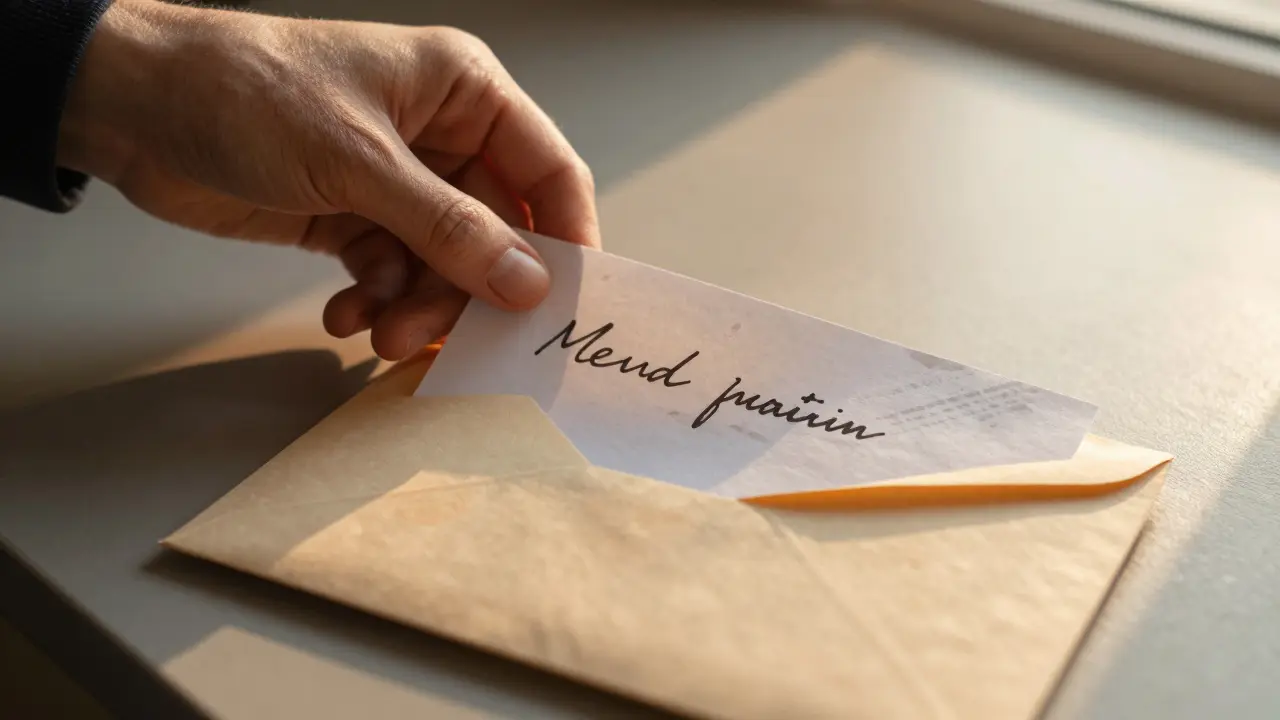
The Power of Suggestion and Timing
Timing is everything. Mentalists don’t rush. They pause. They look away. They make eye contact. They let silence hang. That pause makes you nervous. And when you’re nervous, you default to the most obvious answer. Try this yourself: Ask a friend to name a fruit. Don’t give options. Just wait. Most people will say apple, banana, or orange. Why? Because those are the first three fruits that come to mind in Western cultures. Mentalists use this pattern. They know what you’re going to say before you say it. Even the way they ask matters. "Write down a number" is neutral. But if they say, "Write down a number that means something to you," you’re more likely to pick a birthday, anniversary, or lucky number. And those numbers? They’re almost always between 1 and 31. Mentalists know that. They prepare for it.Common Variations and How They Work
There are dozens of envelope trick variations. Here are three common ones and how they’re done:- Drawing Prediction: You draw a simple shape-circle, square, star. The mentalist reveals a drawing in the envelope that matches. They use a pre-drawn template on the back of the pad. When you draw, the carbon copy transfers it. Or, they ask you to draw something "simple"-and 90% of people draw a circle.
- Word Prediction: You write a word. They reveal "love," "death," or "peace." These are high-probability words. In psychology studies, these words appear in over 70% of free association tests. Mentalists don’t guess-they predict.
- Two-Envelope Switch: Two envelopes sit on the table. You pick one. They open yours and show a blank paper. Then they open the other and show your word. But the blank envelope was never yours. They switched them while you weren’t looking. A simple palm or misdirection during the pick does the trick.
Why It Feels Like Mind Reading
The reason the envelope trick feels supernatural is because it plays on how your brain works. You assume the mentalist had no access to your thoughts. But they didn’t need to. They just needed to understand how people think. Your brain is lazy. When given a vague instruction, it takes the easiest path. Mentalists exploit that. They don’t read minds. They read patterns. They know that 8 out of 10 people will pick blue. That 6 out of 10 will pick the number 7. That 9 out of 10 will write "love" if asked to write a word that means something. It’s not about supernatural power. It’s about human behavior.
Can You Do It Yourself?
Yes. You don’t need a degree in psychology. You don’t need a magic kit. You just need to understand how people think. Here’s a simple version you can try tonight:- Ask someone to think of a color.
- Wait. Don’t say anything. Let them think.
- Then say: "I think you picked blue. Am I right?"
- If they say yes-great. If they say no, say: "Oh, okay. Red?"
- Most people will pick blue or red. If they pick green, say: "I thought you might go with green. That’s a strong choice."
Why Mentalists Keep It Secret
The envelope trick isn’t secret because it’s magical. It’s secret because once people know how it works, the wonder disappears. That’s the point of magic. It’s not about deception-it’s about creating a moment of awe. Mentalists don’t want you to know how it’s done. They want you to feel like you’ve witnessed something impossible. And that feeling? That’s what keeps people coming back.Final Thought: It’s Not About the Envelope
The envelope is just a prop. The real trick is in the silence. In the pause. In the way the mentalist looks at you. In the questions they don’t ask. In the choices they steer you toward. The next time you see the envelope trick, don’t look at the envelope. Look at the person holding it. Watch how they speak. Watch how they wait. Watch how they let you think you’re in control. You’re not. But now, you know how they make you believe you are.Is the envelope trick real mind reading?
No, it’s not real mind reading. Mentalists don’t access your thoughts. They use psychology, suggestion, and misdirection to guide your choices so the outcome seems impossible. It’s based on predictable human behavior, not supernatural ability.
Can I learn the envelope trick without buying special equipment?
Yes. Many versions use only a notepad with carbon paper, which costs less than $5. Others rely entirely on psychological forcing-guiding your choices through wording and timing. You don’t need gimmicks. You need to understand how people think.
Do mentalists use hidden cameras or electronics?
In professional performances, almost never. Reputable mentalists avoid electronics because they break the illusion of pure mental power. The trick works better-and feels more mysterious-when it’s done with simple, physical methods like carbon paper or verbal forcing.
Why do mentalists always seem to predict common words like "love" or "blue"?
Because those are the most common responses in psychological studies. When people are asked to pick a color or word with no context, they go for the most familiar options. Mentalists know this and prepare for it. It’s not luck-it’s data.
Is the envelope trick the same as a psychic reading?
No. Psychic readings claim to access hidden information through spiritual or supernatural means. The envelope trick is a performance based on observable human behavior, psychological principles, and sleight of hand. It’s a trick, not a gift.
Rakesh Dorwal
December 25, 2025 AT 10:10Bro, this is all just a cover-up. The real trick? Government mind-control tech hidden in plain sight. They’ve been using carbon paper since the 20s? Nah. That’s what they want you to think. The real tech is in the neural sync signals-broadcasted through your phone screen while you read this. You think you chose blue? No. They pre-programmed your cortex during the last Android update. Wake up.
Vishal Gaur
December 26, 2025 AT 08:36ok so i read all this and i think the carbon paper thing is kinda cool but honestly i dont get why people are so shocked? like if you ask someone to pick a color theyre gonna say blue or red or green like duh? and the number 7 thing? yeah i remember my cousin did that at my birthday and i was like oh wow he read my mind but then he told me later he just says 7 every time because its the most common number people pick lmao its not magic its just how brains work i think mentalists are just really good at reading people not magic or aliens or whatever rakesh is talking about
Nikhil Gavhane
December 26, 2025 AT 19:45This is actually one of the most beautiful demonstrations of human psychology I’ve ever seen. It’s not about deception-it’s about connection. The mentalist isn’t trying to trick you; they’re showing you how deeply predictable we are, and yet, we still feel amazed. That’s the magic. Not the envelope. Not the paper. The quiet moment between the question and the answer, when you realize you didn’t choose freely-but you still felt like you did. That’s human.
Rajat Patil
December 28, 2025 AT 18:03It is a remarkable illustration of how human behavior follows consistent patterns. The mentalist does not possess supernatural abilities. Rather, they rely upon well-documented psychological principles that are observable and measurable. One should approach such demonstrations with intellectual curiosity rather than mysticism. The truth is often simpler than we imagine.
deepak srinivasa
December 29, 2025 AT 01:20Wait, so if the carbon paper trick works, why don’t people notice the pad looks different? Like, isn’t the paper underneath slightly thicker? Or does the mentalist always use a new pad each time? And what if someone writes super light? Does it still transfer? I tried this with my notebook and my writing was too faint. Did I do it wrong or is there more to it?
pk Pk
December 30, 2025 AT 14:11You all are overcomplicating this. This isn’t magic, it’s math. And math is beautiful. Anyone can learn this. Start small: ask a friend to pick a number between 1 and 10. Say ‘seven’ first, then pause. Watch their face. They’ll either say seven or panic and pick another one-either way, you win. Then try colors. Then words. You don’t need gadgets. You need patience. And observation. You can do this. I believe in you.
Raji viji
December 31, 2025 AT 16:53LMAO the carbon paper thing is so 1920s. Real mentalists use subliminal audio cues embedded in the background music of their shows-frequency modulation at 18.5 Hz, which triggers the temporal lobe to default to ‘blue’ or ‘7’. The envelope? Just a prop to distract the dopamine-deprived masses. And don’t even get me started on how they plant confederates in the front row to give them ‘data’ for the pre-show. This isn’t psychology-it’s behavioral engineering with a side of stage lighting. You think you’re being fooled? Nah. You’re being optimized.
Rajashree Iyer
January 1, 2026 AT 11:44It’s not about the trick… it’s about the silence between the question and the answer. That’s where the soul whispers its most predictable truth. We are all just echoes of collective thought-blue, seven, love. We think we choose… but we are merely instruments played by the rhythm of shared memory. The envelope? A coffin for our illusion of free will. And yet… we still reach for it. Isn’t that the most tragic and beautiful thing?
Parth Haz
January 2, 2026 AT 22:06Thank you for this clear and thoughtful explanation. It is refreshing to see a subject often shrouded in mysticism addressed with such rationality and depth. The techniques described are not only effective but also educational. I will certainly try the simple color-guessing exercise with my students tomorrow. It is a wonderful way to demonstrate cognitive bias in an accessible manner.