

Most people say they want to read more. But when they open a book, their mind drifts to their phone, their to-do list, or that show they haven’t finished. It’s not that they’re lazy. It’s that reading isn’t trained like a muscle-it’s treated like a chore. The truth? Being a reader isn’t something you’re born with. It’s something you build, day by day, like learning to ride a bike or cook a meal. And like any skill, it starts with small, repeatable actions.
Start with five minutes a day
You don’t need to read for an hour. You don’t need to finish a book a week. You just need to sit with a book for five minutes. That’s it. Set a timer. Sit in the same spot-your favorite chair, the kitchen counter, your bed before lights out. Open the book. Read one paragraph. Then stop. No guilt. No pressure. No checklist.Why five minutes? Because your brain resists big changes. It sees "read a book" and thinks, "That’s too much." But "read for five minutes"? That feels harmless. And once you start, you’ll often keep going. You’ll turn the page. Then another. Before you know it, you’ve read 20 minutes. That’s not luck. That’s momentum.
Try this: Pick one time of day that’s already fixed-right after brushing your teeth, during your coffee break, or while waiting for your kid’s soccer practice. Attach reading to that moment. Don’t wait for "free time." Free time doesn’t exist. You create it by stacking habits.
Choose books you actually want to read
Too many people think they should read "important" books. Classics. Philosophy. Self-help that sounds like a lecture. But if you’re forcing yourself through a book you hate, you’re not training yourself to read-you’re training yourself to avoid reading.Start with what pulls you in. Mystery novels. Graphic novels. Memoirs of athletes. Books about space, cooking, or how your favorite band got started. If you’re curious about something, that’s your book. You don’t need permission to read what you enjoy.
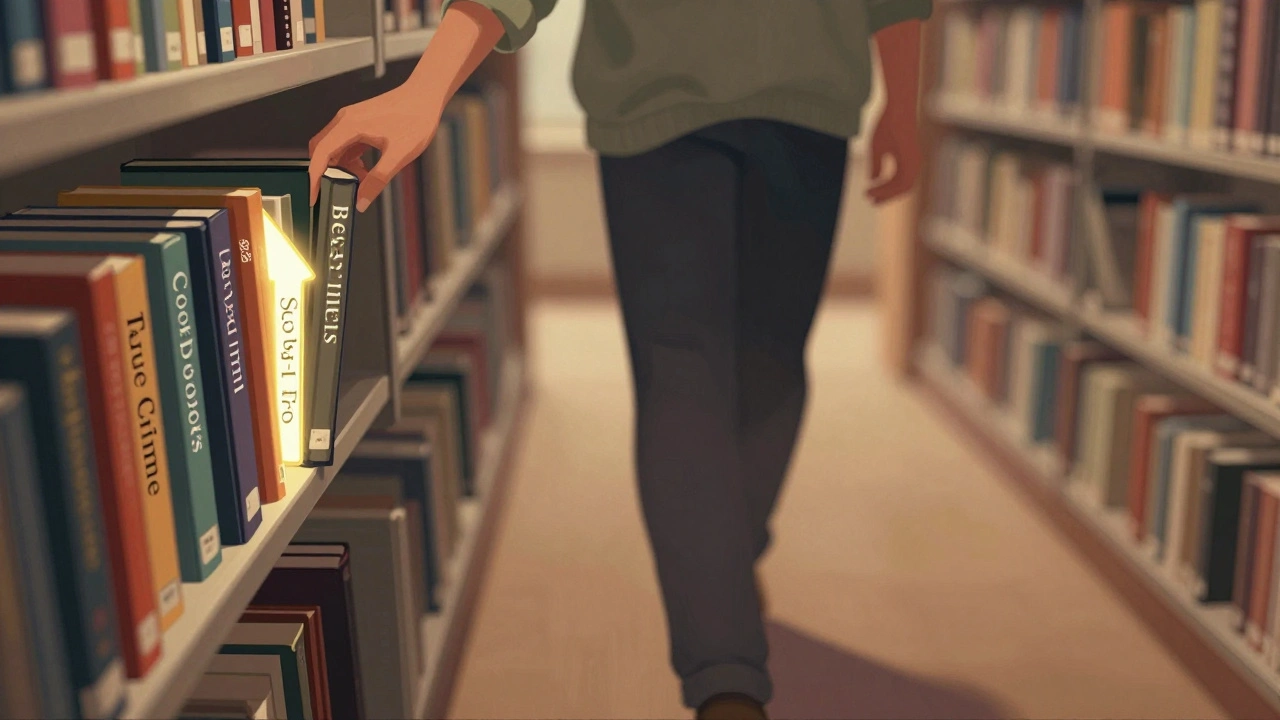
Go to a library or bookstore. Don’t look at the "Bestsellers" shelf. Walk past it. Look at the shelves labeled "True Crime," "Sci-Fi," "Cookbooks," or "Poetry." Pick up a book. Read the first page. If your eyes don’t glaze over, take it home. If you don’t like it after 30 pages, put it down. No shame. That’s not failure. That’s data. You just learned what doesn’t work for you.
There’s no hierarchy in reading. A comic book about a detective can teach you more about pacing and emotion than a dense academic text you dread. Your brain doesn’t care about prestige. It cares about engagement.
Make reading visible
Out of sight, out of mind. If your books are buried in a box, on a high shelf, or tucked away in a closet, your brain won’t remember they exist. Make reading easy to see and easy to reach.Keep one book on your nightstand. One on your coffee table. One in your bag. If you have a Kindle, set it to show your current book as the home screen. Put a bookmark in it so you don’t have to hunt for your place. When you see the book, your brain starts to associate it with relaxation, curiosity, or escape-not obligation.
People who read regularly don’t have more discipline. They just make reading the path of least resistance. You don’t need to be motivated. You just need to make it obvious.
Track your progress, not your pages
Don’t count how many pages you read. Don’t track how many books you finish. That’s how you burn out.Instead, track consistency. Use a simple calendar. Put a big red X on each day you read-even if it was just five minutes. After a week, you’ll have seven X’s. After a month, you’ll have 30. That’s not just progress. That’s proof you’re building a habit.
Studies show that people who mark their progress on a calendar are more likely to stick with a habit for over two years. Why? Because each X is a win. It’s not about the content. It’s about showing up. Your brain starts to crave that streak. You don’t want to break it.
Read with your eyes, not your phone
The biggest enemy of reading isn’t boredom. It’s distraction. Your phone is designed to steal your attention. Every notification, every scroll, every alert rewires your brain to crave quick hits of stimulation.When you sit down to read, put your phone in another room. Or at least turn on Do Not Disturb and flip it face down. If you’re using an e-reader, turn off Wi-Fi. If you’re reading a physical book, leave your phone charging in the kitchen.
Give yourself five minutes of uninterrupted focus. No multitasking. No checking messages. Just you and the words. That’s the training. Your brain learns that reading isn’t something you do while doing something else. It’s something you do alone-with your full attention.
Let yourself reread
There’s no rule that says you have to read a book once and move on. In fact, rereading is one of the most powerful habits a reader can develop.Think about music. You don’t listen to your favorite song once and then never play it again. You come back to it. Books are the same. A sentence you skimmed the first time might hit you differently the second time. A character you didn’t understand might suddenly make sense. You’re not wasting time. You’re deepening your connection to the story.
Keep a small shelf of books you’ve read and loved. When you’re feeling stuck or tired, pick one up. Revisit a chapter. You’ll be surprised how much you remember-and how much more you notice.

Read out loud sometimes
Reading silently is fine. But every once in a while, read out loud. Even if you’re alone. Even if it feels silly.When you speak the words, your brain engages differently. You hear the rhythm. You feel the pacing. You notice the author’s voice. It turns reading from a passive act into a performance. It makes the story come alive.
This is especially helpful with poetry, short stories, or books with rich dialogue. Try reading a page aloud before bed. You’ll remember it better. And you might find yourself smiling at a line you missed the first time.
Don’t wait for inspiration
You don’t need to feel like reading. You don’t need to be in the mood. That’s the myth. People who read regularly don’t wait for inspiration. They show up even when they’re tired, distracted, or busy.Reading isn’t about feeling inspired. It’s about building a relationship with your own mind. The more you do it, the more your brain starts to crave it. You’ll find yourself looking forward to your five minutes. You’ll notice quiet moments in your day where you used to reach for your phone-and now you reach for a book.
This isn’t about becoming a scholar. It’s about becoming someone who can sit with their thoughts. Who can slow down. Who can get lost in another world without needing to check in.
What happens when you stick with it
After a few months, you’ll notice things you didn’t expect. You’ll find yourself thinking about a character’s choice while making coffee. You’ll catch yourself using a phrase from a book in conversation. You’ll feel calmer after reading, even if it was just ten minutes.You’ll start to notice patterns. How authors build tension. How sentences flow. How silence can be more powerful than dialogue. You won’t be reading to impress anyone. You’ll be reading because it’s become part of how you think.
And that’s the real win. You’re not just reading books. You’re building a quieter, sharper, more curious version of yourself.
What if I don’t like any books?
You haven’t found the right ones yet. Try genres you never considered-cookbooks, travel journals, biographies of artists, or even graphic novels about science. Read the first page of five different books. If none grab you, try audiobooks while walking or doing chores. Sometimes hearing a story works better than seeing it.
How long does it take to become a reader?
It takes about 21 days to form a habit, but becoming a reader isn’t about speed. It’s about consistency. If you read five minutes a day for 30 days, you’ve already built a foundation. After three months, reading will feel natural. After a year, you’ll wonder how you ever lived without it.
Should I read fiction or nonfiction first?
Start with whatever feels easier. Fiction pulls you in emotionally. Nonfiction gives you facts and ideas. If you’re drawn to stories, pick a novel. If you’re curious about how things work, try a book about cooking, history, or animals. There’s no right answer-only what works for you.
I keep starting books but never finish them. Is that okay?
Yes. Finishing every book isn’t the goal. The goal is to keep reading. Many great readers have dozens of half-finished books. What matters is that you’re still opening them. If a book isn’t working, put it down. Try another. You’re not failing-you’re exploring.
Can I read on my phone or tablet?
Yes, but be careful. Phones are full of distractions. If you use an e-reader like Kindle or Kobo with no internet, it’s fine. If you’re reading on your phone, turn off notifications, use a reading app that blocks ads, and avoid switching to other apps. The device doesn’t matter-your focus does.
Patrick Tiernan
December 13, 2025 AT 06:20five minutes my ass i tried that and ended up reading for two hours straight like a weirdo
Amy P
December 13, 2025 AT 16:23OMG YES THIS. I used to think I was bad at reading until I stopped forcing myself through classics and picked up a graphic novel about quantum physics. Now I read every night before bed. My brain feels like it finally got a massage.
Ashley Kuehnel
December 14, 2025 AT 07:31just started doing the five minute thing last week and i already caught myself picking up my book instead of scrolling during my coffee break. it’s wild how small habits change everything. also, try reading out loud sometimes - it makes the words feel alive. i did it with a poetry book and cried in my kitchen. no regrets.
Colby Havard
December 15, 2025 AT 20:00While the author’s assertions regarding the cultivation of reading as a habit are not without merit, one must acknowledge the underlying epistemological assumption that all cognitive engagement must be quantified and systematized. The notion that ‘momentum’ emerges from arbitrary five-minute intervals reflects a deeply instrumentalist view of human consciousness, one that reduces aesthetic experience to behavioral conditioning. Is reading truly a ‘skill’ to be trained, or might it be, rather, a form of contemplative surrender?
Liam Hesmondhalgh
December 16, 2025 AT 14:59lmao this whole post is just a marketing pamphlet for kindle. read five minutes? sure. then they sell you a $100 device and 3000 books you never finish. i read on my phone and i’m fine thanks.
Zelda Breach
December 16, 2025 AT 23:13Oh please. You’re telling people to ‘make reading visible’ like it’s some kind of wellness trend. Meanwhile, the same people who read ‘five minutes a day’ are the ones who post ‘book haul’ selfies on Instagram. Reading isn’t a virtue signal. It’s a quiet rebellion against the algorithm. And no, I don’t care if you read comics.
Patrick Bass
December 17, 2025 AT 13:08the part about rereading hit me hard. i went back to a book i read in college last month and realized i’d missed half the meaning because i was rushing. now i keep a little shelf of favorites. it’s not about how many you finish, it’s about how many you return to.
Aryan Gupta
December 18, 2025 AT 12:19you know what they don’t tell you? the government doesn’t want you to read deeply. it keeps you distracted. that’s why they push audiobooks and short-form content. five minutes? that’s the exact amount they want you to spend before you go back to your phone. wake up.
adam smith
December 20, 2025 AT 01:09Reading is a disciplined activity. One must approach it with structure. I adhere to a daily regimen of 45 minutes, beginning at precisely 06:30, with no distractions, in a temperature-controlled room, with a single candle lit. Five minutes is not discipline. It is indulgence.
Mongezi Mkhwanazi
December 21, 2025 AT 09:49Let me tell you something. People say ‘read five minutes’ like it’s magic. But have you ever considered that maybe your brain is telling you something? Maybe you don’t actually enjoy reading. Maybe you’re just trying to fit into some cultural expectation that’s been sold to you by publishers and influencers. I used to force myself to read. Now I don’t. I listen to podcasts. I watch documentaries. I live. And I’m happier.
Alan Crierie
December 22, 2025 AT 17:36reading out loud changed everything for me. i do it with my kid before bed - even if it’s just a page. she starts quoting lines back to me. we’ve built a little ritual. it’s not about being ‘productive.’ it’s about connection. 📖❤️
Fredda Freyer
December 23, 2025 AT 01:10the real shift isn’t in the minutes, it’s in the permission. permission to not finish. permission to hate a book. permission to read only what feels like a secret whisper between you and the page. the moment you stop treating reading as a task, it becomes a sanctuary. and sanctuaries don’t need to be measured.
Kelley Nelson
December 23, 2025 AT 15:38It is deeply concerning that this article normalizes the commodification of literary engagement. The suggestion to ‘track progress’ with red X’s is a regressive, behaviorist tactic reminiscent of corporate productivity metrics. True intellectual cultivation cannot be reduced to calendrical reinforcement.
Gareth Hobbs
December 24, 2025 AT 22:13you lot in the US think reading is some kind of therapy. over here in the UK we just read because it’s what we do. no rituals, no apps, no red X’s. we just… read. you’ve turned a simple act into a cult. pathetic.
Tyler Springall
December 26, 2025 AT 13:09It’s not about five minutes. It’s about the existential void you’re trying to fill. You don’t read to ‘build a habit.’ You read because you’re terrified of being alone with your thoughts. And no amount of bookmarks or X’s will change that.