
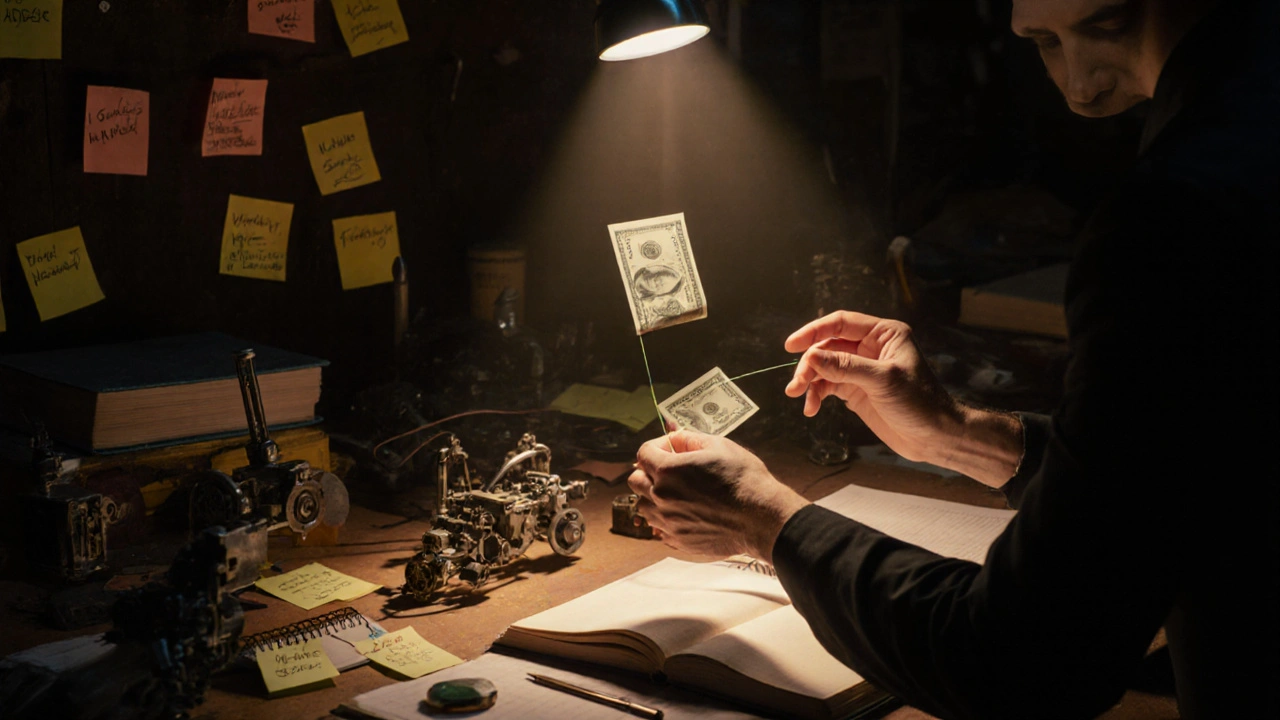
Ever wonder how a magician pulls a rabbit out of an empty hat-or makes a car vanish on stage? It’s not luck. It’s not magic. It’s years of careful design, brutal testing, and a deep understanding of how your brain works. Most people think magic tricks are bought from catalogs or copied from YouTube videos. The truth? The best magicians build their own tricks from scratch, and they do it in ways you’d never guess.
The Real Starting Point: A Problem, Not a Trick
Professional magicians don’t start with "I want a card to fly." They start with a feeling they want to create. Maybe it’s the shock of seeing something impossible happen right in front of your eyes. Or the quiet awe when someone realizes they were fooled without even knowing it. That feeling is the goal. Everything else is just the path.Take David Copperfield’s famous "Fly" illusion. He didn’t wake up one day and say, "I’ll make people fly." He asked: "What if someone could defy gravity in a way that feels personal, not just big?" That question led to years of engineering, hidden supports, lighting tricks, and audience positioning. The trick wasn’t the flying-it was the moment you forgot you were watching a performance and started believing you were seeing a real person break the laws of physics.
Stealing Isn’t Creating-But Borrowing Is
New magicians often copy moves from DVDs or TikTok. Seasoned ones? They steal ideas-but not the trick itself. They steal the principle.For example, the "Ambitious Card" trick-where a selected card keeps returning to the top of the deck-has been around since the 1800s. But modern magicians don’t just use the classic method. They combine it with misdirection from mentalism, timing from comedy, and presentation from theater. One magician I know turned it into a story about a lost love letter, using the card’s journey to mirror emotional recovery. The trick stayed the same. The meaning changed completely.
This is how magic evolves. You don’t need to invent a new sleight. You need to find a new reason for it to matter.
The Hidden Lab: Testing on Real People
Most tricks fail before they ever reach an audience. Why? Because the magician tested them on friends who already know the secret.Real magicians test their tricks on strangers-people who’ve never seen magic before. They set up impromptu shows in coffee shops, libraries, or even grocery store lines. They watch for three things:
- Where did people look? (Did they miss the move or catch it?)
- Did they laugh, gasp, or just shrug?
- Did they try to figure it out right away-or did they sit with the wonder for a while?
One magician in Portland spent six months testing a coin vanish on over 200 people. He changed the angle, the speed, even the type of coin. He tried it with gloves. Without gloves. With a flick. With a drop. Only when 87% of people had no idea how it happened did he consider it ready.

Engineering the Impossible
Large-scale illusions aren’t magic-they’re engineering. Think of the "Sawing a Woman in Half" trick. It doesn’t work because of quick hands. It works because of hidden compartments, mirrored panels, and precise timing. The magician’s assistant isn’t just lying there-she’s contorting her body in a way that fits the box, breathing through a hidden tube, and moving only when the audience’s eyes are distracted.Modern magicians use 3D modeling software to test stage layouts. They simulate lighting conditions. They test sound cues. One illusionist in Chicago used a drone to map audience sightlines before building a new levitation trick. He found that people in the third row couldn’t see the hidden wires-so he adjusted the angle of the platform. That one change turned a "meh" reaction into standing ovations.
The Psychology of Misdirection
Magic isn’t about hiding the move. It’s about making people look elsewhere-on purpose.Neuroscientists have studied this. When a magician says "Look at my left hand," your brain automatically shifts focus-even if your eyes don’t move. That’s called inattentional blindness. Magicians use this like a weapon. They don’t just wave a hand. They tell a joke, make eye contact, pause just a beat too long. They use silence as a tool.
One veteran magician told me he once made a watch disappear by asking the audience, "Who here has ever been late to work?" The room laughed. Everyone thought about their own life. And in that split second-the watch vanished. No sleight. No distraction. Just a well-timed question that rewired attention.

Why Most Tricks Die Before They’re Born
Over 90% of original tricks never see the light of day. Why? Because they’re too complicated. Too slow. Too obvious. Too boring.The best magic is simple. It looks like it shouldn’t work. But it does. And it leaves you wondering how.
Take the "Floating Bill" trick. A dollar bill floats in midair, slowly turning. It’s been done a thousand times. But one magician made it unforgettable by using a single strand of fishing line-so thin it was invisible under stage lights-and pairing it with a story about a lost inheritance. The bill wasn’t magic. The emotion was. The audience didn’t care how it worked. They cared that it felt real.
Complexity kills magic. Clarity creates it.
The Long Game: Building a Signature Style
The greatest magicians aren’t the ones with the flashiest tricks. They’re the ones with the most consistent voice.Harry Houdini didn’t just escape chains-he told stories about freedom and oppression. David Blaine made people feel like they were watching a man survive the impossible, not just perform a stunt. Penn & Teller? They don’t hide the method-they show it, then make you feel stupid for not seeing it sooner.
Developing your own style means asking: What do I believe about magic? Is it about wonder? Is it about exposing lies? Is it about making people feel small-or powerful?
Your answers shape every move, every word, every pause. That’s what turns a trick into a signature.
Final Thought: Magic Is a Craft, Not a Gift
You don’t need to be born with "magic hands." You need patience. You need to fail. You need to test on strangers. You need to care more about the feeling than the method.The secrets aren’t hidden in locked drawers. They’re in the notebooks of magicians who’ve spent 10,000 hours trying to make one moment feel impossible. And if you’re willing to do the same? You don’t need to be a professional to create something that leaves people speechless.
Can anyone learn to create magic tricks, or do you need natural talent?
Anyone can learn. Natural talent helps with dexterity, but the real skill is in understanding psychology, timing, and storytelling. Most professional magicians started with zero coordination. What they had was persistence. They tested, failed, adjusted, and repeated-over and over. Magic is a craft, not a gift.
How long does it take to develop a good magic trick?
It varies. A simple card trick might take weeks. A full stage illusion can take years. The average time for a trick to go from idea to performance is about 8 to 18 months. That includes testing on 50+ people, refining the presentation, and fixing every point where the audience gets confused or bored.
Do magicians ever reveal how their tricks work?
Most don’t-out of respect for the craft and their peers. But some, like Penn & Teller, reveal methods on stage to show how easily we’re fooled. The goal isn’t to teach the trick-it’s to teach the mind. Once you understand how you were tricked, you see the world differently. That’s the real magic.
What’s the most common mistake beginners make when creating tricks?
They focus too much on the method and not enough on the story. A trick with a perfect sleight but no emotional hook will be forgotten in seconds. The best tricks make you feel something-awe, curiosity, even fear. The method is just the vehicle. The feeling is the destination.
Is it better to invent your own tricks or use existing ones?
Use existing tricks to learn. But if you want to stand out, you need to create your own. The magic industry is flooded with copycat routines. The ones that last are the ones with a unique voice. Even if your trick uses a classic principle, your presentation, your pacing, your story-it’s yours. That’s what makes it powerful.
Soham Dhruv
November 29, 2025 AT 03:14Bob Buthune
November 30, 2025 AT 06:10Jane San Miguel
December 1, 2025 AT 22:21Kasey Drymalla
December 3, 2025 AT 10:49Dave Sumner Smith
December 5, 2025 AT 08:02Cait Sporleder
December 6, 2025 AT 19:55Paul Timms
December 7, 2025 AT 23:31Jeroen Post
December 8, 2025 AT 10:47Nathaniel Petrovick
December 9, 2025 AT 16:10Honey Jonson
December 11, 2025 AT 05:34Sally McElroy
December 13, 2025 AT 00:25Destiny Brumbaugh
December 13, 2025 AT 01:37Sara Escanciano
December 14, 2025 AT 05:01