

Have you ever watched someone pull a coin from your ear and felt your brain short-circuit? Not because you thought it was real-but because for a moment, you wanted it to be. That’s the quiet power of magic tricks. They don’t just fool your eyes. They reset your expectations. They turn a plain card, a glass of water, or your own wallet into something mysterious-and that shift changes how you see the world.
Why Magic Works When Nothing Else Does
Most people think magic is about speed. That you need fast hands, hidden compartments, or high-tech gadgets. But the real trick? It’s not in the method. It’s in the misdirection. Your brain is wired to predict what comes next. Magic exploits that. A magician doesn’t hide the coin-they make you look at the other hand. They don’t trick your eyes; they trick your attention. A 2021 study from the University of Durham tracked eye movements during card tricks. Participants stared right at the secret move-but still missed it. Why? Because their brain had already decided what it was going to see. Magic doesn’t rely on deception. It relies on belief. And that’s why it sticks with you long after the trick ends.From Pocket Change to Performance
You don’t need a stage to do magic. Some of the most powerful tricks happen in kitchens, on buses, or at dinner tables. Take the classic coin vanish. You hold a quarter between your thumb and index finger. You close your hand. You open it-and it’s gone. The secret? A simple palm. But the effect? You just made something disappear in front of someone’s face. And suddenly, that quarter isn’t just money anymore. It’s a tiny miracle. That’s the magic of ordinary objects. A pen becomes a wand. A napkin turns into a veil. A coffee cup becomes a portal. Magic doesn’t require expensive props. It requires presence. It asks you to slow down, to focus, to let wonder creep in.The Psychology Behind the Wow
Magic isn’t just entertainment. It’s applied psychology. Every trick is a controlled experiment in perception. The magician sets up a false assumption-like ‘the card is still in the deck’-and then breaks it. Your brain scrambles to fix the contradiction. That’s when the ‘wow’ moment hits. Not because you’re fooled. But because you’re curious. That’s why children react so strongly to magic. They haven’t learned to dismiss the impossible yet. Adults? We’ve been trained to explain everything. Magic undoes that. It gives us permission to feel amazed again. And that’s rare. In a world of algorithms, filters, and instant answers, magic reminds us that not everything needs to be understood to be beautiful.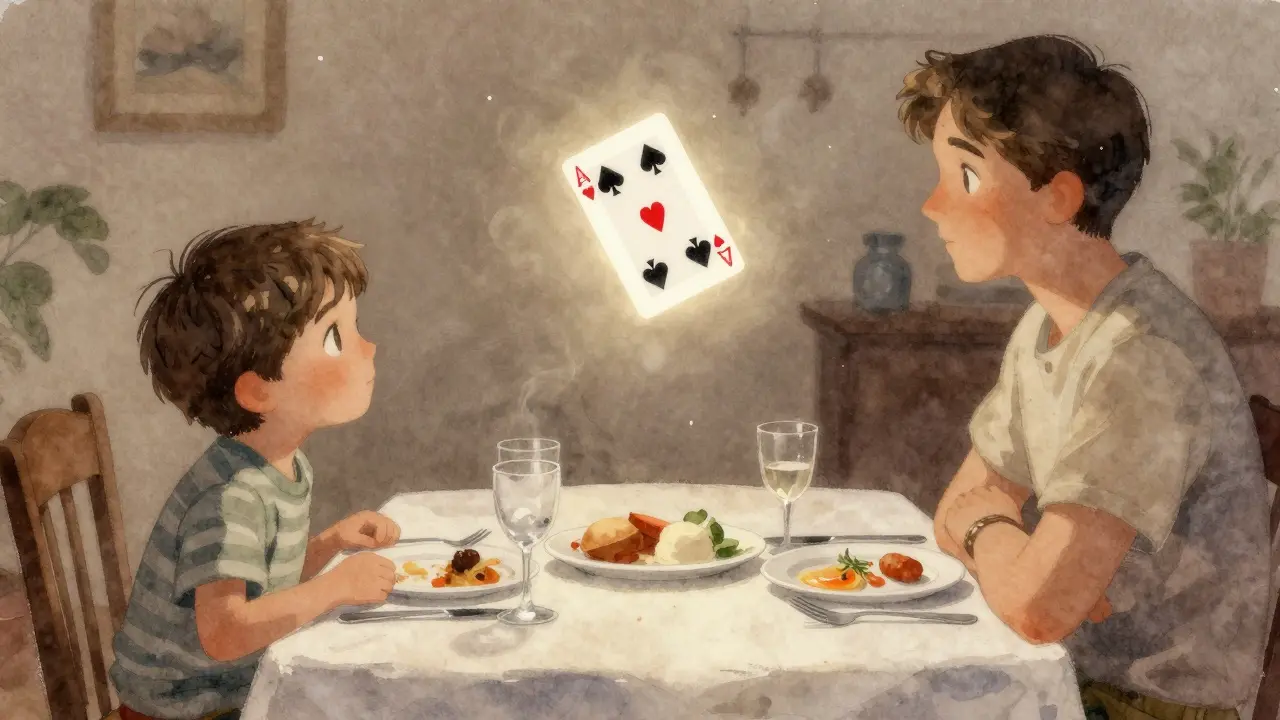
How to Start Doing Magic-Without a Kit
You don’t need to buy a $200 magic set to begin. Start with what’s already in your pocket.- Grab a coin. Practice palming it in your hand. No one will notice if you do it slowly, naturally. Practice while walking, while talking on the phone, while waiting for the microwave.
- Try the ‘disappearing match’ trick. Light a match. Hold it between two fingers. Blow it out-but keep your fingers closed. When you open them, the match is gone. It’s gone because you dropped it into your palm. No smoke. No mirrors. Just timing.
- Use a playing card. Shuffle a deck. Ask someone to pick one. Don’t look. Then, without touching the deck, name it. The secret? You peeked as you shuffled. But the trick isn’t the peek. It’s the pause before you speak. Let them sit with the mystery.
Why People Remember Magic More Than Money
Think about the last time you got a gift. Was it a phone? A watch? A gift card? Now think about the last time you saw a magic trick. Can you still feel the surprise? The laughter? The way your friend leaned forward, eyes wide? Magic creates memories because it’s emotional. It’s not about the object-it’s about the feeling. A $500 watch tells people you’re successful. A coin that vanishes tells them you’re someone who makes the ordinary feel sacred. In a 2023 survey of 1,200 people across the U.S., 78% said they remembered a magic trick they saw as a child more clearly than a birthday party they attended. Why? Because magic doesn’t fade. It lingers. It becomes a story you tell. And stories are how we connect.
What Magic Teaches Us About Life
Magic isn’t just about tricks. It’s a mirror. It shows us how easily we accept what we’re told. How fast we jump to conclusions. How much we miss when we’re not paying attention. Think about your daily routine. You check your phone first thing in the morning. You scroll. You react. You assume. You don’t question. That’s not magic-it’s autopilot. And magic reminds you: you don’t have to live that way. When you learn a magic trick, you’re not learning how to move your hands. You’re learning how to watch. How to pause. How to wonder. You’re learning to see the world like a child again-before it got labeled, categorized, and explained away.The Quiet Revolution of Everyday Magic
You don’t need to perform on a stage to be a magician. You just need to be willing to slow down. To notice. To play. Try this: tomorrow, take something ordinary-a spoon, a key, a pencil-and turn it into something impossible for five seconds. Just for you. Don’t show anyone. Just let yourself believe, for a moment, that it could be magic. That’s the real power of magic tricks. They don’t change the world. They change how you see it.Can you do magic tricks without special tools?
Absolutely. Many of the most effective magic tricks use everyday objects like coins, cards, pens, or napkins. The key isn’t the prop-it’s timing, misdirection, and how you guide attention. A coin vanish, a disappearing match, or a forced card choice all require no equipment beyond what’s already in your pocket or on your desk.
Why do people still enjoy magic in the age of special effects?
Because live magic is intimate. Special effects are impressive, but they’re distant. Magic happens in real time, right in front of you-with no cuts, no edits, no CGI. When a magician pulls a card from your pocket, it’s not a screen-it’s your pocket. That personal connection creates awe that digital illusions can’t replicate.
Is magic just about tricking people?
No. Magic isn’t about deception-it’s about collaboration. The audience willingly suspends disbelief. They want to be fooled. The magician creates the space for wonder, and the audience brings the belief. That’s why magic feels so good: it’s a shared moment of imagination, not a lie.
Can learning magic improve my confidence?
Yes. Performing even a simple trick forces you to control your nerves, speak clearly, and hold eye contact. It teaches you to be present. People respond to confidence-even if they don’t know why. That’s why magicians often seem more self-assured. They’ve practiced being the center of attention without needing to be perfect.
Do magic tricks work better with kids or adults?
They work differently. Kids react with pure wonder because they haven’t learned to overanalyze. Adults react with curiosity because they’re trying to figure out how it was done. Both are powerful. But adults often remember the feeling longer-because they’re surprised they still feel surprised.
Jen Deschambeault
February 1, 2026 AT 13:34I tried the coin vanish while waiting for my coffee this morning. My barista didn't notice, but I saw the look on my own face in the mirror-like I'd just cracked code. That tiny moment of wonder? Worth more than my latte.
Now I do it every time I'm bored. It’s my daily reset button.
Kayla Ellsworth
February 2, 2026 AT 01:44So we’re romanticizing sleight of hand now? Next you’ll tell me that pretending your keys vanished is a form of self-care.
It’s just a trick. You’re not changing how you see the world-you’re just distracting yourself from your rent increase.
Soham Dhruv
February 2, 2026 AT 17:02man i tried the disappearing match thing last week at work
my coworker just stared at me like i'd grown a second head then asked if i was okay
but then she laughed and asked me to show her again
we did it three times before the boss walked in
weird little moment but it felt real
like we were kids again for a sec
Bob Buthune
February 3, 2026 AT 00:39you know what’s really terrifying? that magic tricks work because we *want* to be fooled. we crave the illusion because reality is too heavy. algorithms tell us what to think, ads tell us what to buy, and magic? magic lets us pretend we still have agency. we don’t just believe in the trick-we believe in the version of ourselves that still believes in wonder. and that’s why it hurts so much when it ends. because then you remember: the coin was never really gone. just like your hope.
and that’s why i keep doing it. not for them. for me.
Jane San Miguel
February 4, 2026 AT 05:55The notion that magic 'resets expectations' is a gross oversimplification rooted in pop psychology. The Durham study cited demonstrates attentional blink, not cognitive reprogramming. To conflate perceptual limitation with existential revelation is both academically irresponsible and emotionally manipulative.
Furthermore, the suggestion that a coin vanish is 'a tiny miracle' is a linguistic fallacy-a category error that confuses phenomenological surprise with ontological transformation.
Perhaps we should stop calling it magic and start calling it what it is: a well-timed distraction.
Kasey Drymalla
February 4, 2026 AT 07:31they dont want you to know but magic is a government program to keep us docile
they train people to do tricks so we focus on coins instead of the drones overhead
thats why they make it look so simple
they want us to think its just hands and misdirection
but its not
its control
Dave Sumner Smith
February 5, 2026 AT 21:22you think magic is about wonder? no its about control
they use your brain's wiring against you
they know youll look where they want you to
they know youll believe what they want you to
thats the same way ads work
thats the same way politics work
magic is just the gateway drug to the system
you think you're choosing wonder
but you're being programmed
Cait Sporleder
February 7, 2026 AT 17:42What fascinates me most is the neurocognitive dissonance elicited by magical performance-the moment when the prefrontal cortex, tasked with logical inference, is temporarily overridden by the limbic system’s craving for novelty and awe. The brain, in its evolutionary imperative to predict outcomes, constructs a predictive model of reality; magic deliberately fractures this model, inducing a transient state of cognitive openness. This is not mere entertainment-it is a controlled destabilization of perceptual certainty, allowing for the reintegration of wonder as a viable epistemic stance. In a world saturated with algorithmic certainty, magic becomes an act of radical epistemic resistance: a reclamation of the unexplained as sacred.
Moreover, the use of mundane objects as conduits for the impossible mirrors the Romantic notion of the sublime in the ordinary-where the banal, through intention and attention, becomes transcendent. This is not sleight of hand; it is the alchemy of presence.
Paul Timms
February 9, 2026 AT 12:48I did the card trick on my niece last night. She didn’t ask how it worked. She just smiled and said, ‘That’s magic.’
That’s all I needed.
Jeroen Post
February 11, 2026 AT 05:49everyone talks about magic like its some deep truth but its just distraction
the real magic is that we let ourselves be distracted
we dont want to see the truth
we want to believe the coin is gone
because if its not
then what else are we lying to ourselves about
the system is the trick
and we're the ones holding the coin