
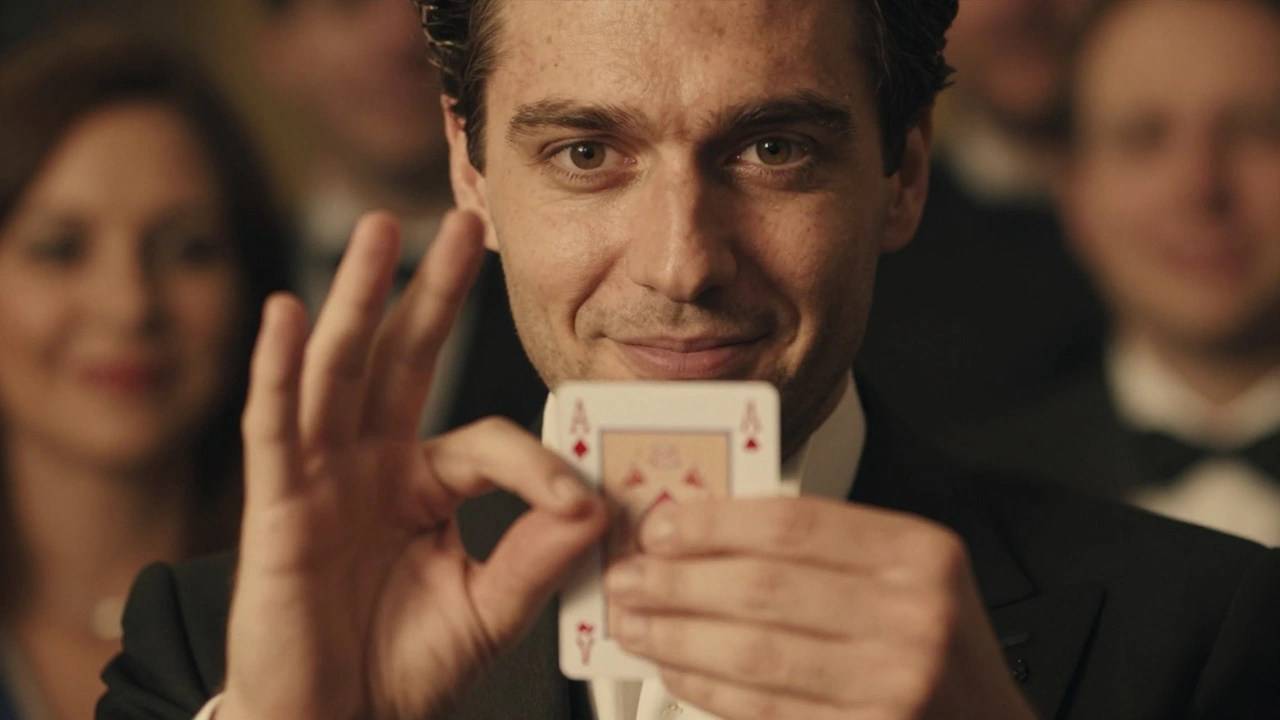
Ever watched a card vanish into thin air or a person split in half and wondered, How in the world did they do that? You’re not alone. Millions of people have asked the same question. But here’s the truth most magicians won’t tell you: there’s no supernatural force at work. No hidden lasers. No quantum physics. Just sharp observation, clever misdirection, and years of practiced repetition.
The Real Secret: It’s All in Your Brain
Magic doesn’t work because of what the magician does-it works because of what you don’t notice. Your brain is wired to fill in gaps, assume patterns, and trust what it sees. Magicians exploit that. A classic example? The classic sleight of hand card trick. You’re staring at the magician’s face, smiling, talking about how impossible this is. Meanwhile, their fingers are flipping the card behind their palm-faster than your eyes can track. You didn’t miss it because you weren’t paying attention. You missed it because your brain decided the important action was happening somewhere else.Studies in cognitive psychology show that humans can only focus on one or two things at a time. That’s called inattentional blindness. Magicians use this like a weapon. A loud clap, a sudden glance to the left, even a well-timed laugh-all of it pulls your attention away from the actual move. It’s not magic. It’s neuroscience.
Sleight of Hand: The Foundation of Most Tricks
If you want to understand how magic tricks work, start with sleight of hand. It’s the backbone of card tricks, coin vanishes, and even some stage illusions. This isn’t about speed alone-it’s about control, timing, and misdirection working together.Take the palming technique. A magician holds a coin or card in their hand without you seeing it. How? They use the natural curve of their fingers and the shadow of their hand to hide the object. It looks empty, but it’s full. Done right, your brain refuses to believe something’s there because you don’t see it. That’s the illusion.
Another common move: the double lift. Instead of picking up one card, they pick up two-but make it look like one. The top card is the one you see. The second card is the real one, hidden beneath. It’s not magic. It’s physics and psychology combined. A beginner might think they need to move faster. The truth? They need to move slower, smoother, and with more purpose.
Misdirection: The Art of Looking Elsewhere
Misdirection isn’t just about waving your hands. It’s storytelling. A magician doesn’t say, “Watch my left hand.” They say, “I’ve been doing this trick for 30 years, and no one’s ever figured out how I make the rabbit appear.” Suddenly, you’re hanging on every word. Your brain is processing the story, not the hands.One famous example is the “Cups and Balls” routine. You see three cups, three balls. The magician makes one ball disappear under a cup. Then another. Then all three. But here’s the twist: the balls aren’t the same ones. There are hidden duplicates. The magician uses rhythm and eye contact to make you believe the ball you just saw is the same one now under the cup. It’s not magic. It’s memory manipulation.
Even the silence between moves is part of the trick. A pause makes you think something big is coming. In reality, the move already happened. Your brain fills in the gap with what you expect-not what’s real.

Props and Mechanics: Hidden Tools, Not Magic Wands
Some tricks rely on gadgets. A sawing-in-half illusion? It’s not magic. It’s a specially designed box with hidden compartments, angled mirrors, and a second person inside. The audience sees one person. The mirrors reflect the shape of the empty half. The “cut” is just a gap in the blade. The person isn’t cut-they’re just hiding.Even something as simple as a floating card trick uses thin, nearly invisible threads or magnetic systems. The thread is so fine, it blends into the background lighting. The magnet is hidden in the table or under the magician’s sleeve. These aren’t sci-fi tools. They’re off-the-shelf items modified with precision.
Modern magicians use LED lights, thin wires, and even smartphone apps to enhance effects. But the core principle stays the same: make the audience believe the impossible is happening, while the real mechanism stays invisible.
Why You Can’t Figure It Out-Even When You Know It’s Not Magic
Here’s the kicker: even if you know magic tricks are based on tricks, not magic, you still can’t see how they’re done. Why? Because your brain is trained to see what it expects. Magicians know this. They design tricks to trigger your brain’s assumptions.For example, if you see a magician reach into a hat, your brain assumes they’re pulling something out. So when they don’t, you don’t notice they never put anything in to begin with. That’s called expectation bias. Your mind fills in the story before the magician even finishes the setup.
Even professional magicians who’ve seen thousands of tricks still get fooled by new ones. That’s because magic isn’t about hiding things-it’s about controlling perception. It’s like watching a movie. You know it’s not real. But you still feel fear, joy, surprise. Magic works the same way.

What You Can Learn From Magic Tricks
Magic isn’t just entertainment. It’s a masterclass in human behavior. If you study how tricks work, you start noticing how easily people are misled-in ads, in politics, even in everyday conversations. A salesperson who distracts you with a discount while hiding the fine print? That’s misdirection. A politician who changes the subject when asked a hard question? That’s classic magic.Learning magic tricks teaches you to pay attention. To question assumptions. To look for what’s missing. Many psychologists and detectives study magic to improve their observation skills. FBI agents have taken classes in sleight of hand to spot deception. It’s not about becoming a magician. It’s about becoming sharper.
Can You Learn to Do Magic Tricks?
Absolutely. You don’t need special hands. You don’t need to be born with talent. You need patience. Start small. Learn to palm a coin. Practice it in front of a mirror. Do it for 10 minutes a day. After a week, try it on a friend. Watch their eyes. See where they look. That’s your feedback loop.Most beginners quit because they think they need to do it perfectly the first time. But magic isn’t about perfection. It’s about consistency. One smooth motion beats ten rushed ones. One well-timed pause beats ten flashy gestures.
There are hundreds of free tutorials online. Start with coin vanishes, card forces, or the classic “rising card.” Don’t jump to sawing people in half. Build your foundation. The secret isn’t in the trick. It’s in the practice.
Final Thought: Magic Is About Wonder, Not Secrets
The real secret behind magic tricks isn’t a hidden mechanism or a clever move. It’s the ability to bring back wonder. In a world full of explanations-where everything can be decoded, streamed, or AI-generated-magic reminds us that not everything needs to be understood to be enjoyed.When you watch a magician make a card disappear, you don’t need to know how. You just need to feel the awe. That’s the real magic. And that’s why, no matter how many secrets are revealed, magic will never die.
Are magic tricks based on real supernatural powers?
No. Magic tricks rely entirely on psychology, misdirection, sleight of hand, and mechanical props. There is no evidence of supernatural forces involved. Even the most elaborate illusions are built on physical principles and human perception flaws.
Can anyone learn to do magic tricks?
Yes. Magic doesn’t require special talent-it requires practice. Anyone with patience and focus can learn basic sleight of hand, card controls, or coin vanishes. Many professional magicians started with simple tricks and practiced daily for months before performing in front of others.
Why do magic tricks still work even when people know they’re illusions?
Because magic doesn’t rely on ignorance-it relies on perception. Even if you know a trick is fake, your brain still processes the visual cues the same way. A well-designed illusion exploits how your mind fills in gaps, expects patterns, and trusts what it sees. Knowing it’s an illusion doesn’t stop your brain from being fooled.
What’s the most common mistake beginners make when learning magic?
Trying to do too much too fast. Beginners often focus on flashy moves instead of smooth, controlled actions. They rush their sleight of hand, skip practicing in front of mirrors, and don’t study misdirection. The best magicians move slowly, deliberately, and make the trick look effortless-even if it took hundreds of hours to perfect.
Do magicians ever reveal how their tricks work?
Most professional magicians never reveal their methods publicly-it’s part of the code of ethics in the magic community. However, many teach the principles behind tricks through books, courses, and online tutorials. These focus on the psychology and technique, not the exact secret move, so the wonder remains intact.
Bharat Patel
December 14, 2025 AT 19:26It's wild how much our brains just auto-fill reality. Like, you watch a card vanish and your mind screams 'magic!' when really it's just your attention being gently led away. I think this is why we love magic-it doesn't lie, it just lets us lie to ourselves in the best way. Kinda beautiful, really.
Bhagyashri Zokarkar
December 16, 2025 AT 05:07omg i just realized my bf does this exact thing when he hides my charger like he's doing a card trick and i just sit there staring at the table like wtf happened to it like why do i believe him when he says he didnt touch it i swear my brain is broken
Rakesh Dorwal
December 17, 2025 AT 09:52They don't want you to know the truth. These 'magicians' are just frontmen for tech firms testing neural manipulation. Look at the mirrors, the lighting, the timing-it's all too precise. They're training us to ignore what's real so when the government rolls out the real mind-control tech, we won't even notice. I've seen the patterns. This isn't entertainment. It's conditioning.
Vishal Gaur
December 19, 2025 AT 03:57so i read this whole thing and honestly i think the real trick is how the author made me feel like i should be impressed by something that's basically just people being good at sleight of hand and talking while moving their hands. like yeah i get it our brains are dumb but like... is this really worth a 10 minute read? i could've just watched a youtube video and saved myself the effort
Nikhil Gavhane
December 19, 2025 AT 12:23This is one of those posts that makes you feel smarter just by reading it. Not because you learned a secret, but because you finally understand why you felt so amazed as a kid. Magic doesn't need to be real to be meaningful. It's okay to just enjoy the wonder.
Rajat Patil
December 21, 2025 AT 05:29It is a remarkable thing how human perception can be gently guided. The magician does not deceive with force, but with harmony. The mind, seeking pattern and meaning, willingly participates in its own illusion. This is not trickery. It is collaboration.
deepak srinivasa
December 22, 2025 AT 16:05Wait, so if misdirection works because of inattentional blindness, does that mean we're all just constantly being fooled in daily life? Like in ads, politics, even relationships? I never thought of magic as a mirror to society before. That's kind of chilling.
pk Pk
December 24, 2025 AT 02:23If you want to learn magic, start with a coin. Not a deck. Not a rabbit. A coin. Practice until your hand forgets it's doing a trick and your brain just believes it's empty. That's the real lesson: mastery isn't about speed, it's about making the impossible feel natural. You can do this. Just show up every day.
NIKHIL TRIPATHI
December 24, 2025 AT 11:30I used to think magic was about hiding things, but now I get it-it’s about making you forget to look. Like how my mom always finds my socks even when I’m sure I hid them. Turns out, she’s just better at reading where I’m not looking. Same principle. Magic is everywhere.
Shivani Vaidya
December 24, 2025 AT 16:23It is interesting to consider that the art of misdirection is not unique to magicians. In diplomacy, in negotiation, even in parenting, attention is redirected to preserve harmony. The magician’s craft is simply the most transparent form of this universal human skill.
Rubina Jadhav
December 25, 2025 AT 07:14I just like watching magic. I don't need to know how it works. It makes me happy.
sumraa hussain
December 25, 2025 AT 09:50Okay but imagine if the whole world was a magic trick... like, what if we're all just... one big double lift and the real universe is hiding under the table?!!??!?!?!?!!?!!??! I just spilled my chai.