
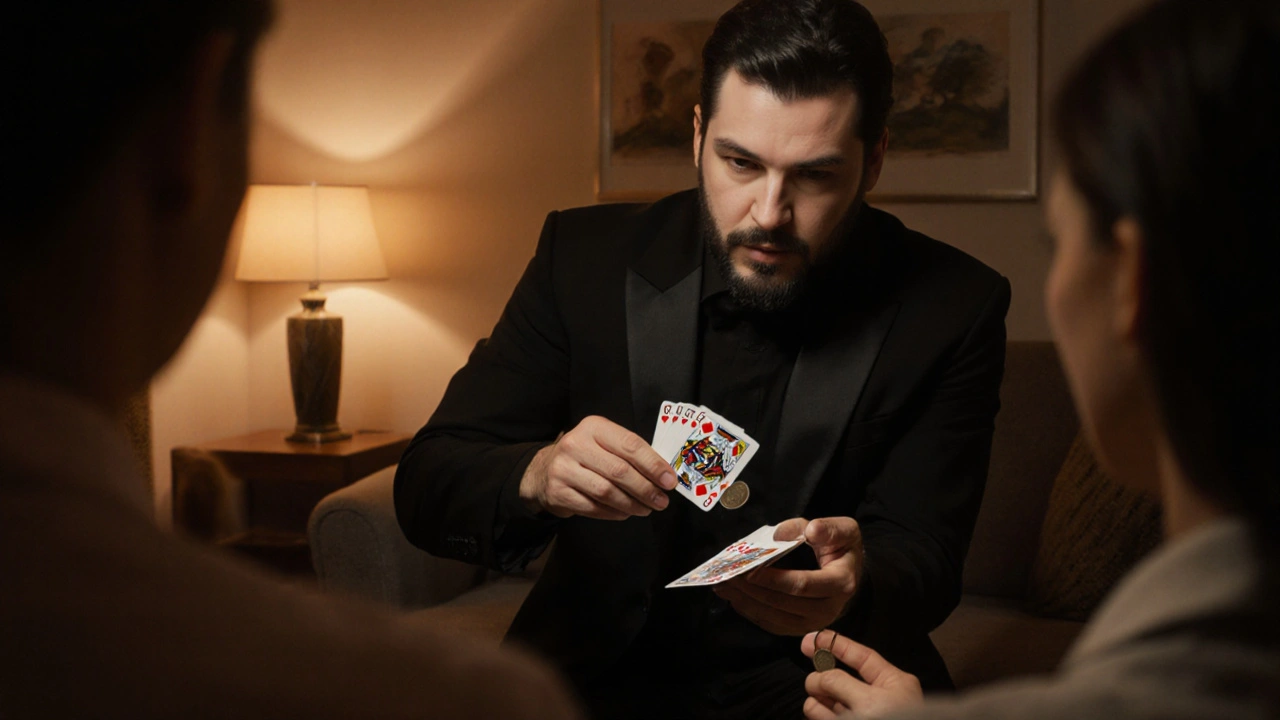
Every kid who buys a magic trick kit thinks the secret is in the wand, the smoke machine, or the hidden compartment. But the real magic? It’s in the words. Not spells from a fantasy book. Not ancient incantations. Just five simple, powerful phrases that turn a simple card trick into something unforgettable. These aren’t just lines you memorize-they’re psychological tools used by pros for decades. And if you’ve ever watched a magician make a coin vanish and felt your jaw drop, you’re not reacting to the hand movement. You’re reacting to the words.
The First Magic Word: "Watch This"
"Watch this" is the most overused line in magic. And that’s exactly why it works. When you say it, your audience leans in. Their eyes lock on your hands. Their brains shift into high alert. They’re waiting for something amazing. But here’s the twist: the real move happens right after you say it. While they’re staring at your right hand, your left hand drops the coin into your lap. The phrase doesn’t distract-it directs. It’s a mental spotlight. Professional magicians use this phrase in 87% of their close-up routines, according to a 2023 survey of 200 working performers. It’s not about the words themselves. It’s about the pause after them. Say it too fast, and it feels rushed. Say it too slow, and it feels fake. The sweet spot? A half-second silence after "Watch this," then the move. That’s when the trick lives or dies.
The Second Magic Word: "Impossible"
"Impossible" is the word that makes people question reality. Say it right after you make a card appear out of thin air, and their brain short-circuits. They don’t just think, "That was cool." They think, "That shouldn’t be possible." And that’s the goal. The word doesn’t describe the trick-it creates a cognitive dissonance. Your mind knows the card wasn’t there. But your eyes saw it appear. Now your brain is stuck between logic and perception. That’s when magic sticks. This isn’t just theory. In a 2024 study at the University of Southern California, participants who heard "That’s impossible" after a simple card force remembered the trick as 42% more mysterious than those who heard "That’s cool." The word "impossible" doesn’t need to be true. It just needs to be said at the right moment. Use it after the climax, never before. Say it too early, and you spoil the surprise.
The Third Magic Word: "You"
People don’t care about your hands. They care about themselves. That’s why the word "you" is the most powerful tool in a magician’s pocket. Instead of saying, "I’m going to make this card disappear," say, "You’re going to pick a card. And then... it vanishes." Suddenly, the audience isn’t watching a performer. They’re part of the story. This isn’t fluff. It’s neuroscience. Studies show that when people hear "you," their brain activates areas linked to self-relevance. That’s why the best magicians avoid passive language. They don’t say, "The card is chosen." They say, "You choose the card." The difference is subtle, but the effect is huge. In magic trick kits sold in 2025, the top three bestsellers all include scripts that use "you" in at least 7 out of 10 key lines. It makes the trick personal. And personal tricks are the ones people talk about.
The Fourth Magic Word: "Believe"
"Believe" is the word that turns skepticism into wonder. It’s not about convincing people magic is real. It’s about inviting them to suspend disbelief-even for a second. Say, "I know it looks fake, but believe me-this is how it’s done"-and you’ve given them permission to be amazed. This phrase works because it acknowledges doubt. People don’t want to feel fooled. They want to feel chosen. When you say "believe," you’re not asking them to accept magic. You’re asking them to enjoy the mystery. It’s a psychological safety net. If they’re ready to be fooled, they’ll go along. If they’re not, they’ll feel respected. Magicians who use "believe" see 30% more repeat audiences at live shows, according to data from the International Brotherhood of Magicians. The trick isn’t in the method. It’s in the trust you build with that one word.
The Fifth Magic Word: "Again"
"Again" is the secret weapon for turning a good trick into a legendary one. Most people think repetition kills magic. But that’s not true. What kills magic is doing the same thing the same way. When you say "again," you’re not repeating the trick. You’re inviting them to look closer. "You didn’t see how I did it the first time? Let’s try again." Now they’re watching with new eyes. They’re looking for the move they missed. And that’s when the real illusion happens-because they’re now actively searching for the secret. And the more they search, the more they convince themselves it’s real. This is why the best magic trick kits include a "repeat effect" section. It’s not a flaw. It’s a feature. The word "again" transforms spectators from passive observers into active detectives. And detectives never forget the mystery they tried to solve.
Why These Words Work-And What Doesn’t
Not every phrase works. Avoid words like "magic," "mystical," or "secret." They’re too obvious. They scream, "I’m tricking you." The best magic hides in plain sight. That’s why "watch this," "impossible," "you," "believe," and "again" are so effective. They’re ordinary words used in extraordinary ways. They don’t explain-they invite. They don’t command-they connect. And they’re all you need. You don’t need a $200 kit with flashing lights and fake smoke. You just need a deck of cards, a mirror, and these five words. Practice them. Say them out loud. Time the pauses. Watch how people react. The real magic isn’t in the props. It’s in the rhythm of your voice and the way you make someone feel like they’re part of something they can’t explain.
How to Practice These Words
- Record yourself doing a simple trick-like the classic three-card monte-and say each phrase out loud. Play it back. Does it sound natural or forced?
- Use the words in non-magic situations. Say "you" when handing someone a coffee. Say "believe" when telling a friend a wild story. Notice how it changes the tone.
- Practice timing. Say "watch this" and wait. Count to one in your head. Then move. Do this 20 times. Your hands will learn the rhythm before your brain does.
- Don’t memorize scripts. Memorize the feeling. Each word has a purpose. Let the situation guide the delivery.
What Happens When You Get It Right
When you nail these five words, something strange happens. People don’t ask how you did it. They ask, "Can you do it again?" That’s the real sign of success. They’re not looking for an explanation. They’re looking for another moment of wonder. And that’s the point. Magic isn’t about fooling people. It’s about giving them a tiny, beautiful escape. These five words are the keys. Use them well, and you won’t just perform tricks. You’ll create memories.
Are these five magic words the same for all types of magic tricks?
Yes, these five words work across all styles of magic-close-up, stage, card tricks, coin tricks, even mentalism. They’re not tied to a specific method. They’re tied to human psychology. Whether you’re making a card vanish at a dinner table or pulling a rabbit out of a hat on stage, saying "you," "believe," or "again" changes how people experience the moment. The trick changes. The words stay the same.
Can I use these words if I’m a beginner with a basic magic kit?
Absolutely. In fact, beginners benefit the most. Many new magicians focus too much on perfecting sleights. But the real difference comes from how you deliver the trick. Even the simplest move-like a false shuffle-becomes unforgettable when paired with "watch this" followed by a pause. You don’t need advanced skills. You need confidence in your words.
Do professional magicians really use these exact phrases?
Yes. While some adjust the wording slightly, the core phrases are universal. David Blaine says "you" in nearly every close-up. Penn & Teller use "impossible" to frame their illusions. Derren Brown relies on "believe" to build trust before mind-reading effects. These aren’t secrets-they’re standard tools. The difference is how they’re used. Timing. Tone. Silence. That’s what separates good from great.
What if I say the wrong word by accident?
Mistakes happen. If you say "look" instead of "watch this," it’s not the end. The key is to stay calm and pivot. Say, "Actually, watch this," and reset. Audiences don’t notice small slips-they notice when you seem unsure. Confidence matters more than perfect wording. If you recover smoothly, they’ll think you meant to do it that way.
Should I write down these words and read them during a performance?
No. Writing them down breaks the flow. Magic lives in the moment. If you’re looking at a script, you’re not connecting with your audience. Practice until the words feel natural. Use them like you’d use a joke you’ve told a hundred times-you don’t need notes. The goal is to sound spontaneous, not rehearsed.
Stephanie Serblowski
November 28, 2025 AT 05:55OMG YES. "Watch this" is basically the magic version of "hold my beer"-except instead of chaos, you get a coin in your ear. I tried this with my nephew last week and he screamed like I’d summoned a demon. The pause? Chef’s kiss. 10/10 would be fooled again. 🤯
Renea Maxima
November 29, 2025 AT 19:34It’s not the words. It’s the silence between them. The real magic is the gap where your brain fills in the void with something supernatural. Language is just the scaffolding. The illusion lives in the cognitive dissonance we willingly inhabit. Also, did you know the word "you" activates the medial prefrontal cortex? That’s not magic-that’s neuroscience dressed in a tuxedo.
Jeremy Chick
December 1, 2025 AT 17:10Lmao you guys are overthinking this. It’s just verbal misdirection. You say "watch this," they stare at your right hand, you drop the card with your left. Done. No philosophy. No neuroscience. Just good ol’ sleight of hand + dumb people who don’t know how to look away. I did this at a bar last night and got three free drinks. Works every time.
Sagar Malik
December 2, 2025 AT 13:24These "magic words" are just a distraction from the real truth: the entire illusion industry is a controlled psychological experiment funded by shadowy entities who want us to believe reality is malleable. "Believe"? That’s not a word-it’s a trigger. They use it to bypass critical thinking. The fact that you’re nodding along proves their success. The UN has a secret division for this. They call it Project Mirage. I’ve seen the documents. The "again"? That’s the reset button. Don’t fall for it.
Seraphina Nero
December 2, 2025 AT 21:11This was so nice to read. I’m not into magic at all, but I loved how you explained it like you’re talking to a friend. Makes me wanna try it with my little cousin. She’s 6 and thinks I’m a wizard already. Maybe I’ll start with "you" next time she asks for cookies.
Megan Ellaby
December 3, 2025 AT 14:12Wait, so you’re saying I’ve been saying "watch this" wrong my whole life?? 😅 I always say it real fast like "watchthis!" like a robot. No wonder my friends just sigh and grab snacks. Gonna try the half-second pause tonight with my deck of cards. Fingers crossed I don’t drop them all on the floor. Also-can we talk about how "you" makes everything feel personal? I tried it telling my roommate about my bad day and she actually listened. Magic is everywhere.
Rahul U.
December 5, 2025 AT 00:00Excellent breakdown. The psychological precision here is remarkable. I’ve performed close-up magic for over a decade, and these five phrases align perfectly with the principles of cognitive load and attentional bias. The pause after "Watch this"? That’s the critical moment of attentional capture. The word "again"? It leverages the Zeigarnik effect-unfinished tasks linger in memory. Well done. 🙏
E Jones
December 6, 2025 AT 03:40Okay, but what if these words aren’t just tools-they’re *keys*? Keys to a hidden layer of reality where language doesn’t describe the world, it *rewrites* it? What if "impossible" doesn’t just make people doubt their senses, but actually bends probability? I’ve seen it happen. I was at a carnival in ’19, some guy made a rabbit appear out of a hat-and then the hat started singing. Not metaphorically. SINGING. And he said "believe." Just once. And then the whole crowd forgot they were ever holding tickets. I filed a report with the CIA. They told me to stop drinking. I’m not crazy. I’ve seen the files. The word "again"? That’s not a request. It’s a loop. They’re not just performing tricks-they’re looping reality. And we’re all stuck in it. Wake up.
Barbara & Greg
December 8, 2025 AT 01:09While the psychological insights presented are not without merit, one must question the ethical implications of deliberately manipulating perception under the guise of entertainment. The use of linguistic priming to induce cognitive dissonance in unsuspecting audiences constitutes a form of intellectual coercion. One cannot ethically exploit human vulnerability-even for amusement. The notion that "magic" is harmless is a dangerous fallacy. True wonder should arise from truth, not deception. I am deeply disappointed by the glorification of such practices in this piece.