
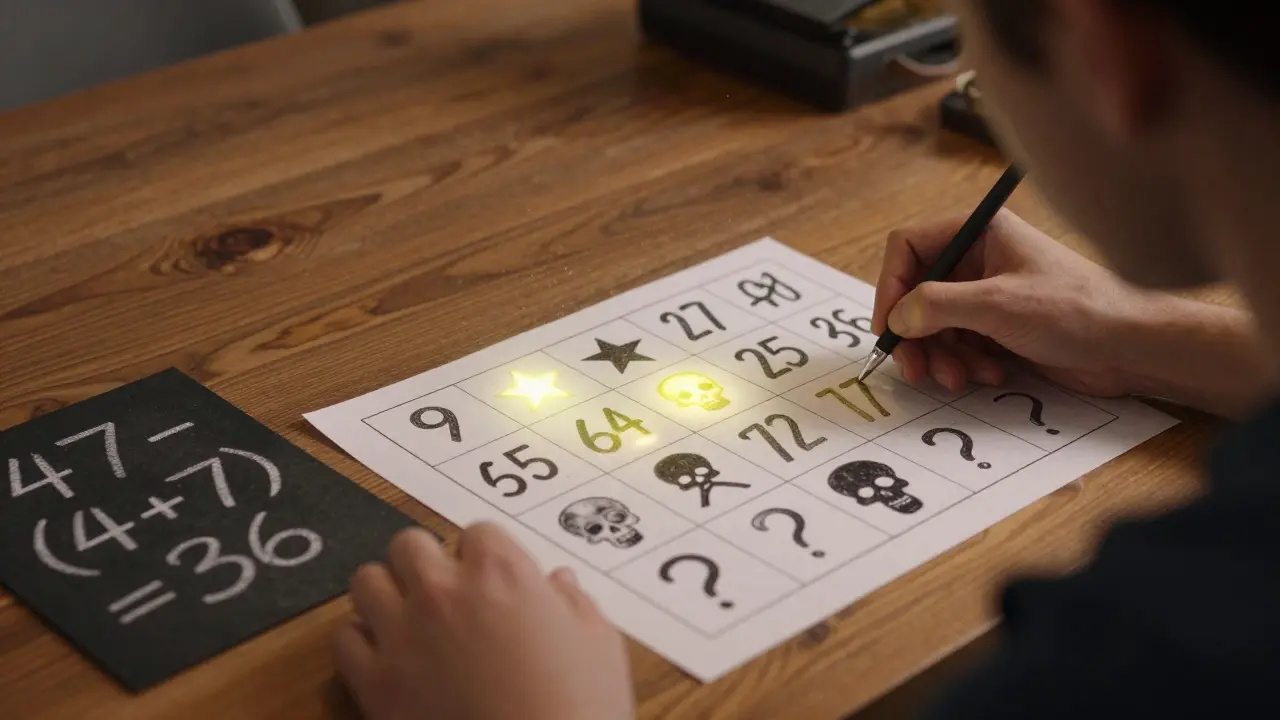
You’ve seen it before: someone asks you to pick any two-digit number, add the digits together, subtract that sum from the original number, and then magically knows what you got. It’s always 9. Or a multiple of 9. And somehow, they always guess the right symbol or object tied to that number. It feels like mind reading. But it’s not magic-it’s math. And it’s one of the most reliable tricks in any magic trick kit.
The Trick Explained Step by Step
Here’s how it works in practice:
- Pick any two-digit number (like 47).
- Add the two digits together (4 + 7 = 11).
- Subtract that sum from your original number (47 - 11 = 36).
- Look at the result. No matter what number you started with, the answer is always a multiple of 9.
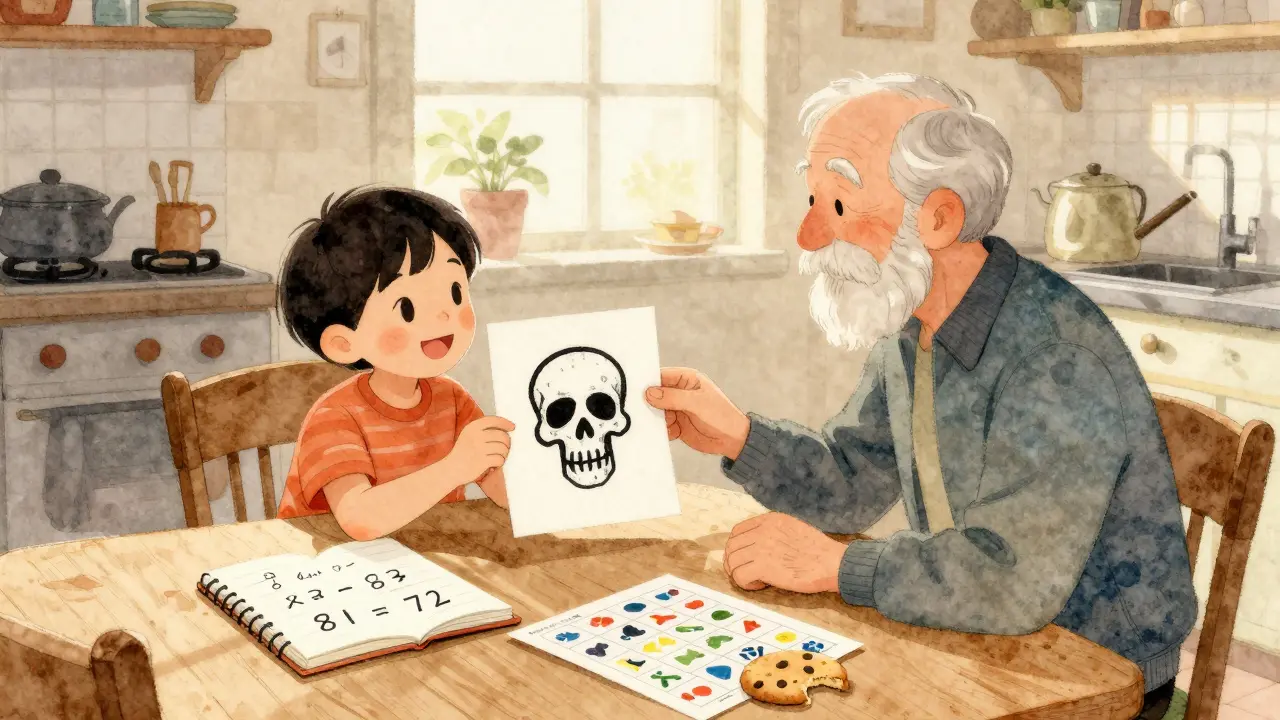
Try it with another number: 83. 8 + 3 = 11. 83 - 11 = 72. Again, 72 is a multiple of 9. Do it with 15: 1 + 5 = 6. 15 - 6 = 9. Still 9. Even with 10: 1 + 0 = 1. 10 - 1 = 9. It never fails.
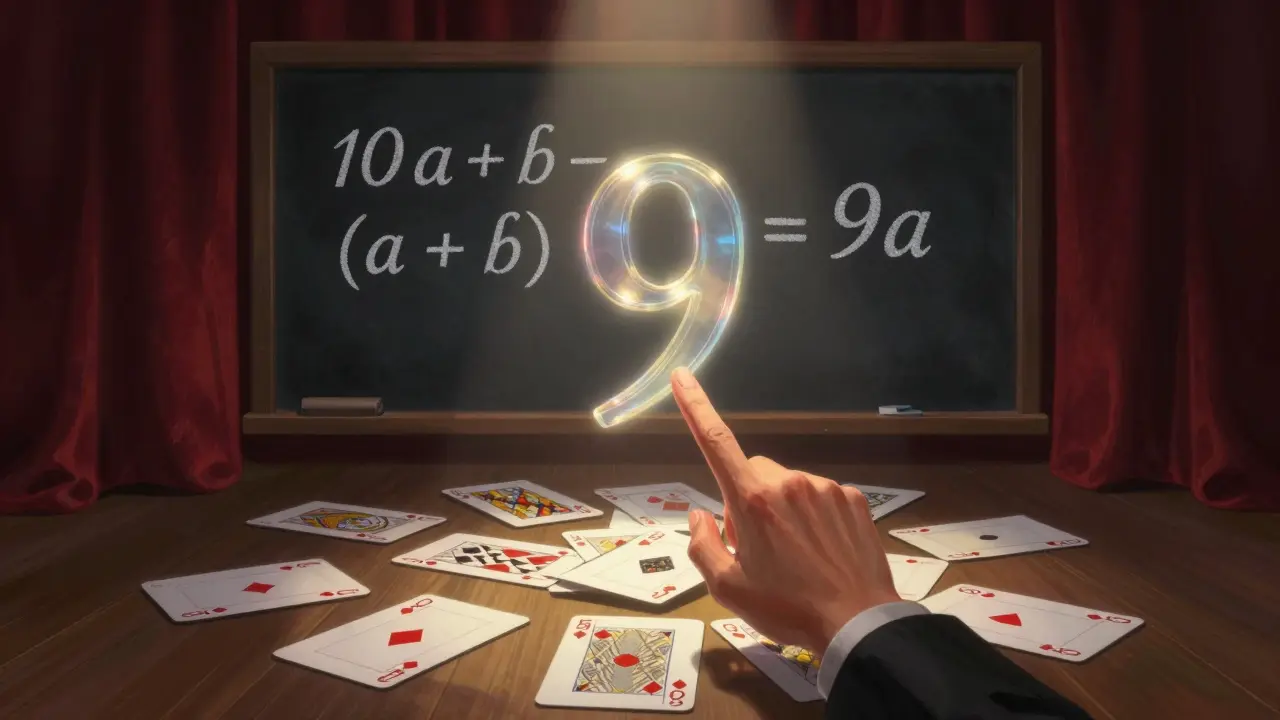
This isn’t luck. It’s a mathematical certainty. The trick works because of how our base-10 number system behaves. Any two-digit number can be written as 10a + b, where a is the tens digit and b is the ones digit. When you add the digits (a + b) and subtract that from the original number, you get:
10a + b - (a + b) = 9a
That’s it. The answer is always 9 times the first digit. So if you pick 64, the result is 9 × 6 = 54. Always. No exceptions.
Why It Feels Like Magic
The illusion comes from how the trick is presented. Magicians don’t say, “You’ll get a multiple of 9.” They show you a grid of symbols-like animals, shapes, or letters-next to numbers 1 through 99. Every multiple of 9 (9, 18, 27, 36, etc.) has the same symbol. The rest of the numbers have random, changing symbols. You do the math, focus on your result, and when the magician reveals the symbol tied to multiples of 9, it seems like they read your mind.
The real magic? You never notice that every possible outcome leads to the same few numbers. You think you’re choosing freely, but the math forces you into a tiny set of outcomes. That’s why this trick shows up in nearly every magic trick kit designed for beginners. It’s simple to learn, impossible to mess up, and blows people away every time.
How to Perform It Like a Pro
Here’s how to make it feel even more mysterious:
- Use a visual prop. Print a grid with symbols next to numbers 1-99. Make sure all multiples of 9 share one symbol-like a skull, a star, or a question mark.
- Change the symbols each time you perform it. This prevents people from spotting the pattern. Use different colors or fonts to make it feel random.
- Don’t say “subtract the sum.” Say, “Take your number and remove the total of its digits.” The wording hides the math.
- Add misdirection. While they’re doing the math, casually ask them about their favorite movie or what they had for breakfast. People forget the steps when distracted.
- After they get their number, say, “Now think of the symbol next to that number.” Pause. Then reveal it. The silence makes it feel supernatural.
Some performers even use a deck of cards. Each card has a number and a symbol. They ask you to pick a card, do the math, and then they flip over the card with the matching symbol. It’s the same trick, just wrapped in a different story.
Why 9? Why Not 7 or 5?
The number 9 has special properties in base-10 math. It’s the largest single-digit number, and it’s one less than the base. That’s why digit sums and subtraction tricks always circle back to it. In fact, this trick is a variation of an ancient mathematical curiosity called casting out nines, used for centuries to check arithmetic.
Try this: Add up the digits of any multiple of 9. 27 → 2 + 7 = 9. 81 → 8 + 1 = 9. 135 → 1 + 3 + 5 = 9. Even 999 → 9 + 9 + 9 = 27 → 2 + 7 = 9. It keeps going. That’s why this trick feels so powerful-it taps into a hidden rhythm in numbers that most people never notice.
Other numbers don’t behave this way. Try the same trick with 7: pick 45, add 4 + 5 = 9, subtract 9 from 45 → 36. Not a multiple of 7. It doesn’t hold. Only 9 has this consistent, predictable behavior in base-10 systems.
Where This Trick Belongs
This isn’t just a party trick. It’s a gateway into deeper math curiosity. Many people who learn this trick go on to explore modular arithmetic, number theory, and even cryptography. Teachers use it to show students that math isn’t just rules-it’s patterns waiting to be discovered.
It’s also a staple in beginner magic trick kits because it requires no props beyond paper or a phone screen. No sleight of hand. No gimmicks. Just pure logic. That’s why it’s so popular among kids and adults alike. You don’t need years of practice to master it. You just need to understand the pattern.
Common Mistakes to Avoid
Even though the math is foolproof, people mess up the performance:
- Using a three-digit number without explaining the rule. The trick only works reliably with two-digit numbers. If someone picks 105, the result is 90-still a multiple of 9-but the pattern isn’t as obvious to beginners.
- Repeating the trick for the same group. If someone figures out the pattern once, they’ll spot it next time. Always change the symbols or the presentation.
- Doing the math out loud with the audience. Let them do it silently. If you show your work, you reveal the structure.
- Forgetting to verify the result. Always double-check your own math before performing. One mistake and the illusion breaks.
Also, avoid using zero as the first digit. Numbers like 07 aren’t considered two-digit numbers in this context. Stick to 10-99 for clean results.
Why It Still Works in 2026
In an age of AI, apps, and digital illusions, this trick hasn’t aged a day. Why? Because it doesn’t rely on technology. It relies on human psychology. People trust their own calculations. They think they’re in control. And that’s exactly what makes the trick so convincing.
Even when you know how it works, it still feels weird. That’s the power of math disguised as magic. It’s not about hiding secrets-it’s about revealing patterns people didn’t know were there.
If you’ve ever bought a magic trick kit for a child, a friend, or yourself, this is probably one of the first tricks inside. It’s cheap to produce, easy to learn, and unforgettable to experience. And it’s still the best way to make someone say, “Wait… how did you know?”
Dave Sumner Smith
January 16, 2026 AT 16:20This trick is a government mind-control test disguised as math. They’ve been using base-10 to condition us since the 1950s. Every time you do this, you’re reinforcing neural pathways that make you obedient to numerical patterns. The real symbol isn’t on the grid-it’s in your skull. They’re mapping your thoughts through digit subtraction. I’ve seen the documents. 9 is not a number. It’s a signal.
Cait Sporleder
January 16, 2026 AT 17:27One is compelled to marvel at the elegant, almost poetic symmetry inherent in this mathematical phenomenon-the way the very architecture of our decimal system conspires to collapse disparate numerical identities into the singular, resonant echo of nine. It is not merely arithmetic; it is a quiet sonnet written in the language of place value, where the tens digit, like a dutiful sentinel, surrenders its full weight to yield a product of ninefold inevitability. One might even argue that 9, as the penultimate digit before the cyclical reset of zero, serves as a metaphysical fulcrum-a liminal threshold between the finite and the infinite, the arbitrary and the absolute. To witness this unfold is to glimpse the sublime order beneath the chaos of daily numeracy.
Paul Timms
January 18, 2026 AT 08:26Simple math. Always 9a. No magic. Just base-10.
Jeroen Post
January 19, 2026 AT 18:499 is the key because it’s the last digit before the system resets. That’s not math that’s control. The system wants you to think you’re free choosing but you’re always landing on 9. They use it in banks. In voting machines. In your phone’s calculator. You think you’re doing math but you’re just confirming the pattern. They’ve been doing this since Babylon. 9 is the lock. You’re the key.
Jasmine Oey
January 21, 2026 AT 13:34OMG I just did this with my coffee order number and it worked?? Like… I picked 73, did 7+3=10, 73-10=63, and then I looked at my receipt and the symbol next to 63 was a HEART?? I cried. Not because I’m emotional, but because the universe is whispering to me through arithmetic. Someone’s watching. And they like me. Maybe it’s my spirit animal. Or the IRS. Either way, I’m now a disciple of the Nine. 🙏✨
Marissa Martin
January 21, 2026 AT 15:13I find it disturbing how casually people treat this as harmless fun. The fact that so many are willing to participate in a ritual that manipulates their perception of choice… it’s a microcosm of how we surrender autonomy to systems we don’t understand. I don’t perform this trick anymore. I just watch. And I feel sad.
James Winter
January 22, 2026 AT 01:55USA invented math. Canada uses it. This trick works because Americans built the system. You guys just follow. Try it in binary. It fails. Because we’re better at numbers. End of story.
Aimee Quenneville
January 23, 2026 AT 07:03so like… i tried this with my cat’s age (she’s 7, but we’re pretending she’s 42 bc she’s a legend)… 4+2=6… 42-6=36… and then i looked at the symbol next to 36 on my fridge magnet board… it was a fish. my cat’s favorite snack. i think the universe is sending me a message… or maybe i just need to sleep. 🐱💤