
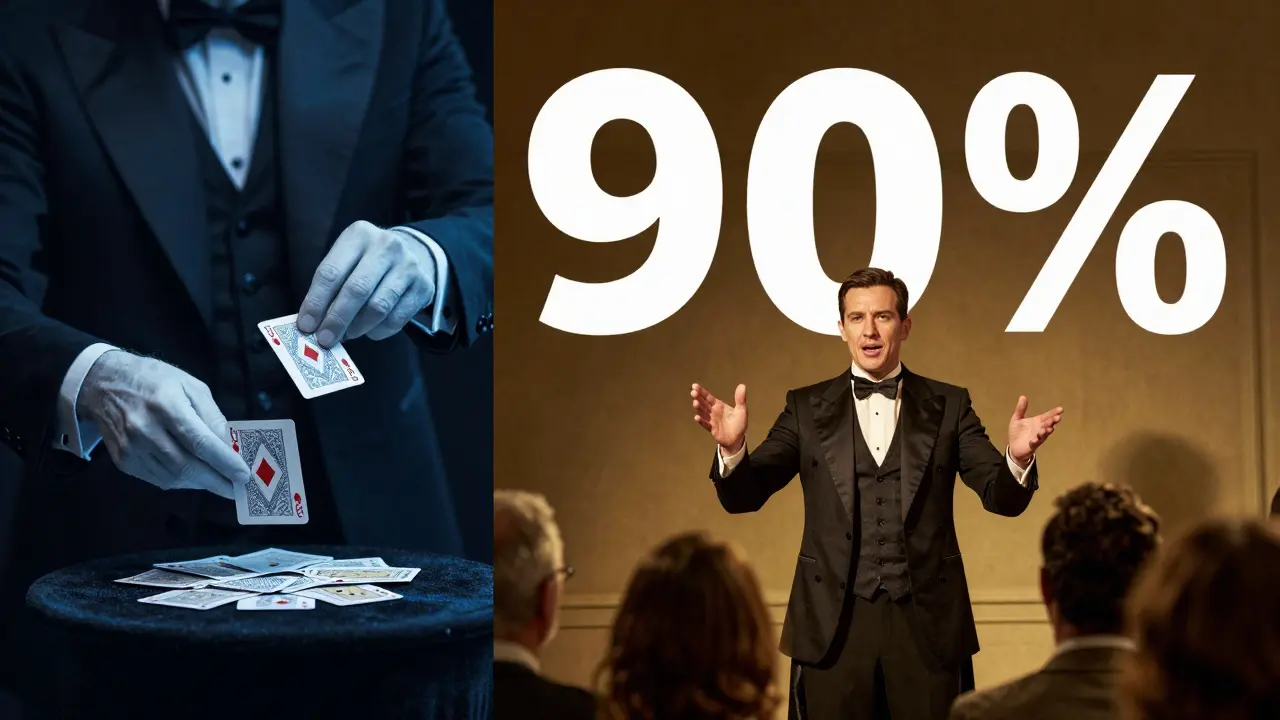
Many beginners think magic is all about the trick itself-pulling a rabbit from a hat or making a coin vanish. But the real secret? It’s not about what you do, but how you do it. The 90-10 rule of magic is a principle that states 90% of a trick’s impact comes from audience psychology and presentation, while only 10% is the physical mechanics of the trick. This means the magic isn’t in the trick-it’s in the performance.
What the 90-10 Rule Actually Means
When you hear "magic trick," you probably picture sleight of hand or special props. But the 90-10 rule flips that idea. Think of it like this: the physical move (like palming a card) is just 10% of the work. The other 90% is everything else-how you talk to the audience, where you look, when you pause, and how you tell a story. For example, if you hand someone a coin and ask them to hold it tight, they’ll focus on their hand. Meanwhile, you’re secretly moving it to your pocket. That’s misdirection in action, and it’s all part of the 90%.
Magicians like David Copperfield or Penn & Teller don’t rely on complex moves. They use simple tricks made unforgettable through storytelling and timing. A coin vanish might look impossible, but it’s really just a quick hand motion. What makes it magical is how they make you believe it happened. That’s the 90% at work.
Why This Rule Matters for Magic Trick Kits
Most magic trick kits focus on the 10%-the physical props and moves. You get a box with cards, coins, or gimmicked props. But if you only practice the mechanics, you’ll struggle. Kits often include instructions for the physical steps, but they rarely teach the presentation side. That’s why beginners get frustrated. They follow the steps perfectly, but the trick falls flat because they forgot the 90%.
Take a common kit trick: the "disappearing coin". The kit shows you how to palm the coin (the 10%). But the real magic happens when you distract the audience. Maybe you say "Watch my eyes" while subtly shifting your gaze. Or you tell a funny story about a lost coin, making people laugh while you hide it. Without those presentation tricks, the move looks obvious. The magic trick kit gives you the tool, but you have to build the magic around it.
90% vs 10%: A Clear Comparison
| Aspect | 90% (Presentation) | 10% (Mechanics) |
|---|---|---|
| Focus | Psychology, storytelling, audience engagement | Physical sleight of hand |
| Practice Time | 90% of preparation | 10% of preparation |
| Examples | Misdirection, timing, patter | Card flourishes, coin moves |
This table shows why magic trick kits alone aren’t enough. If you spend 90% of your time on presentation skills, even basic moves become magical. But if you focus only on the mechanics, you’ll end up with tricks that feel flat. The real value in a kit isn’t the props-it’s the chance to learn how to present them.

Common Mistakes People Make
Here’s what usually goes wrong: beginners spend hours perfecting the physical move. They practice palming a card 100 times but never think about how to distract the audience. Or they memorize the steps but forget to add personality. A trick like "the floating ring" looks boring if you just show the ring and say "watch this." But if you tell a story about a lost treasure and use hand gestures to guide attention, the same move becomes captivating.
Another mistake is ignoring audience reactions. Magic isn’t a solo act-it’s a conversation. If someone looks confused, you need to adjust. Maybe they’re staring at your hands too much, so you shift their focus with a joke. Or if they laugh at your patter, you lean into it. The 90-10 rule means every interaction matters. You can’t just go through the motions.
How to Apply the Rule with Magic Kits
Start by treating your magic trick kit as a tool for learning presentation, not just tricks. Here’s how:
- Record yourself: Film your practice sessions. Watch for where you look, how you speak, and if the audience would be distracted. Fix the awkward parts.
- Use storytelling: Turn every trick into a mini-story. For example, "This coin was once used to pay for a king’s ransom" before vanishing it. The story makes the trick memorable.
- Practice misdirection: Try simple techniques like saying "look at my left hand" while moving your right. Test it on friends to see if they fall for it.
- Focus on timing: Pause before the reveal. Let the audience wonder. A well-timed silence is more powerful than fast hands.
Take the "invisible thread" trick from a kit. The physical move is easy-just hide a thread in your palm. But the magic happens when you act like you’re pulling something heavy, or pretend to struggle with an invisible weight. The audience sees the effort, not the thread. That’s the 90% in action.
Real-World Examples
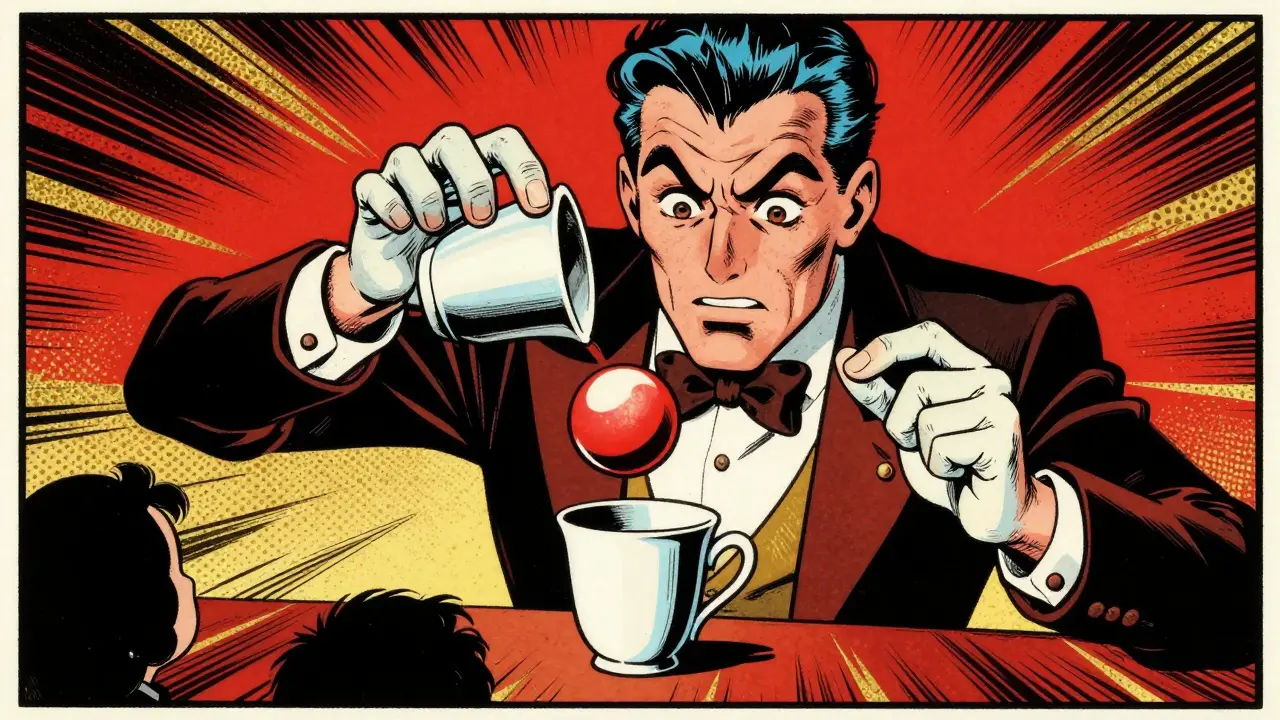
Think about the classic "cups and balls" trick. The physical moves involve sliding balls under cups. But the real magic is in the rhythm. Magicians like Derren Brown make it feel like a game of chance, with laughter and tension. They use misdirection-glancing away when the ball moves-so the audience misses the trick. The physical steps are simple, but the presentation turns it into art.
Another example: the "card force". You make someone pick a specific card without them knowing. The physical move is a subtle hand motion. But the magic comes from how you interact. You might say "choose any card, but avoid the red ones" to guide them. Or you use a joke like "I sense you’re a diamond person today." The trick is 10% mechanics, 90% psychology.
FAQ: Your Top Questions About the Rule
Is the 90-10 rule the same for all types of magic?
Yes, the rule applies universally. Whether you’re doing close-up magic with cards, stage illusions, or mentalism, the audience’s perception drives the effect. The physical trick is just the vehicle; how you present it determines the magic. For example, a stage illusion like sawing a person in half relies 90% on timing, lighting, and audience distraction-not the actual sawing mechanism.
How do I practice the 90% part of magic?
Start with small habits. Practice talking while doing the trick-record yourself to spot awkward pauses. Try simple misdirection exercises, like asking someone to watch your left hand while you move your right. Also, observe how real magicians interact with audiences. Watch videos of Penn & Teller or David Copperfield and note how they use humor, eye contact, and storytelling. These skills take time but transform simple tricks into unforgettable moments.
Can beginners use the 90-10 rule effectively?
Absolutely. In fact, beginners often have an advantage-they haven’t built bad habits yet. Start with one simple trick from a magic trick kit. Focus 90% of your practice on presentation: how you speak, where you look, and how you react to the audience. Even if the physical move isn’t perfect, strong presentation will make it seem magical. For example, a beginner’s coin vanish looks impressive if they act surprised and say "Wow, that’s weird!"
Does the 90-10 rule apply to mentalism tricks?
Yes, mentalism relies even more on the 90% side. Tricks like reading minds or predicting choices are built on psychology, not sleight of hand. The "mechanics" are often just subtle cues-like body language or word choice. For example, asking "Do you have a favorite number?" while subtly watching their reaction tells you more than any physical move. The real magic is in reading the audience, not the method.
What’s the biggest mistake when learning magic?
Focusing too much on the physical trick. Many people buy a magic trick kit and spend weeks perfecting the move. But if they skip presentation practice, the trick feels flat. The best magicians spend 90% of their time on storytelling, timing, and audience connection. A simple move done well is always better than a complex move done poorly.
Final Takeaway
The 90-10 rule of magic isn’t just a theory-it’s the difference between a boring trick and a memorable experience. When you use a magic trick kit, remember: the props are just the starting point. The real magic happens in how you present it. Practice the presentation as much as the move, and suddenly every trick will feel like real magic.
Ronak Khandelwal
February 8, 2026 AT 04:50The 90-10 rule is a game-changer for anyone learning magic. I used to obsess over perfecting sleight of hand, but once I focused on storytelling and audience engagement, everything clicked. For example, when I do the classic coin vanish, I don't just do the move-I tell a story about a lost treasure. The audience gets so wrapped up in the narrative that they miss the actual trick. It's all about creating a moment of wonder, not just executing a technique. The physical move is just the tool; the real magic happens in how you present it. I've seen beginners struggle because they skip the presentation part, but once they practice it, their tricks feel alive. Practice your patter as much as your hand movements. Record yourself to see where you can improve. Use pauses effectively-silence can be powerful. Make eye contact and connect with each person in the audience. Don't just memorize steps; understand why each part matters. Magic is about emotion, not just mechanics. Trust me, the 90% is where the real art lives. 🌟✨
Jeff Napier
February 9, 2026 AT 17:00Actually 90-10 split nonsense mechanics more important presentation Ive seen magicians focus storytelling cant do simple trick properly audience notices sloppy mechanics Without solid technique presentation distraction not 90-10 mastering both real secret practice mechanics flawless before presentation Otherwise fooling yourself 🤷♂️
Sibusiso Ernest Masilela
February 9, 2026 AT 18:58How dare you reduce magic to such a simplistic ratio The 90-10 rule is amateurish nonsense True magicians dont need to justify their craft with such arbitrary numbers The real art of magic is beyond quantification Your post is filled with shallow analysis that does nothing to honor the true depth of the craft Its like saying Shakespeares plays are 90% dialogue and 10% plot Absurd The mechanics and presentation are inseparable This is why beginners fail they listen to such simplistic advice Real magic requires years of study not some made up rule 🎭
Daniel Kennedy
February 9, 2026 AT 21:51While the 90-10 rule might seem oversimplified, it's a useful framework for beginners. The key is understanding that both aspects matter, but the presentation often gets overlooked. I've helped many students who focused too much on mechanics and failed to engage their audience. It's not about dismissing the mechanics-it's about balancing both. Magic is an art form that requires both skill and connection. Let's not dismiss the rule outright; instead, use it as a tool to improve. 🤝
Eric Etienne
February 10, 2026 AT 03:48Mechanics are everything.
Dylan Rodriquez
February 11, 2026 AT 19:56The 90-10 rule isn't a rigid formula but a guiding principle. It's about recognizing that the audience's experience is shaped more by how you present than the trick itself. I've seen magicians who can do perfect sleight of hand but fail to connect with people. On the flip side, those who focus on storytelling can make simple tricks feel incredible. It's not about ignoring the mechanics but understanding that the real magic happens in the mind of the audience. Every performer should prioritize creating that sense of wonder. Keep practicing both aspects, but remember: the connection is everything. ✨
Amanda Ablan
February 12, 2026 AT 03:42That's exactly right. I've practiced the coin vanish for weeks but only started seeing real results when I focused on the story and timing. The mechanics alone are boring, but when you add a narrative and engage the audience, it becomes magical. It's all about making them feel part of the experience. Thanks for sharing this perspective-it's helpful for beginners like me. 😊
Meredith Howard
February 13, 2026 AT 06:11The emphasis on presentation aligns with psychological principles of perception without audience engagement mechanics are irrelevant however the 90-10 ratio may vary by context in close up magic mechanics may require more attention still the core insight is valid thank you for the thoughtful discussion