
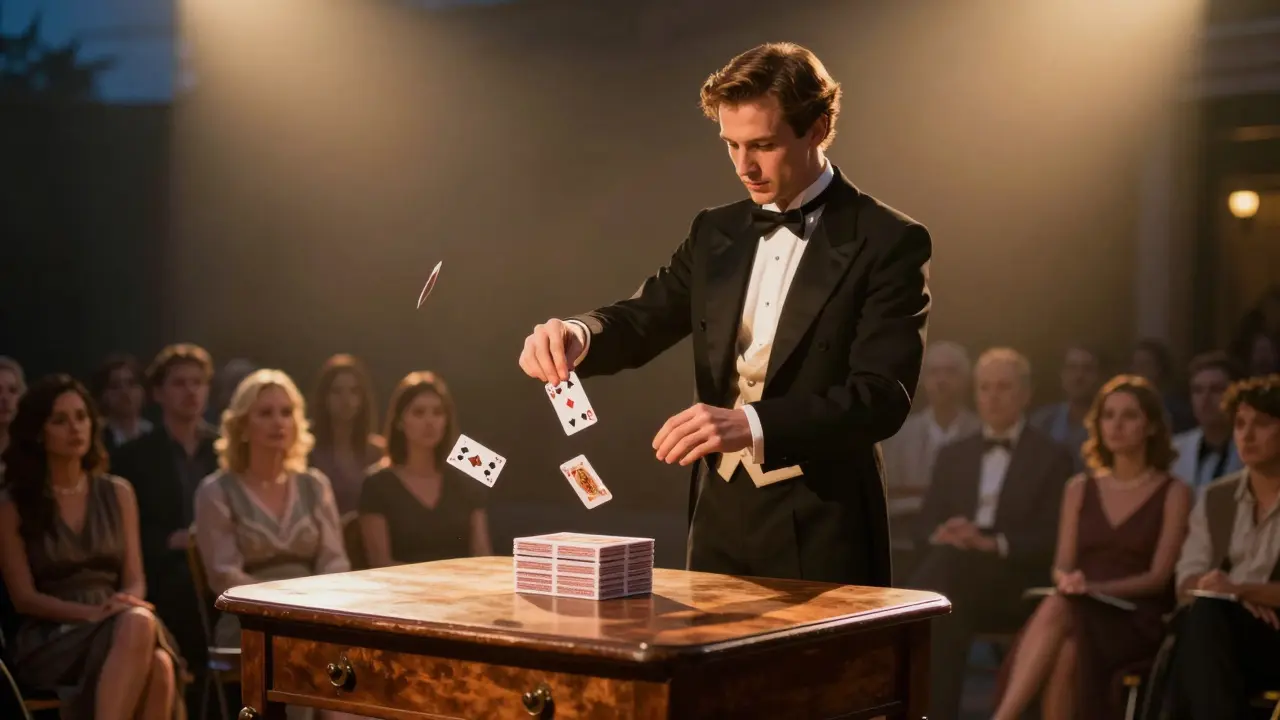
Some magic tricks don’t just disappear after the curtain falls-they stick around for decades, even centuries. While technology changes, smartphones evolve, and social media reshapes entertainment, a few illusions refuse to grow old. These aren’t just tricks passed down by word of mouth. They’re the ones that still leave audiences gasping, even when they know the secret. If you’ve ever watched a card trick and thought, "How did they do that?"-you’ve felt the power of magic that’s stood the test of time.
The Rising Card That Never Gets Old
Imagine this: a magician asks a volunteer to pick a card. They do. They sign it. They put it back in the deck. The magician shuffles. Then, one by one, the cards rise out of the deck-until finally, the signed card floats up all on its own. No wires. No magnets. No hidden assistants. Just a deck, a table, and a moment of pure disbelief.
This is the Rising Card, and it’s been baffling people since the 1800s. The original version used a simple thread and a cleverly placed finger. Modern versions rely on a thin, nearly invisible thread or a magnetic system built into the table. But the real magic isn’t in the mechanism-it’s in the timing. The magician doesn’t rush. They let the audience see the cards fall back. They pause. They smile. They make you think it’s impossible. And that’s why it still works today. Even when people know how it’s done, they still can’t explain how it looks so real.
The Sawing-a-Woman-in-Half That Started It All
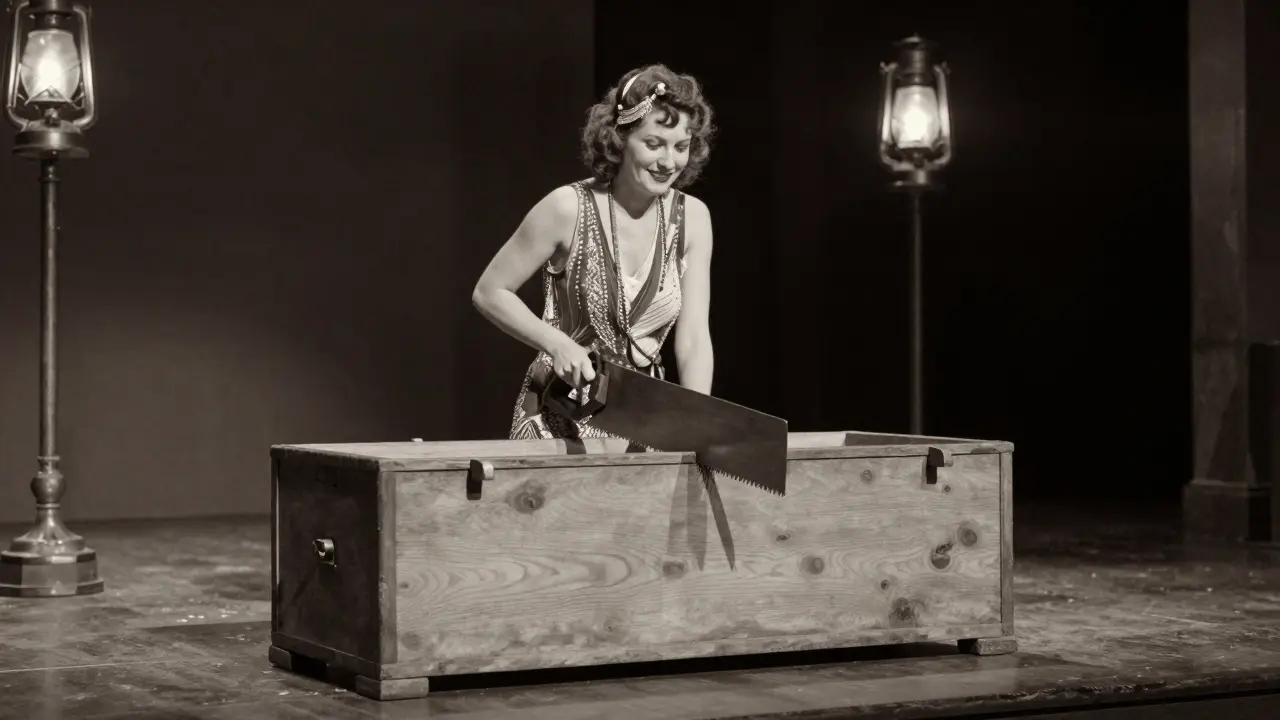
In 1921, P.T. Selbit stunned London with a trick that made headlines: a woman was placed in a box, and a saw was pushed through the middle. When the box opened, she was still smiling. The audience screamed. Newspapers called it "the most dangerous illusion ever performed."
Today, you see this trick in every magic show, from Las Vegas to small-town carnivals. The secret? Two people. One woman in the box, another hidden in a compartment below. The saw doesn’t cut through flesh-it cuts through a false section. The woman’s legs are angled so they look like they’re in the same space as the top half. The trick’s survival isn’t because it’s easy-it’s because it’s primal. People fear being cut in half. And magic that taps into that fear? It lasts.
What’s wild? The original sawing trick used no mirrors. No electronics. Just wood, steel, and perfect misdirection. Modern versions add lights and smoke, but the core hasn’t changed in over 100 years.
The Cups and Balls: Magic’s Oldest Trick
Go back to ancient Egypt. Go back to Roman amphitheaters. Go back to street performers in 14th-century Italy. You’ll find the same thing: three cups, three balls, and a crowd that can’t believe what they’re seeing.
The Cups and Balls is the grandfather of all magic. It’s simple: balls appear, vanish, multiply, and jump from cup to cup. No boxes. No traps. Just hands, cups, and sleight of hand that’s been refined for over 2,000 years.
Modern magicians like David Blaine and Dynamo still use it. Why? Because it’s the perfect test of skill. There’s no gimmick you can hide. No remote control. No pre-rigged table. If you’re good, the balls move like they’re alive. If you’re not, everyone sees the cheat. That’s why it’s still taught to beginners-and why it’s the first trick every professional must master.
The secret? A combination of false palms, misdirection, and timing. The magician doesn’t make the balls disappear. They make you look away at the exact right moment. And that’s the real magic: controlling where your eyes go.
The Linking Rings: When Steel Defies Logic
Four or five metal rings, each one solid. The magician holds them up. He drops one through another. Then another. Then all five link together like chain mail. He pulls them apart. They’re separate again. No strings. No hinges. No magnets.
This trick dates back to China in the 1800s. It made its way to Europe, where magicians like Houdini turned it into a signature act. The rings are specially made-each one has a small gap that’s hidden by the angle of the light and the way they’re held. The magician uses a tiny, nearly invisible latch to open and close the rings during the performance.
But here’s what most people don’t realize: the real skill isn’t in the rings. It’s in the rhythm. The magician doesn’t rush. He lets you watch. He makes eye contact. He smiles. He lets you think you’ve caught the move. And that’s why it still works. People think they’re sharp. They’re not. Not when the magician controls the story.
The Card Force: Making You Choose What He Wants
"Pick any card. Any one at all." You do. You’re sure you chose freely. Then, the magician reveals it-exactly as you picked. How? Because you didn’t choose. Not really.
This is the Card Force, and it’s the foundation of almost every card trick ever performed. There are dozens of ways to do it: the Hamman Force, the Classic Force, the Hindu Force. Each one makes you think you’re in control. But you’re not. You’re following a path the magician laid out long before you picked up a card.
It’s not magic. It’s psychology. And it’s why this trick still works in 2026. Even when people know about forces, they still fall for them. Why? Because the magician doesn’t look like he’s forcing anything. He’s calm. He’s casual. He lets you believe you’re the one making the decision.
Some magicians use this to predict your card. Others use it to make you pick the same card as someone else. The technique hasn’t changed. But the way it’s used? It’s evolved. Today, you’ll see it in street magic videos, YouTube tutorials, and even corporate team-building events. Because at its core, it’s not about cards. It’s about control.

Why These Tricks Last
So why do these five tricks-Rising Card, Sawing in Half, Cups and Balls, Linking Rings, and the Card Force-still amaze us? Not because they’re complex. Not because they use cutting-edge tech. It’s because they’re built on something deeper: human perception.
They don’t rely on computers or holograms. They rely on the way your brain works. Your brain fills in gaps. It ignores what it doesn’t expect. It trusts what looks natural. These tricks exploit that. They don’t trick your eyes. They trick your mind.
And that’s why no app, no AI, no virtual reality can replace them. You can’t code a moment of disbelief. You can’t simulate the gasp of a crowd when they realize they were fooled-again.
These tricks survived wars, revolutions, and the rise of the internet. They’re not relics. They’re living traditions. Every time a magician performs them, they’re not just repeating a pattern. They’re keeping alive a conversation between performer and audience that’s been going on for centuries.
What You Can Learn From Them
If you’ve ever tried to learn magic, you probably started with a kit. A plastic deck. A rubber ball. A trick that says "amaze your friends!" But those tricks fade. They don’t stick.
The real magic isn’t in the props. It’s in the practice. The Rising Card teaches patience. The Cups and Balls teach control. The Card Force teaches influence. These aren’t just tricks. They’re lessons in how to hold attention, how to guide thought, how to make someone believe what you want them to believe.
That’s why, even today, the best magicians in the world still rehearse these tricks daily. Not because they’re easy. But because they’re perfect.
Tyler Durden
February 14, 2026 AT 12:38LeVar Trotter
February 15, 2026 AT 18:44Aafreen Khan
February 17, 2026 AT 13:09Pamela Watson
February 18, 2026 AT 13:21michael T
February 19, 2026 AT 09:37Christina Kooiman
February 20, 2026 AT 10:49Sagar Malik
February 21, 2026 AT 17:29Megan Ellaby
February 22, 2026 AT 12:04Rahul U.
February 23, 2026 AT 16:25E Jones
February 25, 2026 AT 05:00Frank Piccolo
February 25, 2026 AT 07:46James Boggs
February 27, 2026 AT 04:46Addison Smart
February 28, 2026 AT 19:34