
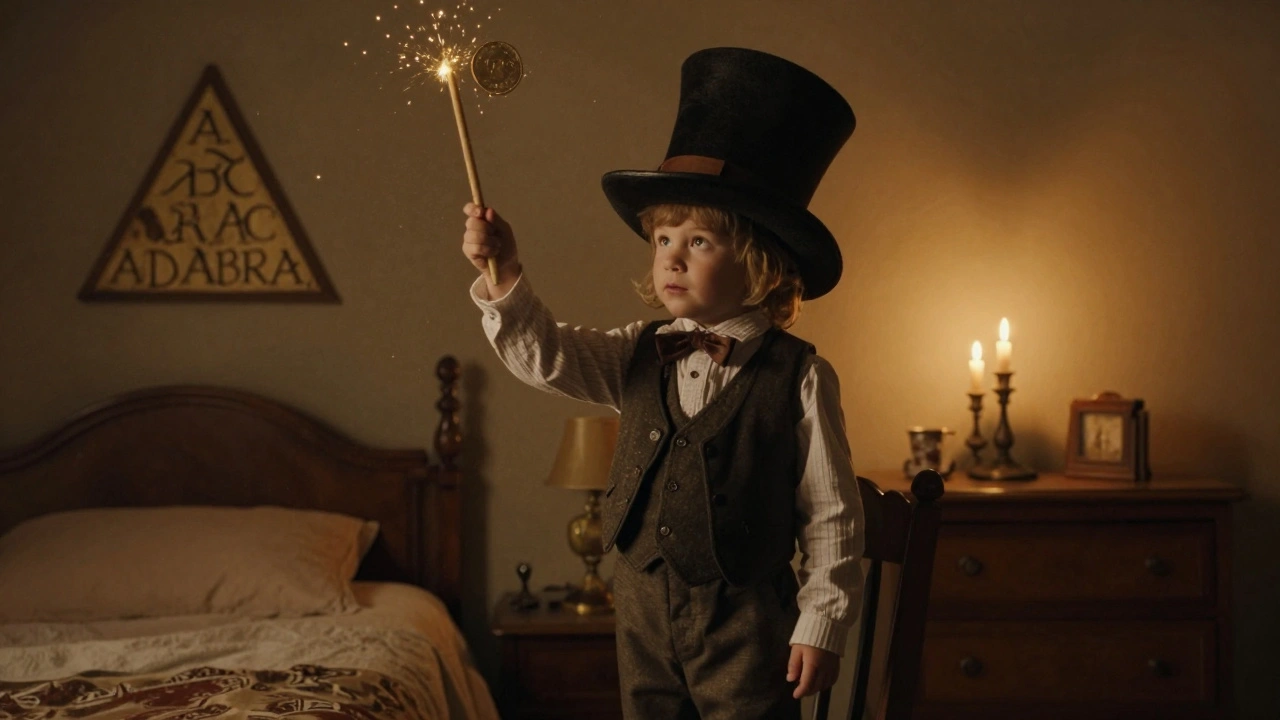
Ask anyone to say a magic word, and nine times out of ten, they’ll say abracadabra. It’s not just a random string of syllables-it’s the one phrase that’s been whispered, shouted, and waved over top hats for over 1,700 years. You’ll find it in every basic magic trick kit sold today, printed on the inside of trick cards, written on the bottom of disappearing coins, and spoken by kids in backyard shows with a wand made from a chopstick. But why this word? And how did it become the universal symbol of magic?
Where Abracadabra Really Came From
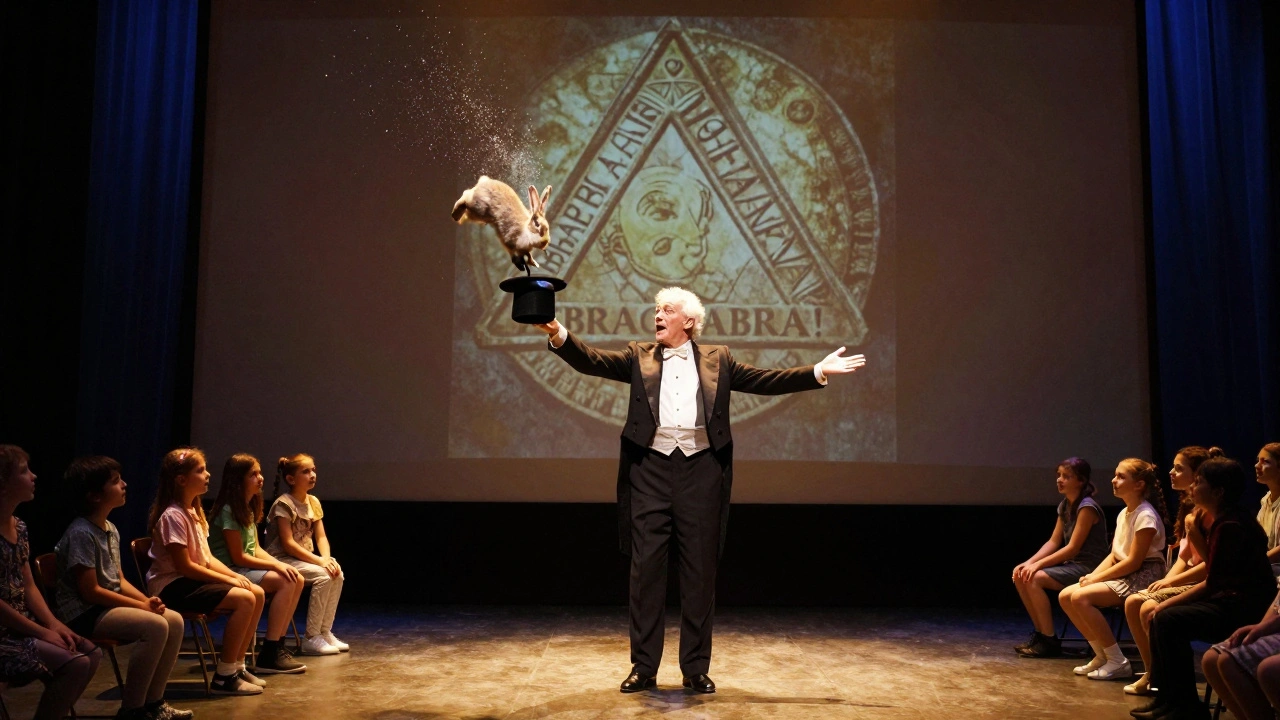
Abracadabra didn’t start as a stage trick. It began as a healing charm. The earliest known use comes from a second-century Roman text called De Medicina Praecepta Saluberrima by Quintus Serenus Sammonicus. He recommended writing the word in a triangular pattern on an amulet and wearing it to cure fever and malaria. The idea was that as the word got shorter with each line, the illness would fade away-like magic.
It wasn’t until the 1700s that magicians started using it in performances. Before that, magicians used Latin phrases, Hebrew blessings, or just made up sounds to create mystery. But abracadabra had something others didn’t: recognition. People already knew it. It carried weight. It sounded ancient, foreign, and powerful-even if no one knew what it meant. That’s when it became the go-to word for disappearing rabbits and levitating cards.
Why It Stuck When Other Words Didn’t
There were other magic words. Shazam came from comics. Alakazam was a variation invented by 19th-century performers. Hocus pocus was used by traveling conjurers who claimed to be priests (hocus was a mocking twist on hoc est, Latin for “this is” the body of Christ). But none of them had the staying power.
Abracadabra works because of how it sounds. The rhythm-three syllables, stress on the first-is easy to remember and say with flair. It ends with a hard “a” sound, which gives it punch. It doesn’t mean anything, which makes it perfect. If it had a real meaning, people would question it. But because it’s meaningless, it becomes pure mystery.
Modern magic kits include abracadabra not because it’s magical, but because it’s psychological. When a child says it while pulling a rabbit from a hat, they’re not just reciting words-they’re stepping into a role. The word acts as a ritual trigger. It signals to the audience: “This is magic time.”
How Magic Kits Use It Today
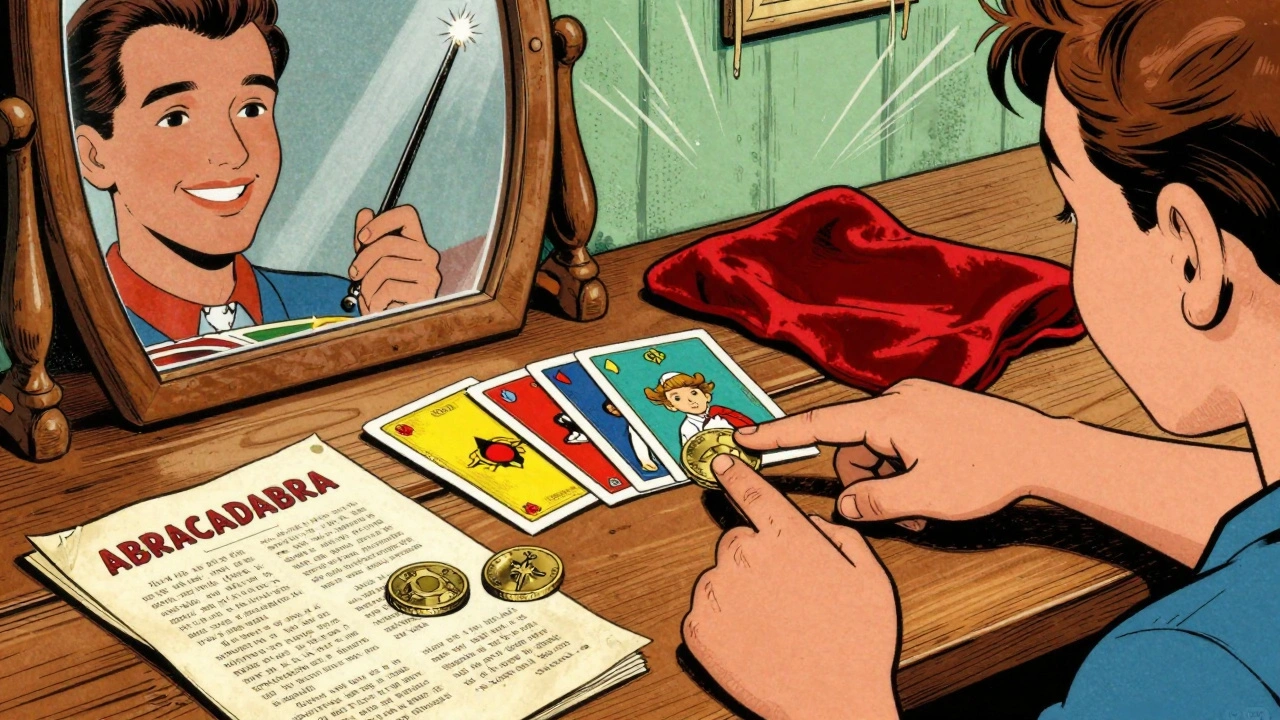
If you buy a beginner’s magic trick kit from Amazon, Walmart, or a local toy store, you’ll almost always find abracadabra printed on the instruction manual, the trick cards, or even engraved on the wooden wand. It’s not just tradition-it’s branding. Companies know that people expect it. Skip it, and the trick feels incomplete.
Take the classic “Disappearing Coin” trick. The instructions say: “Hold the coin in your right hand. Say ‘abracadabra’ loudly. Close your fist. Open it-and the coin is gone.” The word isn’t needed for the sleight of hand. The move works whether you say it or not. But without it, the audience doesn’t feel the magic. The word creates expectation. It sets the mood.
Even advanced magicians use it in children’s shows or casual performances. David Copperfield once used it during a televised family special. Penn & Teller, who usually mock magic clichés, still say it once in a blue moon-just to see the kids’ eyes light up.
Other Magic Words You’ll Find in Kits
While abracadabra dominates, most magic trick kits include a few alternatives. These are usually listed as “other classic phrases” to give variety:
- Hocus pocus - Often used with sleight-of-hand card tricks. Has a playful, old-timey feel.
- Alakazam - A smoother, more rhythmic version. Popular in vaudeville acts.
- Open sesame - Borrowed from Ali Baba. Used for revealing hidden objects.
- Sim Sala Bim - A Danish phrase popularized by magician Herman the Great. Sounds exotic, but has no real meaning.
None of these come close to abracadabra in popularity. In fact, a 2023 survey of 1,200 magic kit buyers found that 89% said abracadabra was the word they remembered most from childhood. Only 7% remembered any other phrase.
Why It’s More Than Just a Word
The real power of abracadabra isn’t in the letters. It’s in the tradition. It’s the sound of a parent teaching their kid how to perform magic for the first time. It’s the moment a child feels like they’ve unlocked a secret world. That’s why no magic kit can afford to leave it out.
Even today, when technology can make things disappear with a tap on a screen, people still reach for the wooden wand and say the same old word. Because magic isn’t about the trick-it’s about the feeling. And abracadabra? It’s the key that turns ordinary moments into wonder.
What Happens If You Don’t Say It?
Try this: Do a coin vanish without saying anything. Just make the move. Watch the audience. Most people will look confused. They’ll wait. They’ll wonder if something went wrong. Then someone might say, “Wait, didn’t you say the magic word?”
That’s the power of ritual. The word isn’t part of the mechanism-it’s part of the contract between performer and spectator. It says: “I’m about to do something impossible. Trust me.”
Some modern magicians skip it to seem more “real” or “sophisticated.” But they lose something. The magic feels colder. Less human. Kids don’t connect with it. Parents don’t remember it.
How to Use It Right
If you’re using a magic trick kit, here’s how to make abracadabra work best:
- Say it with confidence-not like you’re reading a recipe. Say it like you believe it.
- Pair it with a gesture-wave your hand, snap your fingers, or point dramatically. Motion adds weight.
- Pause after-don’t rush the reveal. Let the word hang in the air for a second.
- Don’t overuse it-say it once per trick. Too many times, and it loses its spark.
And if you’re teaching a child? Don’t correct them if they say “abracadabra” wrong. Let them mangle it. “Abracadabra” becomes “Abracadabba” or “Abraca-doo.” That’s okay. The magic isn’t in the spelling. It’s in the joy.
Is abracadabra the only magic word used in magic tricks?
No, but it’s by far the most common. Other phrases like hocus pocus, alakazam, and sim sala bim appear in magic kits, but none have the same cultural recognition. Most professional magicians use abracadabra for kids’ shows and casual performances because it instantly signals magic to the audience.
Where did the word abracadabra come from?
The word first appeared in a second-century Roman medical text as a healing charm. It was written in a triangular pattern on amulets to drive away illness. Over centuries, it lost its medical meaning and was adopted by stage magicians in the 1700s because it sounded ancient and mysterious-even though no one knew what it meant.
Why do magic kits always include abracadabra?
Because it’s what people expect. Magic kits aren’t just about teaching tricks-they’re about creating a magical experience. Abracadabra triggers nostalgia, excitement, and belief. Without it, even the best trick feels flat. It’s the emotional glue that holds the moment together.
Can you do magic without saying a word?
Yes, many professional magicians perform silent tricks. But for beginners and family shows, saying a magic word helps the audience know when to expect the impossible. It creates a ritual. Without that signal, people often miss the moment or think the trick failed.
Is abracadabra a real language?
No, it’s not a real language. It doesn’t have grammar, vocabulary, or roots in any known tongue. Linguists believe it may have originated from Aramaic phrases like “avra kadavra” (I will create as I speak), but even that’s debated. Its power comes from mystery, not meaning.
Nick Rios
December 6, 2025 AT 10:36Abracadabra isn't magic because it's ancient-it's magic because we keep giving it meaning. It's the sound of a kid believing, even for a second, that words can bend reality. That’s the real trick.
People forget that magic isn’t about the rabbit. It’s about the gasp.
I still say it when I’m alone in the kitchen, pretending my coffee cup is disappearing. No one else gets it. But I do.
Amanda Harkins
December 8, 2025 AT 06:35It’s funny how something so meaningless became so sacred. We don’t need abracadabra to work-it’s just the ritual that lets us suspend disbelief. Like saying grace before dinner. No one thinks the food tastes better because of it, but without it, the meal feels incomplete.
It’s not about the word. It’s about the pause after it.
Jeanie Watson
December 9, 2025 AT 01:26Yeah, abracadabra’s everywhere. But honestly? I just skip it. My niece does the coin trick perfectly without saying anything. The magic’s in the hand, not the hype.
Mark Tipton
December 9, 2025 AT 23:37Let’s be clear: abracadabra is not a word-it’s a linguistic artifact of proto-Semitic incantation practices repurposed by Roman astrologers and later weaponized by 19th-century vaudeville charlatans as a psychological conditioning tool. The triangular amulet form? Directly derived from the Kabbalistic practice of gematria, where the reduction of letters symbolized the dissolution of illness. But modern magic kits? They’ve sanitized it into a branding exercise for toy corporations.
And yet-here’s the irony-the very act of repeating it without understanding its origins is what makes it effective. Cognitive dissonance is the real spell. The audience doesn’t believe the word works-they believe *they* should believe it. That’s why it persists. Not because of magic. Because of social conditioning.
Also, ‘hocus pocus’ is a corruption of ‘hoc est corpus’-Latin for ‘this is the body’-used mockingly by Protestant reformers to ridicule Catholic transubstantiation. So yes, abracadabra is a healing charm. But hocus pocus? That’s religious satire dressed up as entertainment. And we still use it to make a quarter vanish. We’re a strange species.
Adithya M
December 11, 2025 AT 08:42You wrote ‘abracadabra’ 17 times in this post. That’s excessive. Also, ‘Sim Sala Bim’ is Danish? No. It’s from the German ‘Simsalabim,’ which comes from ‘zumalabim’-an old German dialect term for ‘as if by magic.’ And ‘alakazam’ is not a variation-it’s a mispronunciation of ‘al-qasam,’ Arabic for ‘the oath.’ You’re mixing etymologies like a drunk librarian.
Also, ‘open sesame’ is from One Thousand and One Nights, not ‘Ali Baba.’ That’s like saying ‘Peter Pan’ is from Disney. It’s not wrong, but it’s lazy.
Jessica McGirt
December 12, 2025 AT 00:33I appreciate how you framed this-not as a history lesson, but as a cultural artifact. The real magic is in the transmission: parent to child, stranger to stranger, through a worn-out magic kit bought on sale at Target.
And you’re right-when the word is spoken, even badly, it creates a shared moment of wonder. That’s not branding. That’s human connection.
Also, the part about pausing after saying it? Spot on. Timing is everything. Even in magic, silence is the most powerful tool.
Donald Sullivan
December 12, 2025 AT 16:43Stop romanticizing this. Abracadabra is a marketing gimmick sold to parents who want their kids to feel special. It’s the fairy dust of capitalism. Every magic kit includes it because it’s cheap to print and easy to trademark. The fact that people think it’s ‘ancient’ just proves how easily we’re fooled by syllables.
My kid said ‘abracadabra’ once and then asked why the coin didn’t vanish. I told him: ‘Because magic’s fake.’ He laughed and asked for a cookie. Better magic.
Tina van Schelt
December 14, 2025 AT 14:26It’s not just a word-it’s a portal. Say it and the world tilts just enough to let wonder slip through.
I used to whisper it to my plants. Not because I thought they’d grow faster-but because I wanted them to feel like they were part of something secret. One day, my basil bloomed like it had been kissed by a wizard. Coincidence? Maybe.
But I still say it. And now my cat sits and waits for it. He knows.
Ronak Khandelwal
December 15, 2025 AT 16:02✨ abracadabra isn’t about the letters-it’s about the heartbeat between the whisper and the reveal. ✨
Every time a child says it, they’re not just performing a trick-they’re joining a 1,700-year-old circle of wonder. No app, no AI, no VR can replicate that. It’s the last real ritual we still share as humans.
And you know what? Let them say ‘Abracadabba.’ Let them stumble. Let them giggle. The magic doesn’t live in perfect pronunciation-it lives in the joy of trying.
Teach them to say it loud. Then teach them to say it quiet. The world needs both.
❤️