
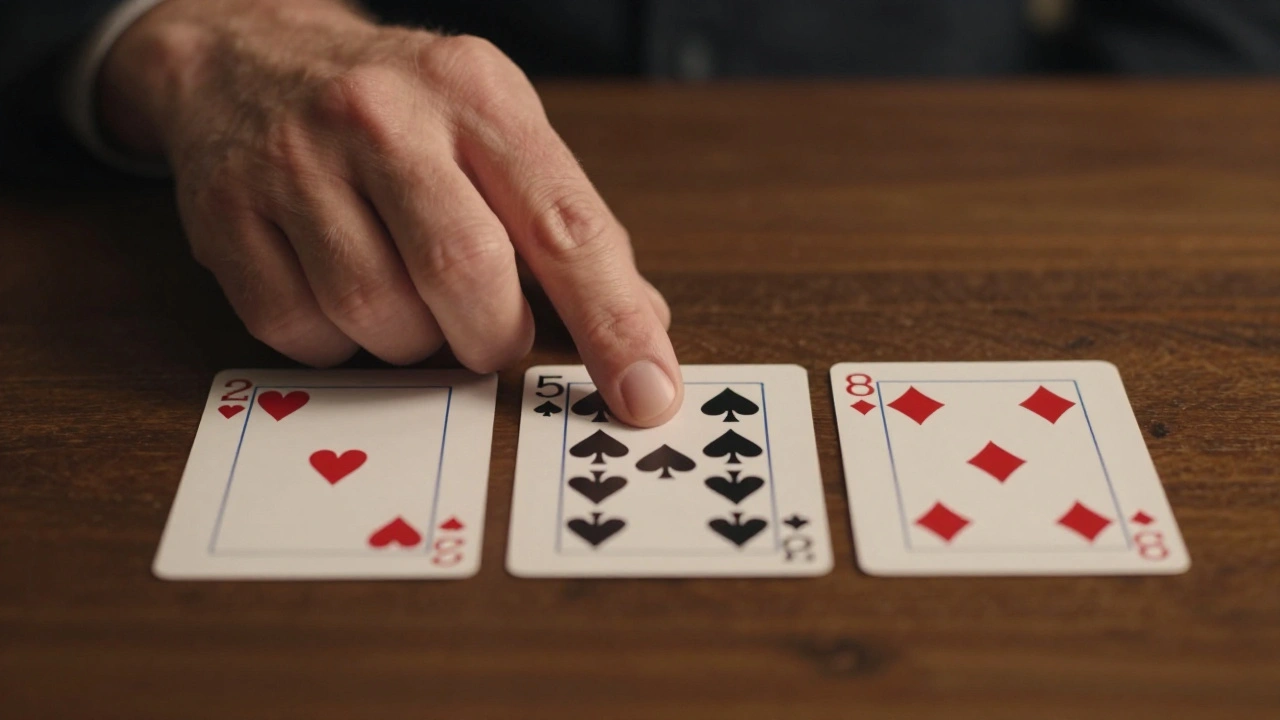
Three peeking isn’t a spell, a hidden device, or a secret code. It’s a simple, clever trick that looks like mind reading - and it’s been fooling people for decades. If you’ve ever seen someone guess a card you picked without touching it, or name a number you thought of while your back was turned, you’ve probably witnessed three peeking in action. It’s not magic in the supernatural sense. It’s psychology, timing, and misdirection wrapped in plain sight.
How Three Peeking Actually Works
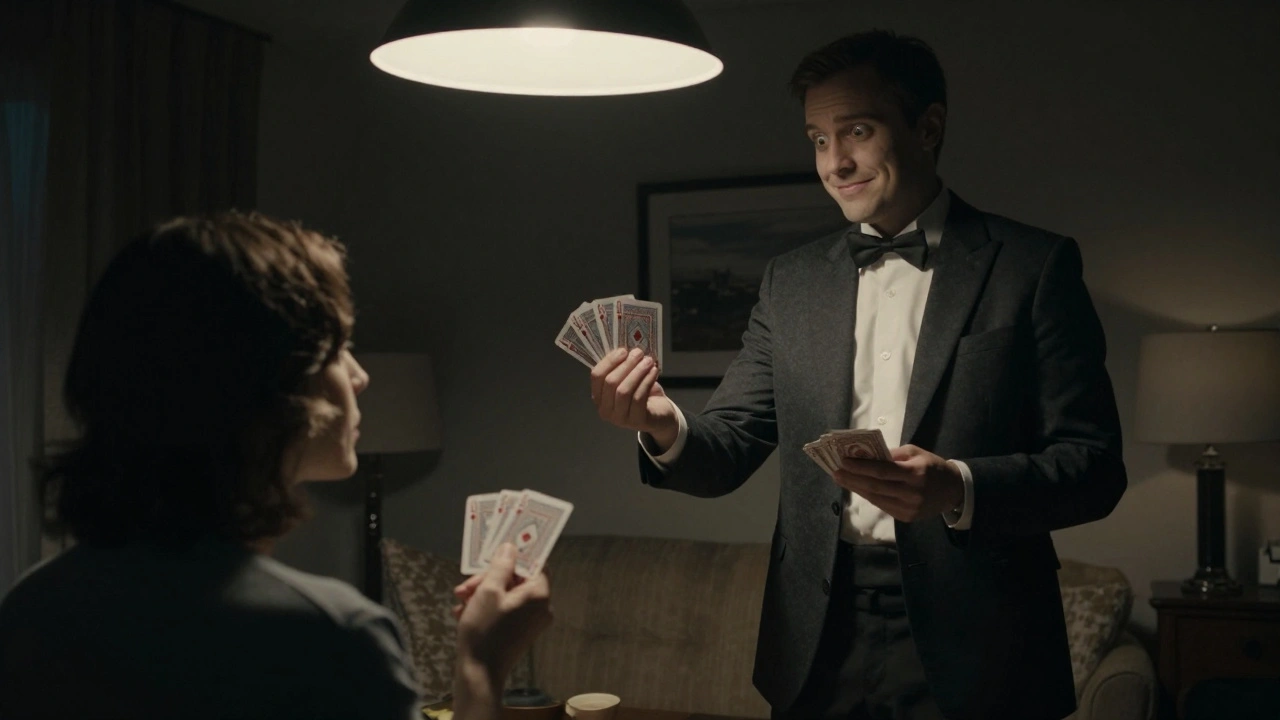
Three peeking gets its name from the way the performer handles three cards - usually from a standard deck. The spectator picks one card, looks at it, and puts it back. The performer shuffles the deck, then reaches in and pulls out the exact card the spectator chose. No sleight of hand. No gimmicks. Just three cards and a trick of attention.
Here’s the real secret: the performer never lets the spectator believe they’re in control. The choice feels free, but it’s guided. The spectator is handed three cards - say, the 7 of hearts, the Queen of spades, and the 4 of diamonds. They’re told to pick one, look at it, and remember it. Then they place the card back into the deck, face down.
What they don’t know is that the performer already knows which card they’ll pick. Why? Because the three cards aren’t random. They’re set up in a specific order. The performer subtly controls the situation by how they present the cards - the way they slide them, which one they point to first, the rhythm of their speech. Most people pick the middle card. It’s a psychological bias called the center stage effect. People trust the middle. It feels safest. It feels neutral.
So when the spectator says, "I picked the Queen," the performer already knew that was the most likely choice. The other two cards? They were decoys. The performer doesn’t need to guess. They just need to act like they’re reading your mind.
Why It Feels Like Mind Reading
Three peeking works because it exploits how the human brain fills in gaps. We don’t like uncertainty. When someone picks a card and you guess it correctly, your brain jumps to the conclusion: "They read my mind." But the truth is simpler: you were nudged into making a predictable choice.
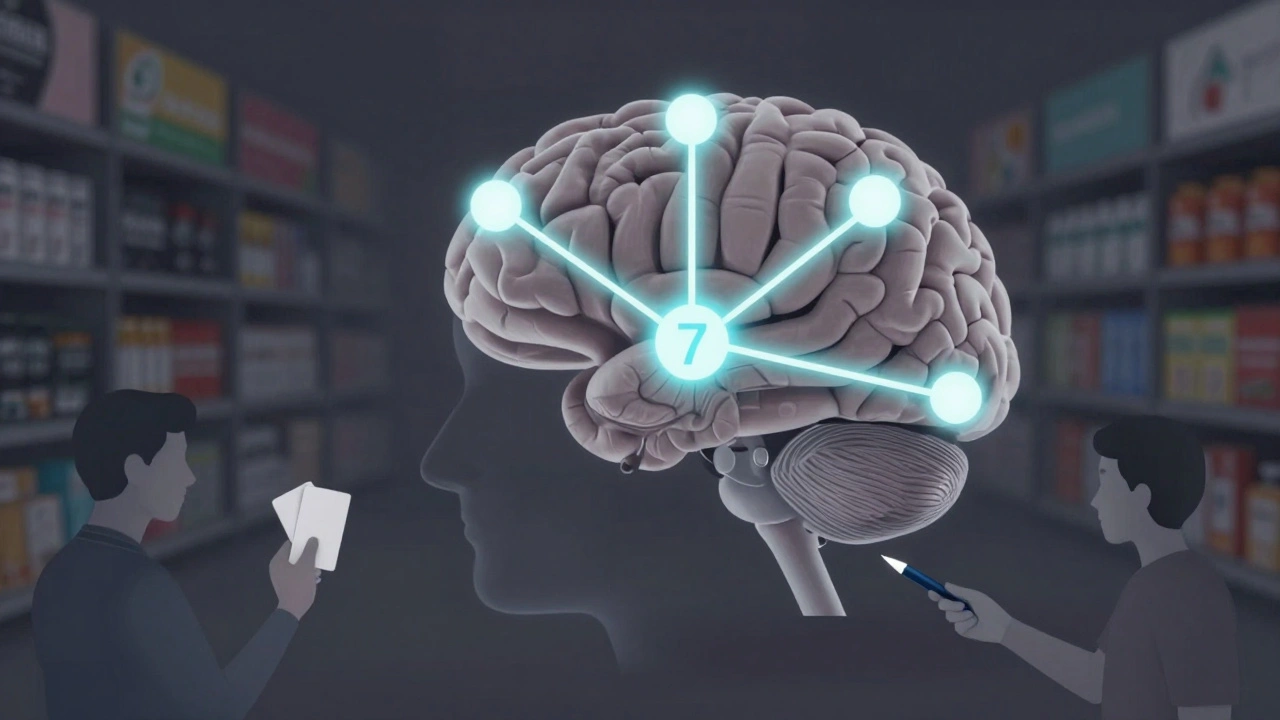
This trick taps into a well-documented behavior in psychology. In a 1971 study by Richard Nisbett and Timothy Wilson, participants were asked to explain why they chose one product over another. Most gave detailed reasons - color, design, brand - but the real reason was the product’s position on the shelf. They had no idea. The same thing happens with three peeking. The spectator believes they made a free choice. The performer knows it wasn’t free at all.
The performance sells it. The performer pauses. Looks into your eyes. Says, "I’m getting a red card... no, wait - a face card..." Then they reveal it. That pause isn’t for effect. It’s to let you convince yourself you were being watched. You’re not being fooled by speed or skill. You’re being fooled by your own assumptions.
Common Variations of Three Peeking
Three peeking isn’t locked to cards. It shows up in different forms:
- Number peeking: You’re asked to think of a number between 1 and 10. The performer says, "I’m sensing a 7." Most people pick 7. It’s the most common answer in psychological studies. People avoid 1 and 10 because they feel too obvious. They avoid even numbers because they feel "too planned." Seven feels random - so it’s the default.
- Color peeking: "Pick a color: red, blue, green." Green is rarely chosen. Red and blue dominate. The performer picks red - and gets it right 80% of the time.
- Object peeking: Three objects on a table - a pen, a coin, a key. The spectator picks one. The performer names it. The key is usually ignored. The coin feels too plain. The pen is the middle ground. It’s the safe pick.
Each version relies on the same principle: limited options + predictable human behavior = perfect guess.
Why It’s Still Powerful Today
In a world full of AI, algorithms, and data tracking, three peeking feels refreshingly analog. There’s no app. No camera. No hidden microphone. Just a person, a few cards, and the quiet power of human predictability.
That’s why it still works in 2025. People think they’re too smart to be fooled. They’ve seen too many YouTube videos. They’ve watched magicians expose secrets. But three peeking doesn’t rely on deception - it relies on your own brain doing the work for the performer.
Even when you know the trick, it’s hard to shake the feeling. You’ve seen it done. You understand the setup. But the next time someone holds up three cards, you still feel that little chill. That’s the power of the trick. It doesn’t just fool your eyes. It fools your sense of self.
How to Practice Three Peeking
If you want to try it yourself, start simple:
- Grab three playing cards - any three. Don’t use face cards at first. Use 2, 5, 8.
- Hold them face down in a row. Don’t let the spectator see the values.
- Slide them slowly. Pause slightly before the middle one. Say, "Pick one. Any one."
- Watch their hand. Most will reach for the center card.
- When they say which card they picked, pretend to concentrate. Then reveal it.
Practice in front of a mirror. Notice how your body language changes when you expect the middle pick. Then try it on friends. Don’t tell them how it works. Just watch their reaction. The moment they say, "How did you know?" - that’s the magic.
The Real Lesson Behind Three Peeking
Three peeking isn’t just a party trick. It’s a mirror. It shows you how easily you’re influenced - even when you think you’re in control. The same psychological patterns that make you pick the middle card are the same ones that make you choose the middle-priced product, click the middle ad, or believe the middle opinion.
Once you understand three peeking, you start seeing it everywhere. Advertisers use it. Politicians use it. Algorithms use it. The world is full of three-card tricks disguised as choices.
Knowing how it works doesn’t make you immune. But it does make you aware. And in a world that’s always trying to guess what you’ll do next - that awareness is the only real magic.
Is three peeking the same as card forcing?
No. Card forcing is a technique where the magician physically controls which card the spectator picks - using sleight of hand, a gimmick, or a stack. Three peeking doesn’t require any physical control. It works by guiding the spectator’s mental choice. The card is freely selected - but the choice is predictable.
Can three peeking be used with more than three cards?
Technically yes, but it loses its power. The trick relies on the psychological pull of the middle option. With four or more cards, the bias becomes weaker. People start picking randomly, or based on personal preferences. Three is the sweet spot - enough to feel like a choice, but not enough to break the pattern.
Do professional mentalists still use three peeking?
Yes. Even top mentalists like Derren Brown and Banachek use variations of three peeking in their acts. It’s not flashy, but it’s reliable. In live performances, where distractions are high and audience members are skeptical, three peeking delivers a quiet, undeniable moment of wonder - without needing complex props.
Can you use three peeking to guess someone’s thoughts?
Not thoughts - but predictable mental patterns. You can’t read someone’s mind. But you can predict what they’re likely to think. People often pick the same numbers, colors, or objects under limited choices. Three peeking exploits those patterns. It’s not mind reading. It’s pattern reading.
Is three peeking ethical?
Yes - as long as it’s performed as entertainment. The trick doesn’t deceive for profit, manipulation, or harm. It’s meant to amaze, not exploit. Ethical performers make it clear it’s a trick. They never claim real psychic powers. The magic lies in the reveal - not in the illusion.
Ian Cassidy
December 2, 2025 AT 10:30Three peeking is just cognitive bias on a stage. Center stage effect + forced choice = illusion of mind reading. No magic, just stats. People think they’re unique, but we’re all predictable as hell.
Zach Beggs
December 2, 2025 AT 22:07That’s actually kind of beautiful in a weird way. It’s not about tricking people - it’s about showing how our brains just default to the middle. Like, we’re all programmed to pick the safe option.
Kenny Stockman
December 3, 2025 AT 11:14Yup. I tried this on my cousin last weekend with three coins. She picked the middle one. Looked at me like I was psychic. Then I told her how it works. She didn’t believe me until I did it again. Classic. 😅
Antonio Hunter
December 3, 2025 AT 16:03It’s fascinating how deeply embedded this tendency is in human decision-making. The center stage effect isn’t just a party trick - it’s a cognitive heuristic that manifests in consumer behavior, political polling, even dating app swipes. We don’t choose the best option; we choose the one that feels least risky. And that’s why this trick endures - because it mirrors the architecture of our own minds.
Paritosh Bhagat
December 4, 2025 AT 06:15Wow, this is so obvious. Like, why are we even talking about this like it’s some deep secret? Everyone knows people pick the middle thing. Also, you spelled 'peeking' wrong. It's 'peaking'. You mean like 'peak' as in top? Or are you just bad at English? 🤦♂️
Aaron Elliott
December 4, 2025 AT 11:58One must question the ontological implications of this phenomenon: if choice is illusory, then free will is merely a social construct engineered by evolutionary heuristics. Three peeking is not a trick - it is a metaphysical indictment of human autonomy.
Chris Heffron
December 5, 2025 AT 04:08That’s wild 😮 I did this with my niece and she picked the middle card. Then she said ‘you’re a wizard!’ I didn’t have the heart to tell her… 😅
Adrienne Temple
December 5, 2025 AT 09:44I love how this shows we’re all just following patterns without realizing it. I’ve noticed this with menus too - people always pick the middle price. It’s not about value, it’s about comfort. We’re all just trying to feel safe. ❤️
Sandy Dog
December 7, 2025 AT 03:42OMG I JUST REALIZED THIS IS WHY I ALWAYS PICK THE MIDDLE SONG ON PLAYLISTS 😭 I THOUGHT I WAS SO COOL AND RANDOM BUT NOPE - I’M JUST A PREDICTABLE HUMAN BEING 😭😭😭 I’M SO VULNERABLE NOW 😭
Nick Rios
December 8, 2025 AT 18:16This is one of those things that makes you feel a little less alone. Everyone thinks they’re making their own choices, but we’re all just following the same quiet rules. It’s humbling, really.
Amanda Harkins
December 10, 2025 AT 15:18It’s wild how much of life is just three-card tricks. Job offers, political candidates, even who you date - it’s all about the middle ground. We don’t choose the best. We choose the one that doesn’t make us uncomfortable.
Jeanie Watson
December 11, 2025 AT 14:11So… you’re saying I’m not special? Cool. I’ll just go back to scrolling now.
Tom Mikota
December 12, 2025 AT 13:14Three peeking? More like THREE-PEEKING!! 😤 I mean, come on - the word is ‘peeking’ not ‘peaking’ - and you’re telling me people don’t know that? And then you say it’s ‘not magic’ - well duh, it’s psychology! Why is this even a post? I mean, seriously?!
Mark Tipton
December 13, 2025 AT 14:58Let’s be real - this isn’t just psychology. This is a controlled experiment in mass behavioral manipulation. The same pattern is used by advertisers, social media algorithms, and yes - even government polling. Three peeking is the gateway drug to the surveillance state. They don’t need cameras. They just need you to pick the middle option. And you do. Every. Single. Time.
Adithya M
December 15, 2025 AT 14:50Bro this is so basic. You're telling me people don't know this? I learned this in high school psychology. Also, your spelling is wrong - it's 'peeking' not 'peaking'. Fix your grammar before you post again.