

Ever watched a mentalist guess your secret number, read your mind, or predict exactly what you were thinking - and wondered how they did it? It’s not magic in the supernatural sense. It’s not ESP. It’s not psychic power. What lies inside mentalism is a carefully crafted mix of psychology, misdirection, cold reading, and human behavior patterns - all honed over decades by performers who turned observation into art.
The Real Tools of a Mentalist
Mentalism doesn’t rely on supernatural forces. It relies on the fact that people are predictable. Humans give away far more than they realize. A slight hesitation before answering, a shift in posture, the way someone avoids eye contact - these aren’t random. They’re clues. Mentalists train to notice them.
Take cold reading, one of the most common techniques. A mentalist says something vague like, “I’m sensing someone in your life who passed away unexpectedly - maybe suddenly, maybe in their 40s.” That’s not a guess. That’s a statistical bet. Most people have lost someone close, and sudden death in middle age is statistically common. When the person nods, the mentalist builds on that. When they don’t, the statement is quietly dropped. No one remembers the misses. They remember the hits.
Then there’s hot reading - using hidden information. A mentalist might have an assistant in the audience who slips a note. Or they’ve researched the person beforehand - social media, public records, even casual conversations overheard before the show. It’s not magic. It’s research. And it’s surprisingly easy when people post everything online.
How Mentalism Tricks Work - Step by Step
Most mentalism routines follow a simple pattern: build trust, plant ideas, guide choices, and make it feel inevitable.
- Build rapport - The mentalist smiles, makes eye contact, uses open body language. People feel safe. They lower their guard.
- Plant the idea - They say, “Think of any number between one and ten.” But they’ve already primed you. Earlier, they mentioned “seven” casually during a story. Your brain latches on to it without realizing.
- Control the outcome - You think you’re choosing freely. But the mentalist has set up the options. If you pick a card, they’ve already known the likely choice based on how the deck was shuffled, how the cards were held, or even the way you hesitated.
- Make it feel supernatural - The reveal is dramatic. A sealed envelope. A written prediction. A phone call from a stranger who knew your answer. The trick isn’t in the prediction - it’s in the presentation.
One famous example: the “book test.” The mentalist asks you to open a book to any page, pick a word, and remember it. Then they reveal the exact word - written down earlier. How? The book isn’t random. It’s a special edition with only one page that has a word on it. Or the mentalist has a duplicate book with the same layout and flips to the same page as you - timing it so you think you’re choosing freely. The word is always the same.

The Psychology Behind Why We Believe
Why do we fall for this? Because our brains are wired to find patterns - even where none exist. We’re story-driven creatures. When something feels meaningful, we ignore the odds. If a mentalist says, “I see a name starting with J,” and you think of your uncle Joe, you don’t think, “That’s one of the most common initials.” You think, “They knew.”
Confirmation bias plays a huge role. You remember the times they got it right. You forget the dozens of times they didn’t. And mentalists are careful to never say something too specific until they get a reaction. They use phrases like “I’m getting a feeling,” “It’s coming to me,” or “There’s a name… it’s fuzzy.” That ambiguity gives them room to adjust.
Studies in cognitive psychology show that people are terrible at judging randomness. In one experiment, participants were asked to pick a random number between 1 and 10. Over 70% picked 7. That’s not random - that’s human. Mentalists know this. They know you’re more likely to think of the color red than turquoise. They know you’ll pick the middle card in a row of five. They know your brain will latch onto the first word you hear.
What Mentalism Isn’t
It’s not mind control. You’re never forced to think something. You’re guided - subtly, skillfully - toward a choice the mentalist already anticipated.
It’s not telepathy. There’s no brain-to-brain connection. No energy transfer. No hidden signals between the performer and audience member. The connection is psychological, not supernatural.
And it’s not always ethical. Some mentalists use these techniques to exploit vulnerable people - grieving individuals, the elderly, those seeking answers after loss. That’s where the line between performance and manipulation blurs. Professional mentalists avoid it. They make it clear: this is entertainment. Not truth.
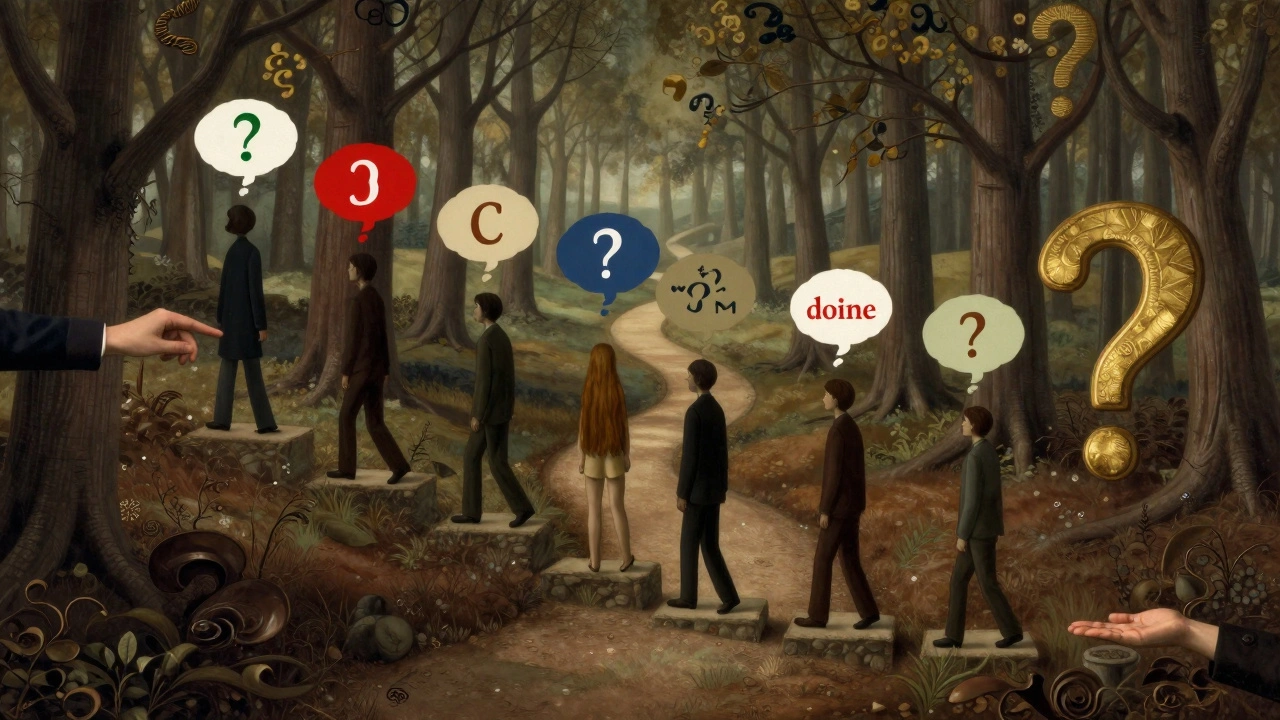
How to Spot a Mentalism Trick
If you want to see through the illusion, look for these red flags:
- Too vague - “I sense a change coming in your life.” That could mean anything. It’s designed to fit anyone.
- Too fast - If the mentalist rushes through the reveal, they’re hiding the method. Real mentalists let the silence breathe.
- Too personal - If they claim to know your deepest secret without asking, they’ve done research. Or they’re lying.
- No repetition - If you try to recreate the trick with a friend, it won’t work. That’s because the trick depends on your specific behavior, not a universal formula.
The best way to understand mentalism? Try it yourself. Ask a friend to pick a number. Don’t tell them anything. Then say, “I think you picked 7.” If they say yes - you didn’t read their mind. You used probability. And that’s exactly what the pros do.
Why Mentalism Still Captivates Us
At its core, mentalism taps into a deep human desire: to believe we’re not alone. To think someone can see inside us - truly see us. That’s why it’s so powerful. We want to believe in hidden connections, in unseen forces. Mentalism gives us that feeling - safely, temporarily - inside a theater, under bright lights.
But the real magic isn’t in the trick. It’s in the human mind. The way we fill in gaps. The way we trust. The way we want to believe. That’s what mentalists are really reading.
Is mentalism the same as magic?
Mentalism is a branch of magic, but it’s different in focus. Traditional magic uses sleight of hand, props, and visual illusions - like making a card disappear. Mentalism focuses on the mind - thoughts, choices, emotions. It feels more personal, more intimate. You don’t see a coin vanish - you feel like your secret was revealed.
Can anyone learn mentalism?
Yes - but not overnight. Mentalism requires practice in observation, memory, and communication. You need to learn how people think, how they react under pressure, and how to control attention. Many start with simple tricks like forcing a card or using the “force” technique. Books like "The Cold Reading Formula" by Richard Webster or "13 Steps to Mentalism" by Tony Corinda are common starting points. It’s less about talent and more about patience.
Are mentalists real psychics?
No. There’s no scientific evidence for psychic abilities. All documented mentalists use psychological techniques, prior research, or hidden information. Even famous performers like Derren Brown openly admit their methods are based on psychology and illusion. The best mentalists are honest about this - they call it entertainment, not truth.
Why do mentalists use black clothing and dim lighting?
It’s not for drama - it’s practical. Dark clothing hides small movements: a hand reaching for a card, a finger tapping a hidden device, a note being passed. Dim lighting makes it harder to see subtle cues - like a glance at a confederate or a quick glance at a wristwatch. It’s all about controlling what the audience sees.
Do mentalists ever use technology?
Sometimes - but rarely in live shows. In televised performances, earpieces, hidden cameras, or apps can be used. But in live settings, most avoid tech because it’s risky. A dead battery or signal interference ruins the illusion. The best mentalists rely on human psychology, not gadgets. If they use tech, it’s usually invisible - like a hidden microphone or a Bluetooth earpiece under a hat.
Is mentalism dangerous?
Not physically. But emotionally? Yes - if misused. Some performers exploit grief, trauma, or loneliness by pretending to contact the dead. This crosses into unethical territory. Reputable mentalists avoid it. They make it clear their shows are performances, not spiritual sessions. Always ask: is this meant to entertain - or to deceive?
Nathan Jimerson
December 8, 2025 AT 18:15Mentalism is fascinating because it reveals how much we trust our own minds to be unique when we’re actually so predictable. I’ve tried some of these techniques on friends and it’s eerie how often they pick 7 or think of red. It’s not magic-it’s math wrapped in theater.
Sandy Pan
December 9, 2025 AT 15:17What’s truly haunting is not the trick, but why we let ourselves be tricked. We crave meaning so desperately that we’ll bend logic to fit a narrative-even when the narrative is just a well-timed pause and a vague phrase. The real illusion isn’t in the mentalist’s hands. It’s in our own need to believe someone sees us.
Eric Etienne
December 9, 2025 AT 18:56Ugh another post pretending this is deep. It’s just parlor tricks with fancy words. People still fall for this? Come on. If you think someone’s reading your mind because they guessed your number, you probably also think your phone listens to you. Wake up.
Dylan Rodriquez
December 10, 2025 AT 02:34I love how this breaks down the psychology without dismissing the art. Mentalism isn’t about deception-it’s about collaboration. The audience gives their attention, their assumptions, their expectations-and the performer shapes them into something beautiful. It’s like poetry with misdirection. Everyone leaves feeling seen, even if they weren’t really read. That’s the gift.
And honestly? If you’ve ever been grieving and someone whispered, ‘I feel your mom’s still with you,’ you’d want to believe it too. That’s why ethics matter more than technique.
Amanda Ablan
December 10, 2025 AT 16:13One thing people forget: mentalism works because we’re social creatures. We mirror expressions, we fill silences, we assume intent. The mentalist doesn’t need to know your secret-they just need you to tell them, without realizing you did. It’s not mind reading. It’s conversation.
Try this: next time someone says ‘pick a number between 1 and 10,’ say ‘6.’ Then watch how often they guess it anyway. It’s not magic. It’s just how humans talk.
Meredith Howard
December 12, 2025 AT 09:49The most compelling part of mentalism is not the method but the psychological vulnerability it exploits. We willingly suspend disbelief not because we are gullible but because we yearn for connection even in artificial contexts. The performer becomes a mirror and we project our desires onto the reflection. This is not illusion. This is human nature.
Yashwanth Gouravajjula
December 13, 2025 AT 13:45In India we have fakirs who do similar things. Same tricks. Different names. People still believe. Culture shapes what we accept as magic.
Kevin Hagerty
December 15, 2025 AT 02:09Wow so the secret is... people are dumb and like to be fooled? Groundbreaking. Next you’ll tell me water is wet and gravity exists. This whole post feels like a 12-year-old’s essay on why Santa isn’t real. Get a life.
Janiss McCamish
December 16, 2025 AT 09:29Most people don’t realize the book test is often a duplicate book. Or the page is pre-selected. I used to do this at parties. People lose their minds. Then I tell them how. They’re mad for a second. Then they laugh. That’s the real trick-making them feel smart after they feel fooled.